Rectal and colon cancer, compared
Colon and rectal cancer differ in symptoms, spread and treatment.
Colon and rectal cancer are both types of colorectal cancer but develop in different parts of the large intestine. These differences influence how each type is diagnosed, treated, and managed.

This article explores the key distinctions in rectal vs colon cancer and what they mean for patients.
+65 8491 1525
In short
Colon
Where one starts
Colon cancer develops in the colon, the longest portion of the large intestine, which absorbs water and nutrients from digested food while forming stool.
Rectum
Where the other starts
Rectal cancer occurs in the rectum, the final segment of the large intestine that connects to the anus, where stool is stored before it is expelled.
Dark or red
How the bleeding differs
Blood from a colon tumour may look dark or tarry because it has been digested on the way down. Rectal bleeding is more often bright red.
The pelvis
Why one is harder to operate on
The rectum sits in a confined space close to other organs, which is what makes rectal surgery and surgical planning more demanding.
Both begin in the large intestine. Not in the same part of it.
This is the difference underneath every other difference on this page. Where the tumour sits decides how much room a surgeon has, and that shapes the scans, the sequence of treatment and the follow-up.
Colon cancer
Develops in the colon, which is the longest portion of the large intestine. The colon absorbs water and nutrients from digested food while forming stool. Tumours can form in any part of the colon, with symptoms and treatment varying depending on location.
Rectal cancer
Occurs in the rectum, the final segment of the large intestine that connects to the anus. The rectum stores stool before it is expelled from the body. Due to its limited space and proximity to other organs, rectal cancer presents unique challenges in treatment and surgical planning.
What colorectal cancer is as a whole, how it is staged, and what screening actually catches is set out on the colorectal cancer page.
Rectal vs colon cancer symptoms: the colour of the blood is the clearest clue to where it is coming from.
Both cause a disturbed bowel habit and both can bleed. What differs is how the blood looks by the time it is seen, and whether the symptoms are felt in the abdomen or lower down.
Blood in the stool of any colour, and any change in bowel habit that does not settle, should be assessed rather than watched.
| Symptom pattern | Colon cancer | Rectal cancer |
|---|---|---|
| How the bleeding looks | Blood may look dark or tarry, digested as it travels through the colon | Often bright red blood in the stool |
| Bowel habit and stool | Persistent diarrhoea, constipation and bloating, with abdominal discomfort | A feeling of incomplete emptying, urgency, and narrow or ribbon-like stools |
| Wider signs | Unexplained weight loss; fatigue and anaemia in advanced cases | Rectal pain, and discomfort while sitting, particularly in later stages |
Colon cancer
Symptoms include persistent diarrhoea, constipation, bloating, abdominal discomfort, and unexplained weight loss. Blood in the stool may appear dark or tarry due to digestion as it travels through the colon. Fatigue and anaemia are also common in advanced cases.
Rectal cancer
Symptoms often include bright red blood in the stool, a feeling of incomplete bowel emptying, and changes in stool shape, such as narrow or ribbon-like stools. Rectal pain, urgency in bowel movements, and discomfort while sitting can also occur, particularly in later stages.
Blood in the stool has a long list of possible causes, and cancer is only one entry on that list. What the colour of the blood suggests, when it needs a scope, and the fuller list of causes are all set out in anal bleeding, causes and treatment.
Mostly the same list, weighted differently.
Most of the list is shared between the two cancers. Where they part is on hereditary conditions and on long-term inflammation, both of which weigh somewhat more heavily on the rectal side.
Colon cancer
Risk increases with age. HealthHub puts the rise from the age of 45, and notes that most people diagnosed in Singapore are older than that. A diet high in processed meats, obesity, smoking, alcohol consumption, and a sedentary lifestyle contribute to higher risk. A family history of colorectal cancer or inflammatory bowel disease (IBD) can also increase susceptibility.
Rectal cancer
While many of the same risk factors apply, rectal cancer has a slightly stronger association with hereditary conditions such as Lynch syndrome and familial adenomatous polyposis (FAP). Long-term inflammation from conditions like ulcerative colitis also raises the risk.

Polyps come into this story as well, and they have their own page. What a polyp is, and what removing one involves, is set out on the colon polyps page.
Diagnosing rectal vs colon cancer: the same workup, with one extra test for the rectum.
A colonoscopy and a biopsy confirm the diagnosis in both. What a rectal tumour needs beyond that is a measurement of how deep it has grown, because that is what decides the operation.
Colonoscopy with biopsy
The tissue sample that confirms the diagnosis
Blood tests
Including CEA, a tumour marker
CT or MRI imaging
To assess the extent and any spread
MRI or endorectal ultrasound
For rectal tumours, to measure depth
Colon cancer
Diagnosis is typically made through colonoscopy with a biopsy, blood tests (such as carcinoembryonic antigen [CEA] levels), and imaging like CT or MRI scans. These tests help assess the extent of the disease and its potential spread.
Rectal cancer
In addition to colonoscopy and biopsy, rectal cancer often requires MRI or endorectal ultrasound to evaluate how deep the tumour has grown into surrounding tissues. This information is necessary for planning treatment, especially surgery.
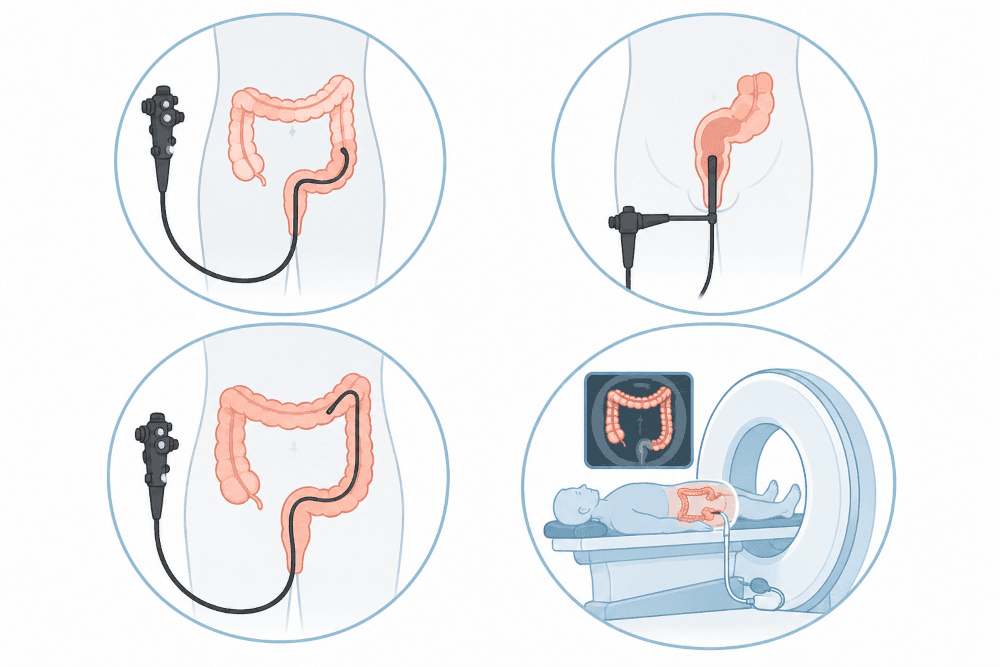
What a colonoscopy involves, from the preparation through to going home the same day, is on the colonoscopy page.
Rectal vs colon cancer treatment: one usually goes straight to surgery. The other often begins with chemoradiation.
Surgery is the primary treatment for both. What separates them is the order things happen in, and how much room the surgeon has to work with once the operation begins.
Chemoradiation
Commonly given first, to shrink the tumour
Surgery
A low anterior resection, or an abdominoperineal resection
Bowel continuity
Preserved where the sphincter allows
Colon cancer
Surgery is the primary treatment. Early-stage colon cancer is often treated with a colectomy, where the affected portion of the colon is removed. In more advanced cases, chemotherapy may be recommended before or after surgery. Radiation therapy is rarely used, except when tumours are located near the rectum.
Rectal cancer
Due to the tight space of the pelvis, treatment is often more involved. Pre-operative radiation therapy (chemoradiation) is commonly used to shrink tumours before surgery, reducing the risk of recurrence. That sequence, chemoradiation before surgery rather than after it, improved local control in the German rectal cancer trial reported by Sauer et al. in 2004. Surgery may involve a low anterior resection (LAR), preserving bowel function, or an abdominoperineal resection (APR), which may require a permanent colostomy if the anal sphincter cannot be preserved.
The reason radiotherapy belongs in the rectal plan and rarely in the colon plan is measurable. In the Dutch Colorectal Cancer Group trial reported by Kapiteijn et al. in the New England Journal of Medicine, 2001, 1,861 patients with resectable rectal cancer were randomised to a short course of radiotherapy before total mesorectal excision or to the operation alone. At two years the cancer had come back in the pelvis in 2.4 percent of those given radiotherapy first, against 8.2 percent with surgery alone. Overall survival at two years was the same in both groups, 82.0 against 81.8 percent, so the radiotherapy earned its place by lowering local recurrence, not by extending life. A colon tumour sits in a roomier space with wider surgical margins, which is why the same step is seldom needed there.
How the operation itself is performed, whether through keyhole ports or with a robotic system, is a separate question from which operation is being done. The two approaches are compared on the robotic colectomy and anterior resection page.
Each tends toward a different organ, and the blood supply is why.
The colon drains blood into the portal vein system, which leads to the liver. The rectum has a different blood supply, and that difference is why the two cancers tend to spread to different organs.
The colon drains into the liver through the portal vein system, while the rectum has a different blood supply.
Colon cancer
More likely to spread to the liver through the portal vein system, as the colon drains blood into this region. Lung metastases can also occur in later stages.
Rectal cancer
More likely to spread to the lungs, as the rectum has a different blood supply. Liver metastases are also common, but lung involvement occurs more frequently compared to colon cancer. A Swedish registry study of 49,096 colorectal cancer patients found the same pattern: rectal cancer spreads to thoracic organs, including the lungs, more often than colon cancer does (Riihimäki et al., 2016).
Found early, both do well. The difference is what happens after treatment.
Early survival is high for both, and at similar rates. Where location matters is in the risk of the cancer returning in the same place, and in what bowel function looks like afterwards.
84 to 86%
Five-year survival, stage one
Survival when colorectal cancer is found at stage one, 84% for men and 86% for women. Once it has spread to distant organs it falls to about 10% and 11%. Individual outcomes depend on the tumour, your general health and how the disease responds, so no figure predicts one person’s result.
Source: HealthHub, Singapore
Five-year survival by stage, Singapore
- Found early
- 84 to 86%
- Spread to distant organs
- 10 to 11%
Source: HealthHub, Singapore
Colon cancer
When detected early, before it has spread, five-year survival is high. For colorectal cancer overall in Singapore, HealthHub publishes survival rates of 84% for men and 86% for women at stage one, and individual outcomes still depend on the tumour and on general health. If the cancer has spread to distant organs, survival rates decline, but treatment can still help control the disease.
Rectal cancer
Early-stage rectal cancer has a similar survival rate to colon cancer, but there is a higher risk of local recurrence. Due to the confined space in the pelvis, complete tumour removal is more challenging, and post-treatment bowel dysfunction is more common.
Some symptoms should be assessed whichever of the two it turns out to be.
Rectal bleeding, unexplained weight loss, ongoing changes in bowel habits, severe abdominal pain, and chronic fatigue all require attention.
If you experience persistent digestive symptoms, a medical evaluation is recommended. Signs that require attention include rectal bleeding, unexplained weight loss, ongoing changes in bowel habits, severe abdominal pain, and chronic fatigue. Early detection significantly improves treatment outcomes, so consulting a doctor if symptoms persist is advised.

The difference in one screen
The difference in one screen
While both rectal and colon cancer originate in the large intestine, their differences affect how symptoms appear, how they spread, and which treatment strategies are most effective. Recognising these distinctions helps guide treatment decisions.
Colon
The longest portion of the large intestine
The colon absorbs water and nutrients from digested food while forming stool. Tumours can form in any part of it, with symptoms and treatment varying depending on location.
Source: Dr Sulaiman Bin Yusof, drsulaiman.com.sg
Rectum
The final segment before the anus
The rectum is the final segment of the large intestine and it connects to the anus. It stores stool before it is expelled from the body, and it sits in a confined space close to other organs.
Source: Dr Sulaiman Bin Yusof, drsulaiman.com.sg
The colon
Absorbs water and nutrients, and forms stool
The rectum
Stores stool before it is expelled
The anus
Where the large intestine ends
Due to its limited space and proximity to other organs, rectal cancer presents unique challenges in treatment and surgical planning.
| Compared on | Colon cancer | Rectal cancer |
|---|---|---|
| Where it develops | The colon, the longest portion of the large intestine | The rectum, the final segment before the anus |
| Symptoms | Diarrhoea, constipation, bloating, abdominal discomfort, weight loss. Blood may look dark or tarry | Bright red blood, a feeling of incomplete emptying, narrow or ribbon-like stools, rectal pain and urgency |
| Risk factors | Age, processed meat, obesity, smoking, alcohol, inactivity, family history, inflammatory bowel disease | Many of the same, with a stronger association with Lynch syndrome and familial adenomatous polyposis |
| Diagnosis | Colonoscopy with biopsy, blood tests including CEA, CT or MRI imaging | The same, plus MRI or endorectal ultrasound to establish how deep the tumour has grown |
| Treatment | Surgery first, usually a colectomy. Chemotherapy in more advanced cases. Radiation therapy rarely | Chemoradiation before surgery, then a low anterior resection or an abdominoperineal resection |
| Where it spreads | Most often the liver, through the portal vein system. Lungs in later stages | More often the lungs, because the rectum has a different blood supply. Liver spread is also common |
| Outlook | High survival when found before it has spread, declining once it reaches distant organs | Similar early survival, with a higher risk of local recurrence and of post-treatment bowel dysfunction |
Each row is set out in full, in his words, in the sections below.
Frequently asked questions about rectal vs colon cancer.
Are rectal cancer and colon cancer the same disease?
Both are types of colorectal cancer but develop in different parts of the large intestine. Colon cancer occurs in the upper sections, while rectal cancer forms in the final segment before the anus. These differences influence how each type is diagnosed, treated, and managed.
How do the symptoms of rectal and colon cancer differ?
Colon cancer tends to cause persistent diarrhoea, constipation, bloating, abdominal discomfort and unexplained weight loss, and blood in the stool may look dark or tarry from digestion as it travels. Rectal cancer more often causes bright red blood in the stool, a feeling of incomplete bowel emptying, and narrow or ribbon-like stools, sometimes with rectal pain or urgency.
Is treatment different for rectal and colon cancer?
Surgery is the primary treatment for both. Early-stage colon cancer is often treated with a colectomy, and radiation therapy is rarely used. Rectal cancer treatment is often more involved because of the tight space of the pelvis: chemoradiation is commonly given first to shrink the tumour, then surgery, either a low anterior resection or an abdominoperineal resection.
What is the survival rate for colorectal cancer in Singapore?
HealthHub publishes five-year survival rates of 84% for men and 86% for women when colorectal cancer is found at stage one, falling to about 10% and 11% once it has spread to distant organs. Individual outcomes depend on the tumour, your general health and how the disease responds, so no figure predicts one person's result.
Why does rectal cancer often need radiotherapy when colon cancer does not?
The rectum sits in the tight space of the pelvis, so surgical margins are narrower and the cancer is more likely to return locally. Giving chemoradiation before surgery shrinks the tumour and lowers that risk: in the Dutch Colorectal Cancer Group trial of 1,861 patients, pelvic recurrence at two years was 2.4 percent with radiotherapy before surgery against 8.2 percent with surgery alone. Colon tumours sit in a roomier space with wider margins, so radiation is rarely used there.
When should I see a doctor about bowel symptoms?
Signs that require attention include rectal bleeding, unexplained weight loss, ongoing changes in bowel habits, severe abdominal pain, and chronic fatigue. Early detection significantly improves treatment outcomes, so consulting a doctor if symptoms persist is advised.
The author

Dr Sulaiman Bin Yusof
Senior Consultant Colorectal and General Surgeon with Colorectal Clinic Associates, Singapore, with over 20 years of surgical experience across public and private practice.
He wrote this article and is responsible for its clinical content.
- Qualifications
- MBChB (Sheffield)
- M.Med (Surgery)
- FRCSEd (General Surgery)
- Fellowship
- Peter MacCallum Cancer Centre, Melbourne
- Previously
- Former Director of Endoscopy, Changi General Hospital
- Also
- Visiting Consultant, Changi General Hospital
Book a consultation
Rectal and colon cancer share similarities. They require distinct approaches.
While rectal and colon cancer share similarities, their differences in location, symptoms, treatment, and recovery mean they require distinct approaches. Rectal cancer often involves more complex treatment due to its confined space and proximity to pelvic organs, while colon cancer typically follows a more straightforward surgical path. Recognising these differences can help with early detection and informed decision-making. Schedule an appointment today to discuss screening options or any concerns about your digestive health.