Hernia surgery in Singapore
Laparoscopic hernia repair. Most hernia surgery is done as day surgery.
A hernia is tissue pushing through a weakness in the muscle wall, and it will not close on its own.
FRCSEd (General Surgery)Five clinics in Singapore
In short
- 0
- Chance it resolves
- A hernia will not close on its own. Surgery is the only repair.
- Same
- Day discharge
- Most repairs are day surgery. Admitted and discharged the same day, with no overnight stay in most cases.
- 5-7
- Days to desk work
- Light exercise from 2 to 3 weeks. No heavy lifting for 4.
- Yes
- Medisave claimable
- Integrated Shield Plans too. The clinic submits pre-authorisation on your behalf.
Medisave and insurance
What you can claim from Medisave and your insurer.
Hernia surgery is Medisave-claimable (source: CPF Board, using MediSave for hospitalisation, opens in a new tab), and the amount depends on the procedure's table code. Most Integrated Shield Plans cover keyhole hernia repair where it is medically needed, with cashless billing once your insurer pre-authorises it. Corporate insurance is also accepted.
What can pay for it
- MediSave
- Integrated Shield Plans, where medically needed
- Corporate insurance
Cash to pay, after MediSave and insurance
$ ___
It depends on your MediSave balance and your policy. The clinic confirms it in writing before the operation.
Integrated Shield Plans






Corporate insurance













MediSave, Integrated Shield Plans, and private or corporate insurance may apply, subject to policy eligibility. The clinic team will check your coverage before any treatment is planned.
His story
Dr Sulaiman Bin Yusof
Colorectal surgeon with over 20 years of surgical experience, seeing patients at five clinics in Singapore.
- MBChB (Sheffield), M.Med (Surgery), FRCSEd (General Surgery)
- Consults in English and Malay
- MOH Fellowship, Peter MacCallum Cancer Centre, Melbourne
- Singapore Health Quality Service Star Award 2023
- Dean's Honour Roll for Teaching
Five clinics across Singapore
ORCHARD / NAPIER
Gleneagles Medical Centre
6 Napier Road #06-08, Singapore 258499
NOVENA
Mount Elizabeth Novena
38 Irrawaddy Road, #10-48/49, Singapore 329563
JOO CHIAT / EAST COAST
Parkway East Hospital
#05-08, 319 Joo Chiat Place, Singapore 427989
THOMSON
Mount Alvernia Hospital
#08-62, Medical Centre D, 820 Thomson Road, Singapore 574623
FARRER PARK
Farrer Park Medical Centre
#14-12, 1 Farrer Park Station Road, Singapore 217562
What to know before the operation
What to know before hernia repair surgery
A hernia does not close on its own, and it does not get smaller with time. Surgery is the only repair.
What a one-sided keyhole repair is billed at
- Median bill, day surgeryRepairing one side. Half of patients were billed below this and half above.
- $13,724
- The middle half of bills
- $12,036 to $17,143
- Median bill, where an overnight stay is needed
- $16,871
Figures include GST, before insurance and MediSave. Repairing both sides is a different operation with its own bill. What you actually pay depends on the hospital, the ward and your insurance, and the section further down sets out what MediSave and the Integrated Shield Plans cover.
Under 1.5%
Needed a second operation within a year
Across the ten most commonly used meshes in that register, fewer than 1.5% of patients needed a second operation for a recurrence within a year, and fewer than 4% within five years. Read it as a floor rather than the whole picture: the register counts reoperations, and not every hernia that comes back is operated on again. Dr Sulaiman will go through your own risk factors at the consultation.
Home the same day
In most cases, rather than an overnight stay
Desk work in 5 to 7 days
Against 2 to 4 weeks after open surgery
Light exercise at 2 to 3 weeks
Against 4 to 6 weeks after open surgery
Heavy lifting after 4 weeks
Against 6 to 8 weeks after open surgery
When surgery is needed
A hernia will not resolve without surgery.
Surgery is advisable if you have any of the following.
Persistent or worsening pain at the hernia site
A hernia that is increasing in size
A bulge that is difficult or impossible to push back
Sudden severe abdominal or groin pain
Nausea or vomiting alongside a painful lump
A firm, tender lump that cannot be reduced
The last three in particular may indicate strangulation, where the blood supply to the herniated tissue is compromised. This requires emergency medical attention.
Who keyhole repair suits.
Hernias on both sides of the groin
The same small incisions used for one side can address both in a single operation, which reduces overall recovery time.
Ventral and incisional hernias
Well suited where mesh reinforcement of the abdominal wall is required.
Femoral hernias
Given the higher strangulation risk, prompt repair is advisable. Keyhole technique allows precise access to the femoral canal with minimal disruption to surrounding tissue.
Where open surgery carries more wound risk
Patients with obesity or conditions that raise the risk of wound complications may benefit from smaller incisions and a lower risk of surgical site infection.
The hernias treated
Five kinds of hernia, one approach.
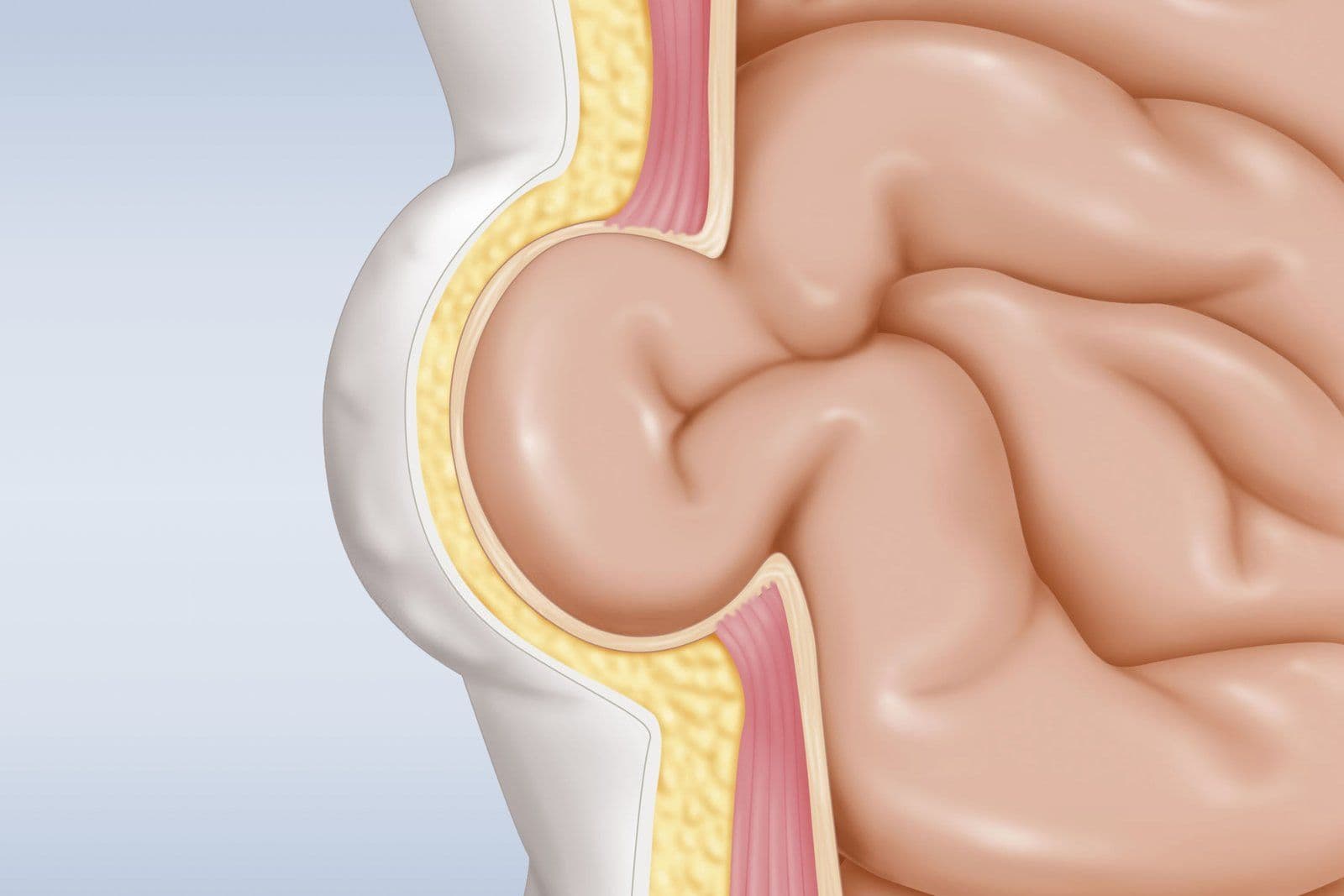
A hernia happens when an organ or tissue pushes through a weakness in the surrounding muscle wall. They develop in different parts of the body and vary in severity. Keyhole repair suits most types, with the approach tailored to the location, size and complexity of each case.
| Hernia type | Location | Most common in | Keyhole repair |
|---|---|---|---|
| Inguinal | Groin | Men | Yes |
| Umbilical | Navel | Adults and infants | Yes |
| Femoral | Upper inner thigh | Women | Yes |
| Ventral or incisional | Abdomen or previous scar | Adults with prior surgery | Yes |
| Complex or recurrent | Variable | Patients with prior repair | Yes, with relevant surgical experience |
A hiatal hernia is a different mechanism, where part of the stomach pushes up through the diaphragm rather than through the abdominal wall.
Inguinal
A visible or palpable lump in the groin, more prominent when standing, coughing or straining. The most frequently treated hernia in Singapore, most common in men. Well suited to keyhole surgery, which reaches the area through small incisions without disrupting the surrounding musculature.
Symptoms, examination and the tests that confirm it are on the inguinal hernia page.
Umbilical
Tissue pushes through a weakness near the navel and may appear as a soft bulge around the belly button. Affects both adults and infants. Keyhole repair suits adult umbilical hernias, particularly where mesh reinforcement is required.
When a small one can be watched, and when it needs repair, is on the umbilical hernia page.
Femoral
Develops just below the groin in the upper inner thigh, more common in women. Less frequent than inguinal hernias but carries a higher risk of strangulation, so it generally warrants prompt surgical assessment.
Ventral and incisional
Ventral hernias occur along the abdominal wall. Incisional hernias develop at the site of a previous surgical scar where the tissue has weakened over time. Keyhole repair reinforces the wall with mesh through small incisions, which shortens recovery compared with open repair.
Complex and recurrent
Hernias that have returned after a previous repair need precise dissection and careful mesh placement. These cases suit keyhole technique, which gives magnified visualisation of the operative field and the surrounding structures.
Choosing the approach
Not every hernia repair is done the same way.
The right approach depends on the type and size of the hernia, your overall health, and whether a previous repair has been attempted.
| Approach | Incision size | Recovery time | Scarring | Best for |
|---|---|---|---|---|
| Keyhole (laparoscopic) | 0.5 to 1 cm | 1 to 2 weeks | Minimal | Most inguinal, femoral and ventral hernias |
| Open repair | 5 to 10 cm | 4 to 6 weeks | More prominent | Large hernias, certain complex cases |
| Robotic-assisted | 0.5 to 1 cm | 1 to 2 weeks | Minimal | Complex, recurrent, or confined anatomy |
Keyhole is the usual choice
Now the preferred approach for most inguinal, femoral and smaller ventral hernias in Singapore. Small incisions, less pain after the operation, and a typical recovery of one to two weeks make it suitable for the majority of patients. Most operations are completed as day surgery.
Open surgery still has its place
Appropriate for very large hernias, cases where keyhole access is not feasible, or where a patient is not suitable for general anaesthesia.
Robotic-assisted, for the difficult ones
For complex or recurrent hernias involving dense scar tissue or confined anatomical spaces, robotic-assisted repair gives 3D visualisation and finer instrument control, which allows more controlled dissection and mesh placement.
In a TAPP repair, short for transabdominal preperitoneal, a synthetic mesh is placed over the hernia defect and secured to reinforce the abdominal wall, which reduces the likelihood of it coming back.
On the day
You arrive, you have the operation, and in most cases you go home.
Dr Sulaiman performs laparoscopic hernia repair as a day surgery procedure.
01
General anaesthesia
The procedure begins with general anaesthesia. Your anaesthetist will discuss the type with you beforehand to make sure you are comfortable and safe throughout.
02
Three to four small cuts
Each around 0.5 to 1 cm, made in the abdominal wall. They are the entry points for the laparoscope and the instruments.
03
The laparoscope goes in
A laparoscope fitted with a high-definition camera and light source goes through one of the incisions, sending magnified images of the abdominal cavity to a monitor throughout.
04
The instruments follow
Specialised laparoscopic instruments go through the remaining incisions, so the hernia can be reached and repaired with precision under continuous camera guidance.
05
Mesh placement
Using the TAPP technique, a synthetic mesh is positioned over the weakness in the abdominal wall and secured with sutures or surgical tacks. This reinforcement reduces the risk of the hernia returning.
06
Closing, and going home
Instruments are removed and the incisions closed with sutures or surgical glue, then covered with sterile dressings. The whole procedure typically takes 45 to 90 minutes. Most patients are discharged the same day.
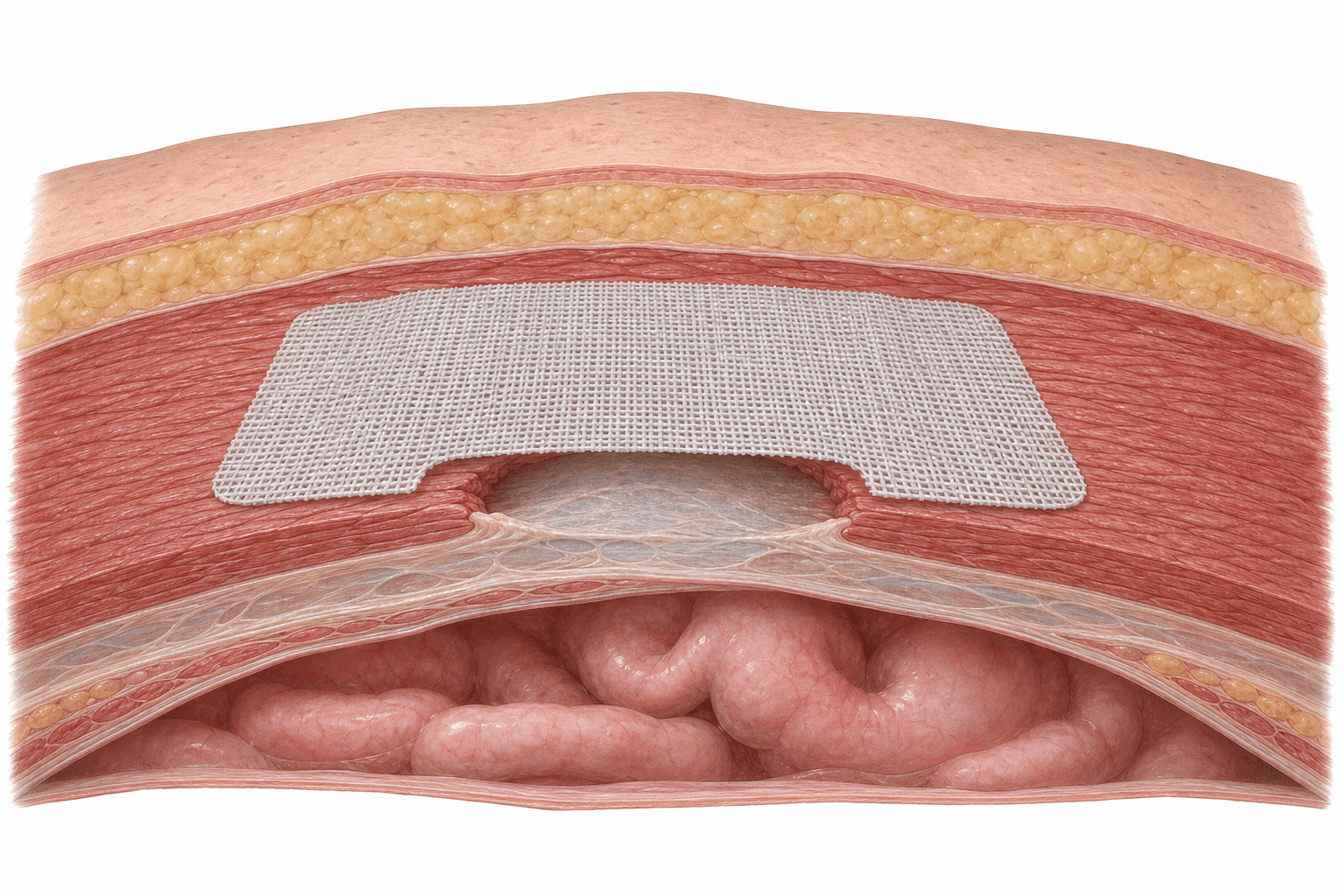
The mesh is laid flat over the gap and well past its edges, so the abdominal wall grows into it rather than being pulled closed under tension. Illustration, not a photograph, and not yet certified by Dr Sulaiman.
Recovery
Desk work in a week, heavy lifting after four.
Recovery after keyhole repair is generally faster than after open repair. Most patients are discharged the same day and return to light activity within one to two weeks.
| Stage | Keyhole repair | Open repair |
|---|---|---|
| Day of discharge | Same day, most cases | 1 to 3 days |
| Return to desk work | 5 to 7 days | 2 to 4 weeks |
| Light exercise | 2 to 3 weeks | 4 to 6 weeks |
| Heavy lifting | After 4 weeks | After 6 to 8 weeks |
The first 48 hours
You are monitored in the recovery area before discharge, with pain relief as required. Rest at home for the first two days and keep the incision sites clean and dry. Have someone available to help with the journey home and the first stretch of care.
The first week
Most patients return to desk-based work and light daily activity within 5 to 7 days. Short walks are encouraged from the first day to support circulation. Do not drive until you are off prescription pain relief and can perform an emergency stop comfortably.
From week four
Reintroduce more strenuous activity gradually, guided by how you feel. Dr Sulaiman advises avoiding heavy lifting for at least four weeks. A full return to exercise is typically possible within four to six weeks.
When to call
Contact the clinic promptly if you have a fever, worsening pain at the surgical site, a new lump or swelling near the incisions, redness or discharge from the wound, or difficulty passing urine.
Risks
Hernia repair risks, and how often they happen.
Serious complications are uncommon. Most side effects are mild and manageable with standard post-operative care.
Infection
Possible at the incision site after any surgery. Redness, swelling, warmth, fever and wound discharge are the signs. Most cases respond well to appropriate medical management.
Minor bleeding
Some bleeding may occur during or after the procedure and is typically managed with routine post-operative care. Rarely, further intervention is needed.
Seroma, numbness, difficulty passing urine
A seroma is a collection of fluid near the surgical site that may develop in the weeks after surgery and usually resolves without intervention. Temporary numbness or tingling in the groin and short-term difficulty passing urine are also occasionally reported and typically settle on their own.
The hernia coming back
With mesh repair the likelihood of recurrence is low. A Danish national register followed 24,542 keyhole groin hernia repairs carried out between 2018 and 2023. Across the ten most commonly used meshes, fewer than 1.5% needed a second operation for a recurrence within a year, and fewer than 4% within five years.
That figure counts reoperations rather than every recurrence, so read it as a floor rather than the whole picture. Dr Sulaiman will discuss your individual risk factors at your consultation.
How safety is approached.
Each patient has a thorough pre-operative assessment, including anaesthesia planning, to confirm suitability for keyhole repair. If a concern arises during or after the procedure, it can be assessed and managed on site.
Training
Where he trained.
Dr Sulaiman Bin Yusof is a colorectal and general surgeon holding the MBChB (Sheffield), M.Med (Surgery) and FRCSEd (General Surgery).
He completed a Ministry of Health sponsored Fellowship at the Peter MacCallum Cancer Centre in Melbourne and continues to serve as Visiting Consultant at Changi General Hospital. He has contributed to eight peer-reviewed publications and is a member of the Singapore Colorectal Society. He was awarded the Singapore Health Quality Service Star Award in 2023.
His surgical expertise spans both routine and complex hernia cases, with a consistent focus on minimising downtime and supporting a smooth recovery through minimally invasive technique.
Common questions
Questions about hernia repair.
Who performs the surgery, and where?
Dr Sulaiman Bin Yusof offers laparoscopic, or keyhole, hernia repair across five private clinic locations in Singapore: Gleneagles, Mount Elizabeth Novena, Parkway East, Mount Alvernia and Farrer Park Medical Centre. Self-referrals are welcome and same-week consultations are typically available.
How long until I am back to normal?
Most patients return to light activity and desk-based work within 5 to 7 days. Heavy lifting and strenuous exercise should be avoided for 4 weeks. Full recovery is typically achieved within 4 to 6 weeks.
Can I use Medisave?
Yes. Keyhole hernia surgery is Medisave-claimable for approved procedures, with withdrawal limits varying by procedure complexity and table code. Most Integrated Shield Plans and corporate insurance policies also cover the procedure when it is medically necessary. The clinic coordinates pre-authorisation and cashless billing on your behalf.
Is it day surgery?
Yes. Most repairs here are performed as day surgery. Patients are admitted, have the operation, and are discharged on the same day in most cases, with no overnight hospital stay required.
Will the hernia come back?
With mesh repair the likelihood is low, though recurrence remains possible. The risks section sets out what the published figures show and where they fall short. Dr Sulaiman will discuss your individual risk factors and the most appropriate repair technique at your consultation.
How long does the operation take?
Typically 45 to 90 minutes, depending on the type and complexity of the hernia. That includes anaesthesia and the repair itself. Most patients are discharged the same day after a period of post-operative monitoring.
Am I suitable for keyhole repair?
It suits most patients with inguinal, femoral, umbilical, ventral and incisional hernias, and it is a preferred option for bilateral inguinal hernias or where open surgery would carry more wound risk. Suitability is assessed individually at consultation.
Is there a follow-up?
Yes. A follow-up appointment is typically scheduled within one to two weeks of surgery to review your recovery and check the incision sites. Additional visits may be arranged based on your progress or if any concerns arise.
Are there hernias keyhole repair is not right for?
In some cases, such as very large hernias or where previous repairs have significantly altered the anatomy, open or robotic-assisted approaches may be more appropriate. Dr Sulaiman will advise on the most suitable technique after a clinical assessment.
When should I be seen urgently?
Sudden severe abdominal or groin pain, nausea or vomiting alongside a painful lump, or a firm tender lump that cannot be pushed back in may indicate strangulation, where the blood supply to the herniated tissue is compromised. That requires emergency medical attention rather than an appointment.
Book a consultation
A hernia does not close on its own. Have it assessed.
Looking for a hernia repair specialist? Your hernia doctor, Dr Sulaiman, repairs hernias laparoscopically and openly as a General Surgery specialist. If you have been diagnosed with a hernia, or you have a lump or groin pain you are concerned about, book a consultation for a diagnosis and a personalised surgical plan. Self-referrals are welcome. Clinics are open Monday to Friday, 9am to 6pm, and Saturday, 9am to 1pm. Sunday and public holiday appointments are available on request. If the pain came on suddenly, or the lump is firm, tender and will not push back in, go to A&E rather than waiting for an appointment.