Piles surgery in Singapore
Not every case of haemorrhoids (piles) ends in piles surgery.
A haemorrhoidectomy, also spelled hemorrhoidectomy and commonly referred to as piles surgery, is a procedure used to address haemorrhoids, swollen veins in the rectum or anus that often cause discomfort, pain and bleeding.
FRCSEd (General Surgery)Day surgery, MediSave-claimableFive clinics in Singapore
In short
- Three
- Ways it is done
- Laser haemorrhoidoplasty, stapled haemorrhoidopexy and conventional haemorrhoidectomy, chosen on the severity of the condition and individual patient requirements.
- Day surgery
- How it is done
- All three procedures are performed under anaesthesia as day surgery, and all three are MediSave-claimable.
- 4 to 5
- Out of 10, the first week
- Post-haemorrhoidectomy pain is real. It settles to 2 to 3 out of 10 by the second week, then 1 to 2 mainly during bowel movements.
- 2 to 4
- Weeks to full recovery
- Light activities such as walking usually resume within a few days to a week. Full recovery takes 2 to 4 weeks, depending on the technique used.
MediSave and insurance
What is claimable, and who to ask before you commit.
All three procedures are day surgery and MediSave-claimable (source: CPF Board, using MediSave for hospitalisation, opens in a new tab), and may be covered under Integrated Shield Plans and corporate schemes. Laser haemorrhoidoplasty and haemorrhoidectomy are billed under TOSP SF836A, and stapled haemorrhoidopexy under SF837A. These are the codes your insurer will ask for.
What can pay for it
SF836A
laser haemorrhoidoplasty and haemorrhoidectomy
SF837A
stapled haemorrhoidopexy
- MediSave
- Integrated Shield Plans
- Corporate insurance
Cash to pay, after MediSave and insurance
$ ___
It depends on your MediSave balance and your policy. The clinic confirms it in writing before the procedure.
Integrated Shield Plans






Corporate insurance













MediSave, Integrated Shield Plans, and private or corporate insurance may apply, subject to policy eligibility. The clinic team will check your coverage before any treatment is planned.
His story
Dr Sulaiman Bin Yusof
Senior Consultant Colorectal and General Surgeon, seeing patients at five clinics in Singapore.
- MBChB (Sheffield), M.Med (Surgery), FRCSEd (General Surgery)
- Consults in English and Malay
- MOH Fellowship, Peter MacCallum Cancer Centre, Melbourne
- Singapore Health Quality Service Star Award 2023
- Dean's Honour Roll for Teaching
Five clinics across Singapore
ORCHARD / NAPIER
Gleneagles Medical Centre
6 Napier Road #06-08, Singapore 258499
NOVENA
Mount Elizabeth Novena
38 Irrawaddy Road, #10-48/49, Singapore 329563
JOO CHIAT / EAST COAST
Parkway East Hospital
#05-08, 319 Joo Chiat Place, Singapore 427989
THOMSON
Mount Alvernia Hospital
#08-62, Medical Centre D, 820 Thomson Road, Singapore 574623
FARRER PARK
Farrer Park Medical Centre
#14-12, 1 Farrer Park Station Road, Singapore 217562
What to expect, in short
What to expect, in short
Three
Ways piles surgery is done
Laser haemorrhoidoplasty, stapled haemorrhoidopexy and conventional haemorrhoidectomy. Which one is used depends on the severity of the condition and on individual patient requirements, and that assessment is what the consultation is for.
Source: Dr Sulaiman Bin Yusof, clinical practice
up to $1,950
What MediSave can cover for day-surgery haemorrhoid surgery
That is up to $1,120 from MediSave for the operation itself, $1,390 where the procedure is a stapled one, plus up to a further $830 a day towards day-surgery charges. Integrated Shield Plans commonly cover the rest of a day-surgery admission, subject to your own deductible and co-insurance, and what you can draw from MediSave is also limited by your own balance. MOH publishes what patients were actually billed before any of that is applied: for a day-surgery haemorrhoidectomy the median was $10,200, with the middle half of bills running $8,894 to $11,590, and stapled haemorrhoidopexy sits a little higher at $10,837. Section 10 breaks the same bill into the surgeon, the anaesthetist and the hospital, and shows the $3,812 spread between one private hospital and another.
Source: CPF Board (source: CPF Board, using MediSave for hospitalisation, opens in a new tab), MediSave withdrawal limits. Median bills: MOH transacted bill data, TOSP SF836A, private hospital day surgery, 1 January to 31 December 2023. Includes GST.
Written fee estimate
Required before the procedure
Letter of Undertaking
Itemised, from the surgical team
Insurer confirms
Pre-authorisation and deductible
Final bill
MediSave and insurance applied
4 to 5
Out of 10, pain in the first week
Post-haemorrhoidectomy pain is real, and it is described here rather than played down. It settles to 2 to 3 out of 10 by the second week and then to 1 to 2, mainly during bowel movements. Sphincteric spasm contributes significantly and catches most patients off guard, so being prepared for it makes a meaningful difference.
Source: Dr Sulaiman Bin Yusof, clinical practice
Pain after conventional haemorrhoidectomy
- First week
- 4 to 5
- Second week
- 2 to 3
- After that
- 1 to 2
Source: Dr Sulaiman Bin Yusof, clinical practice
2 to 4
Weeks to full recovery
How long full recovery usually takes, depending on the surgical technique used. Strenuous activity and heavy lifting wait until the surgeon says otherwise. After laser haemorrhoidoplasty the wound typically heals within seven to ten days and most patients return to normal activity within a few days.
Source: Dr Sulaiman Bin Yusof, clinical practice
Light activity
Walking, within a few days to a week
Full recovery
Usually 2 to 4 weeks
Follow-up
An appointment within a few weeks
When surgery is considered
Piles surgery comes up when the symptoms stop answering to anything else.
This surgery is usually recommended for patients with severe haemorrhoids or when less invasive treatments have not provided sufficient relief. It may be recommended for individuals experiencing ongoing symptoms or specific issues with haemorrhoids.
Persistent rectal bleeding should always be assessed by a specialist before it is assumed to be haemorrhoid-related.
Pain and discomfort
Surgery may be needed when haemorrhoids cause significant discomfort that affects daily life and does not improve with other treatments.
Bleeding
Persistent or heavy bleeding from haemorrhoids that does not respond to conservative measures can be treated with haemorrhoidectomy.
Prolapsed haemorrhoids
Haemorrhoids that extend outside the anus and are challenging to manage with non-surgical options may be removed surgically.
Recurring haemorrhoids
Frequent flare-ups that persist despite changes in diet or lifestyle may benefit from surgical removal.
Not responding to other treatment
Haemorrhoids that do not improve with medications, dietary adjustments, or less invasive procedures may require surgery.
Surgery is not the first thing tried. Rubber band ligation, dietary change and topical treatment come first, and for Grade 1 and Grade 2 haemorrhoids they are often enough.
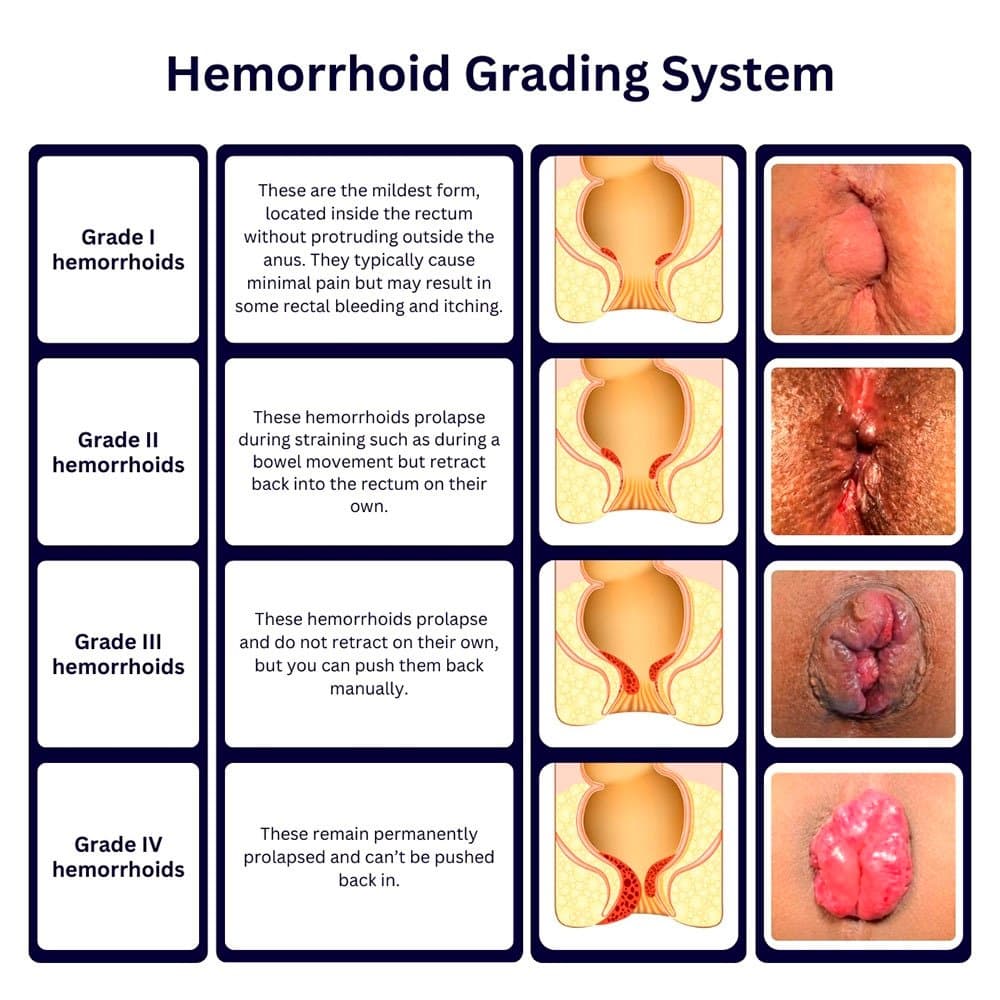
What haemorrhoids are, how they are graded, and the non-surgical options that come before an operation are on the haemorrhoids page. What blood in the stool can mean, and when it needs looking at urgently, is set out in this article on anal bleeding.
What it achieves
What piles surgery is meant to change.
For those with severe or recurring haemorrhoids, haemorrhoidectomy provides several benefits. By removing the affected veins, it aims to alleviate symptoms and prevent potential complications.
Relief from the daily discomfort
Surgery reduces the discomfort associated with haemorrhoids, allowing individuals to go about their day more comfortably.
Fewer complications
Removing haemorrhoids reduces the chance of complications such as anaemia from bleeding or infections linked to prolapsed haemorrhoids.
Easier bowel movements
Surgery can lessen the strain and discomfort during bowel movements, which can also help prevent further issues.
Less chance of it returning
Haemorrhoidectomy lowers the likelihood of future haemorrhoid episodes compared to non-surgical treatments.
The three procedures
Three piles surgery procedures, and the presentation each one is built for.
There are several surgical approaches to treating haemorrhoids, chosen based on the severity of the condition and individual patient requirements. All procedures are performed under anaesthesia as day surgery and are MediSave-claimable.
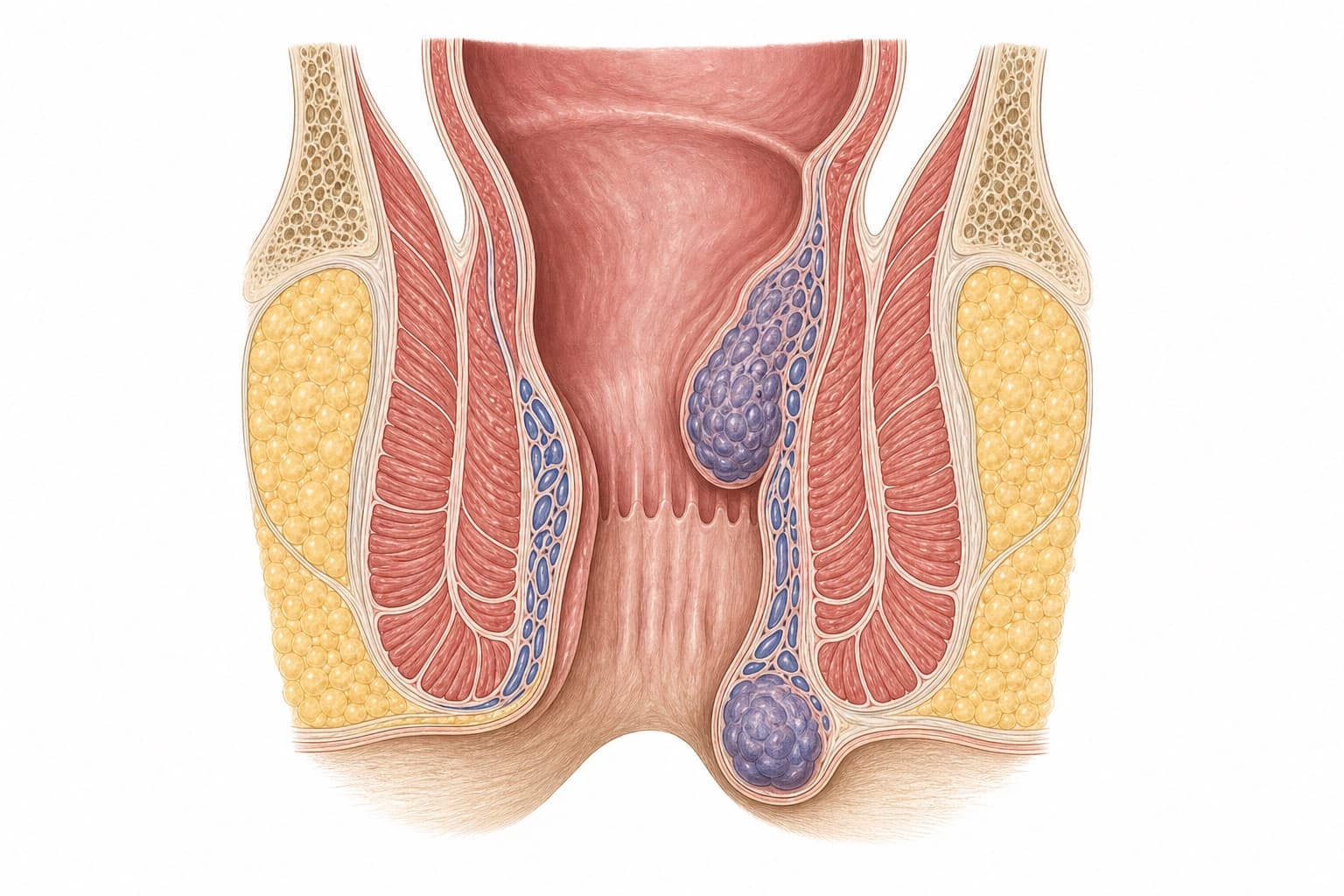
7 to 10
Days for the laser wound to heal
The opening made to introduce the laser fibre is small, and it typically closes within seven to ten days. That is the practical difference laser haemorrhoidoplasty buys for the patient in the middle of the range: significantly less post-operative discomfort than conventional haemorrhoidectomy, and a return to normal activity within a few days.
Source: Dr Sulaiman Bin Yusof, clinical practice
Laser haemorrhoidoplasty
Laser haemorrhoidoplasty fills a specific clinical gap. It is the right option for patients whose haemorrhoids are too large or symptomatic for rubber band ligation, where ligation has failed or is unlikely to work, but who do not yet have the degree of prolapse that makes conventional surgery necessary.
A small opening is made to introduce the laser fibre into the haemorrhoidal tissue, which coagulates and shrinks it from within. This wound typically heals within seven to ten days. Post-operative discomfort is significantly less than conventional haemorrhoidectomy, and most patients return to normal activity within a few days.
Laser haemorrhoidoplasty is billed under the same MOH table code as conventional haemorrhoidectomy, TOSP SF836A.
Stapled haemorrhoidopexy
Stapled haemorrhoidopexy uses a circular stapling device to reposition prolapsed haemorrhoid tissue back into the anal canal and reduce its blood supply, rather than removing it entirely. It is particularly suited for haemorrhoids with circumferential prolapse combined with significant Grade 3 prolapse.
The result is less post-operative pain and a faster recovery than conventional haemorrhoidectomy. Some studies report higher long-term recurrence rates compared to conventional haemorrhoidectomy, and that trade-off is worth discussing before you decide.
Stapled haemorrhoidopexy is billed under MOH table code TOSP SF837A.
Conventional haemorrhoidectomy
Conventional haemorrhoidectomy is the most durable of the excisional options in the published trial evidence. It carries a lower long-term recurrence rate than stapled haemorrhoidopexy and than transanal dearterialisation, though against laser haemorrhoidoplasty the pooled recurrence rates are not significantly different. Where an energy sealing device such as LigaSure is used in place of conventional diathermy, the Cochrane review of twelve randomised trials found less pain on the first day after surgery and a return to work about five days earlier. It is the procedure recommended for Grade 3 to Grade 4 haemorrhoids, large or thrombosed external piles, and cases where other treatments have not provided lasting relief.
Most patients experience pain around 4 to 5 out of 10 in the first week, settling to 2 to 3 out of 10 by the second week. After that, most patients notice mild discomfort of 1 to 2 out of 10 mainly during bowel movements. A yellowish mucoid discharge for two to three weeks is normal as the wound heals.
Conventional haemorrhoidectomy is billed under MOH table code TOSP SF836A.
Under general anaesthesia the sphincter muscles relax completely, which allows an accurate assessment of the anatomy that is not possible in clinic. That assessment is what settles the final choice between stapled haemorrhoidopexy and conventional haemorrhoidectomy.
Preparing for surgery
Three things are settled before the day of the operation.
Preparation covers your general health, what you eat in the days beforehand, and which of your medications need to pause. Each one exists to reduce a specific risk on the day.
01
Medical evaluation
A thorough medical evaluation is conducted to assess the patient's overall health and suitability for the procedure. This may include blood tests, a review of current medications, and an assessment of any existing medical conditions. The evaluation helps identify and manage potential risks before surgery.
02
Dietary advice
Patients may be advised to follow a low-residue diet in the days before the procedure to minimise bowel movements. Fasting is typically required from midnight before the surgery to ensure the digestive system is clear, which reduces complications during the operation.
03
Medication adjustments
Certain medications, such as blood thinners or anti-inflammatory drugs, may need to be stopped temporarily before surgery to reduce the risk of excessive bleeding. Clear instructions will be provided on which medications to pause or continue to ensure patient safety.
Step by step
What actually happens, from anaesthetic to discharge.
The operation follows the same four stages whichever technique is used. It is day surgery, so the last of those stages ends with going home rather than with a ward.
01
Anaesthesia administration
Anaesthesia is administered to ensure the patient remains comfortable and pain-free during the surgery. General anaesthesia may be used to induce sleep, or regional anaesthesia may numb the lower body. The choice depends on the patient's condition and the procedure being performed.
02
Surgical technique
The surgeon selects the most appropriate technique based on the severity and type of haemorrhoids. Options include laser haemorrhoidoplasty, stapled haemorrhoidopexy, or conventional haemorrhoidectomy, each designed to remove or shrink haemorrhoids effectively while minimising tissue damage.
03
Closure
After removing or reducing the haemorrhoids, the surgical site may be left open to heal naturally or closed with dissolvable stitches. The method depends on the specific procedure and the need to promote healing while reducing the risk of infection.
04
Post-procedure monitoring
Patients are monitored in a recovery area until they wake from anaesthesia and are stable enough for discharge. Vital signs and pain levels are assessed, and initial post-operative care instructions are provided before the patient is sent home.
Recovery
Recovery, described as it actually goes rather than as it sells.
Post-haemorrhoidectomy pain is real, and knowing the shape of it in advance is most of what makes it manageable. These are the numbers patients are given in clinic before they agree to anything.
A yellowish mucoid discharge for two to three weeks after conventional haemorrhoidectomy is normal as the wound heals.
Pain management
Most patients experience pain around 4 to 5 out of 10 in the first week, settling to 2 to 3 out of 10 by the second week. After that, discomfort is mainly 1 to 2 out of 10 during bowel movements. Sphincteric spasm contributes significantly, and being prepared for this makes recovery meaningfully easier. Pain relief is provided through prescribed medications.
Resumption of activities
Patients can typically resume light activities, such as walking, within a few days to a week after the procedure. Full recovery usually takes 2 to 4 weeks, depending on the surgical technique used. Strenuous activities and heavy lifting should be avoided until advised by the surgeon.
Follow-up care
A follow-up appointment is scheduled within a few weeks to monitor the healing process and address any concerns. During this visit, the surgeon will check for complications, assess progress, and provide further guidance on activities and care.
A fibre-rich diet with adequate water intake after surgery keeps stools soft and reduces straining, which is what protects the healing wound and what keeps new haemorrhoids from forming later.
Risks
What can go wrong, and what to report.
Haemorrhoidectomy is generally safe, but it is an operation and it carries the risks of one. These are the ones that come up.
- Post-operative pain, which is expected rather than unusual and is managed with prescribed medication
- Minor bleeding during bowel movements
- Infection at the surgical site
- Temporary urinary retention
Most risks are manageable with proper care, but persistent symptoms should be reported promptly.
5.3%
Early incontinence, pooled across 68 randomised trials
The complication patients ask about most is control. Pooling 68 randomised trials covering 8,445 patients, difficulty controlling wind or stool was reported by 5.3 in every 100 patients in the first three months (95% confidence interval 2.7 to 8.5), falling to 2.5 in every 100 beyond three months (1.1 to 4.3). The same review found no significant difference in that risk between excisional haemorrhoidectomy and stapled haemorrhoidopexy. In the 777-patient eTHoS trial, serious adverse events were reported in 7.1 per cent of stapled cases and 9.4 per cent of traditional ones. These are also the events that turn a day case into an overnight stay, which is what moves the hospital charge in section 10.
Source: Jin JZ and colleagues, Surgery, 2025. Systematic review and meta-analysis of 139 studies.
Recurrence divides the three techniques more sharply than complications do. A 2026 meta-analysis of 17 randomised trials found stapled haemorrhoidopexy carried a higher long-term recurrence rate than conventional haemorrhoidectomy, and roughly three times the rate of prolapse coming back specifically, though its authors note the pooled evidence is not yet large enough to settle the question. A 2024 meta-analysis of 6 trials found transanal dearterialisation recurred more often than conventional excision as well. Laser haemorrhoidoplasty is the exception: 17 pooled trials found its recurrence rate not significantly different from conventional surgery, alongside less bleeding and less day-one pain.
Sources: Lauricella S and colleagues, International Journal of Colorectal Disease, 2026. Jee J and colleagues, Digestive Surgery, 2024. Cheng PL and colleagues, Asian Journal of Surgery, 2024. Watson AJM and colleagues, Health Technology Assessment, 2017.
None of that decides your operation. It is context for a conversation, and the technique that suits you is settled by the grade and configuration of your haemorrhoids at examination.
How the bill is structured
One operation, five charges, and a different party behind each one.
Each component of the haemorrhoid surgery bill is billed by a different party. At a private hospital the total for a haemorrhoidectomy comprises the surgeon’s professional fee, the anaesthetist’s fee, operating theatre charges, facility and ward charges, medications, histology, and surgical consumables.
Surgeon's professional fee
The specialist fee for performing the operation, covering the surgeon, any assistant the surgeon brings in, and sedation the surgeon performs. MOH publishes fee benchmarks to guide reasonable private specialist charges, and asks doctors to tell you their total professional fee and how it compares with those benchmarks at financial counselling. Ask for that comparison in writing before the date is set.
Anaesthetist's fee
For sedation or general anaesthesia during the procedure. Billed independently by the anaesthetist. MOH benchmarks this separately from the surgeon's fee, at $700 to $1,000 for haemorrhoid surgery.
Hospital and facility charges
Billed by the hospital. Covers the operating theatre, the day surgery room, nursing care, and the recovery bay. Day surgery significantly reduces this component compared with an overnight stay. An overnight stay also adds the doctor's daily attendance fee, which MOH benchmarks at $210 to $420 a day before GST and which a day case never incurs.
Medications and histology
Medications prescribed during and after the procedure, plus laboratory analysis of removed tissue, which is standard practice. In MOH's own bill breakdown these sit outside the operation fee, alongside ward charges, consultations, tests and consumables.
Surgical consumables
Single-use devices required to perform the operation. The type depends on the surgical technique chosen: a circular stapler for stapled haemorrhoidopexy, a laser fibre for laser haemorrhoidoplasty, or an energy sealing device such as LigaSure for conventional haemorrhoidectomy.
Most patients are treated as day surgery cases, meaning you are admitted and discharged on the same day. That single fact moves the largest variable component of the bill, the hospital charge, by several thousand dollars.
Which operation is on the table in the first place, and whether an operation is needed at all, is set by the grade and configuration of the disease. That is covered on the haemorrhoids page.
Cost by procedure type
Three techniques, and the codes your bill will be built from.
Cost figures are drawn from MOH recommended fees and MOH transacted bill data, reflecting private hospital day surgery.
How to read these figuresBenchmarks, transacted bills and MediSave limits are three different kinds of number
Each row below says what kind of figure it is, because a published benchmark, a transacted bill total and a MediSave withdrawal limit are three different kinds of thing and they do not add up, cancel out or average. The TOSP code beside each technique is the code that appears on your hospital bill and on your insurance claim, so these ranges can be checked against the real document.
All MOH fee benchmarks exclude GST. The publication states this itself, for surgeon, anaesthetist and hospital benchmarks alike. They are reference ranges for reasonable private-sector fees rather than fee caps, and they are not a quotation from Dr Sulaiman.
The two transacted rows are a different kind of number again. MOH publishes them from actual bills for Singapore Citizens, and the current set covers 1 January to 31 December 2023. The typical bill is the median, so half of patients were billed less than it, and the range beneath it is the 25th to the 75th percentile, so it describes the middle half of bills and not the extremes. Both include GST. They sit above the three benchmark rows added together because the benchmarks cover the surgeon, the anaesthetist and the facility only, while a transacted bill also carries medications, tests, consumables and consultations.
Ministry of Health, fee benchmarks and bill amount informationNo figure on this page is a quotation for your own case, and none of them is Dr Sulaiman’s own fee.
Laser haemorrhoidoplasty
No MOH code of its own, usually billed as SF836A
MOH publishes no code and no fee benchmark of its own for laser haemorrhoidoplasty. In practice it is coded to the excisional haemorrhoidectomy code, SF836A, which is why the published benchmarks below are the same ones conventional haemorrhoidectomy carries. The difference between the two operations shows up in the consumable, a laser fibre rather than an energy sealing device, and not in the code. Because the code is a billing decision rather than a published designation, confirm the code that will appear on your own estimate before you compare it with anything here.
| What kind of figure | Amount |
|---|---|
| MOH surgeon fee benchmark, excludes GST | $3,000 to $3,800 |
| MOH anaesthetist fee benchmark, excludes GST | $700 to $1,000 |
| MOH hospital fee benchmark, day surgery, excludes GST | $3,000 to $4,300 |
| Typical transacted bill, private day surgery, includes GST | $10,200 |
| Middle half of those bills, 25th to 75th percentile | $8,894 to $11,590 |
Stapled haemorrhoidopexy
Uses a circular stapling device to reposition prolapsed haemorrhoid tissue. It sits in a higher MOH table than conventional haemorrhoidectomy, which is why both the surgeon and the hospital benchmarks are higher. It is the least painful of the three in the first weeks, and the trial evidence below is consistent that the trade for that is a higher chance of the prolapse returning later.
| What kind of figure | Amount |
|---|---|
| MOH surgeon fee benchmark, excludes GST | $3,400 to $4,200 |
| MOH anaesthetist fee benchmark, excludes GST | $700 to $1,000 |
| MOH hospital fee benchmark, day surgery, excludes GST | $4,300 to $5,100 |
| Typical transacted bill, private day surgery, includes GST | $10,837 |
| Middle half of those bills, 25th to 75th percentile | $10,134 to $11,556 |
Conventional haemorrhoidectomy
TOSP SF836A, Table 2C
The most durable of the excisional options in the published trial evidence. Compared with stapled haemorrhoidopexy it carries a lower long-term recurrence rate, and compared with transanal dearterialisation it does too. Compared with laser haemorrhoidoplasty the pooled recurrence rates are not significantly different, so it is not the most durable option available in every direction. Where an energy sealing device such as LigaSure is used in place of conventional diathermy, the Cochrane review of twelve randomised trials found less pain on the first day after surgery and a return to work about five days earlier.
| What kind of figure | Amount |
|---|---|
| MOH surgeon fee benchmark, excludes GST | $3,000 to $3,800 |
| MOH anaesthetist fee benchmark, excludes GST | $700 to $1,000 |
| MOH hospital fee benchmark, day surgery, excludes GST | $3,000 to $4,300 |
| Typical transacted bill, private day surgery, includes GST | $10,200 |
| Middle half of those bills, 25th to 75th percentile | $8,894 to $11,590 |
Before MediSave and MediShield Life payouts. Actual out-of-pocket costs may be lower depending on Integrated Shield Plan coverage. Transacted figures are MOH's published medians for private hospitals, based on actual bills for Singapore Citizens between 1 January and 31 December 2023.
Two figures that sit outside the tablesAn overnight stay, and the code for transanal dearterialisation
Where an overnight stay is needed rather than day surgery, the hospital fee benchmark rises to $4,800 to $7,500 under SF836A and $6,300 to $7,500 under SF837A. That is the largest single swing available on this bill, which is why the day-case question is worth asking at consultation.
MOH also publishes a surgeon fee benchmark for transanal haemorrhoidal dearterialisation, TOSP SF721A, at $2,200 to $3,400, with the same $700 to $1,000 anaesthetist range. Whether any given technique is appropriate for you is a clinical decision made at consultation and not a decision made from a table.
Sources: MOH hospital fee benchmarks, as of 15 June 2023 (source: Ministry of Health, Singapore, full published fee benchmark list, opens in a new tab), for the overnight ranges. MOH surgeon and anaesthetist fee benchmarks, as of 1 January 2025, for SF721A (source: Ministry of Health, Singapore, fee benchmarks and bill information for SF721A, opens in a new tab). Both exclude GST.
The same operation, six private hospitals
- Mount Alvernia
- $7,618
- Raffles
- $8,282
- Mount Elizabeth
- $9,171
- Gleneagles
- $9,868
- Farrer Park
- $10,368
- Mount Novena
- $11,430
Typical transacted bill, by hospital
That is a $3,812 spread on one operation, and it is the reason a single national figure is a starting point rather than an answer. Where your operation is done is a question worth asking at consultation.
The complications that turn a day case into an overnight stay are the same ones that move the hospital charge into the higher band above, and the published figures for them are set out in section 08, what can go wrong.
Surgical consumables
The consumable follows the technique, and the technique follows the disease.
Surgical consumables are single-use devices required to perform the operation. Their cost is passed on to the patient as part of the hospital bill, which is why two operations sharing the same TOSP code can still produce different totals.
Circular stapler
Used in stapled haemorrhoidopexy, to excise a ring of tissue above the haemorrhoids and reposition what remains.
Laser fibre
Used in laser haemorrhoidoplasty. It is single-use and is not reused between patients, which is why it appears on the bill as a consumable rather than as equipment.
Energy sealing devices such as LigaSure
Used in conventional haemorrhoidectomy, to seal vessels as the tissue is divided.
Not all techniques are suitable for all patients, and the choice of surgical approach is a clinical decision based on the grade and configuration of your haemorrhoids rather than on cost.
Common questions
Questions about piles surgery.
Can haemorrhoids be treated without surgery?
Yes, treatments like rubber band ligation can shrink haemorrhoids or cut off their blood supply. These options are suitable for Grade 1 and Grade 2 cases and may be combined with dietary and lifestyle changes to manage symptoms. When these fail, laser haemorrhoidoplasty fills the gap before surgical options.
How painful is the recovery after piles surgery?
Post-haemorrhoidectomy pain is real. Most patients experience pain around 4 to 5 out of 10 in the first week, settling to 2 to 3 out of 10 by week two. After that, discomfort is mainly 1 to 2 out of 10 during bowel movements. Sphincteric spasm contributes significantly and catches most patients off guard. For conventional haemorrhoidectomy, expect yellowish mucoid discharge for two to three weeks. This is normal. Being prepared makes a meaningful difference.
What should I eat after the operation?
Post-surgery, a fibre-rich diet combined with adequate water intake is crucial to ensure soft stools and reduce strain. This helps minimise complications during recovery and prevent future haemorrhoid issues.
Can haemorrhoids come back after surgery?
New haemorrhoids can develop if factors like straining or constipation are not addressed. Conventional haemorrhoidectomy has a lower long-term recurrence rate than stapled haemorrhoidopexy, though against laser haemorrhoidoplasty the pooled rates are not significantly different. Adopting a healthy diet, staying active, and avoiding prolonged sitting can help reduce the risk of recurrence.
How much does haemorrhoid surgery cost in Singapore?
For a day surgery haemorrhoidectomy at a private hospital, the typical total bill ranges from approximately $8,894 to $11,590 for conventional haemorrhoidectomy and $10,134 to $11,556 for stapled haemorrhoidopexy. This includes all components: surgeon and anaesthetist fees, operating theatre charges, facility fees, medications, histology, and surgical consumables. Those are transacted bill figures for the private sector rather than a quotation, and your own figure comes from the written estimate you are given before the procedure.
Is the MOH benchmark what Dr Sulaiman charges?
No. MOH fee benchmarks are reference ranges published for the private sector to guide what a reasonable fee looks like. They are not a fee cap, they are not a quotation from any individual surgeon, and they exclude GST. Dr Sulaiman has no published personal price for this operation. The figure that applies to you is the one on your own written fee estimate.
How do I get a written estimate before I commit?
Ask for one at consultation. The clinic will provide a full written breakdown of the expected fees before you commit to anything, and the formal Letter of Undertaking follows once a date is set. Nothing on this page is a quotation for your own case.
Can I use MediSave for haemorrhoid surgery?
Yes. Haemorrhoidectomy is a medically necessary procedure and MediSave can be used to offset surgical and hospitalisation fees, subject to MOH withdrawal limits.
Does MediShield Life cover haemorrhoid surgery?
MediShield Life provides basic coverage for haemorrhoidectomy. At a private hospital, this coverage alone is limited. An Integrated Shield Plan with a private hospital rider substantially improves your coverage.
Will my Integrated Shield Plan cover it?
Most Integrated Shield Plans cover haemorrhoidectomy as a medically necessary procedure. Coverage depends on your specific plan tier, deductible, co-insurance terms, and whether pre-authorisation is required.
What is a Letter of Undertaking?
A Letter of Undertaking is a formal pre-procedure cost estimate prepared by your surgical team. It itemises all anticipated fees. Submit this to your insurer before the procedure to confirm coverage and avoid unexpected gaps in your claim.
Book a consultation
Are your symptoms affecting your quality of life?
Consult Dr Sulaiman for an assessment and a personalised treatment plan. Same-day and same-week appointments are available across five clinic locations, and self-referrals are welcome.