Anal and perianal
Anal fistula surgery, for a tract that will not heal on its own.
An anal fistula is an abnormal tunnel between the inside of the anal canal and the skin near the anus, typically developing after an incompletely healed perianal abscess. When the tract runs through the sphincter muscle that keeps you continent, LIFT, VAAFT and laser closure (FiLaC) can treat it without cutting that muscle.
- An abscess forms
- It comes back
- The tract is mapped
- One of the operations
In short
5
Clinic locations
Gleneagles, Mount Elizabeth Novena, Parkway East, Mount Alvernia and Farrer Park.
2-3
Weeks
Usual recovery after fistulotomy, the most common operation for a simple, low fistula.
2
Abscesses
A second abscess in the same place means a fistula tract is almost certainly there.
No
Referral
Self-referrals and GP-referred patients are both accepted.
The anal fistula surgeon
Dr Sulaiman Bin Yusof, anal fistula doctor
Colorectal surgeon with over 20 years of surgical experience, operating on anal fistulas at five clinics in Singapore. His sphincter-sparing operations include LIFT, VAAFT and laser closure (FiLaC), and he has published on a novel use of the VAAFT fistuloscope.
- MBChB (Sheffield), M.Med (Surgery), FRCSEd (General Surgery)
- Consults in English and Malay
- MOH Fellowship, Peter MacCallum Cancer Centre, Melbourne
- Singapore Health Quality Service Star Award 2023
- Dean's Honour Roll for Teaching
Five clinics across Singapore
ORCHARD / NAPIER
Gleneagles Medical Centre
6 Napier Road #06-08, Singapore 258499
NOVENA
Mount Elizabeth Novena
38 Irrawaddy Road, #10-48/49, Singapore 329563
JOO CHIAT / EAST COAST
Parkway East Hospital
#05-08, 319 Joo Chiat Place, Singapore 427989
THOMSON
Mount Alvernia Hospital
#08-62, Medical Centre D, 820 Thomson Road, Singapore 574623
FARRER PARK
Farrer Park Medical Centre
#14-12, 1 Farrer Park Station Road, Singapore 217562
Before you decide
When to see a specialist
An anal fistula almost never resolves without treatment as the internal opening acts as a constant source of bacterial reinfection.
Therefore, delaying treatment increases the risk of a more complex fistula or recurring abscesses.
A second abscess in the same place
If you have had more than one abscess in the same location, an underlying fistula tract is almost certainly present.
Each new abscess is the fistula re-infecting. Recurring infections in the same site should be assessed by a colorectal surgeon, as the abscess will continue to return until the fistula is treated.
The operations
Anal fistula surgery, the operations
| Operation | Best for | Cuts muscle? | Setting | Weeks to recover |
|---|---|---|---|---|
| Fistulotomy | Simple, low tract | Some | Day surgery | 2 to 3 |
| Fistulectomynew | pending | pending | pending | pending |
| Seton | Through the muscle, staged | Some | Staged | months |
| LIFT | Transsphincteric | No | Day or overnight | 3 to 6 |
| Advancement flap | High or complex | No | Day or overnight | 3 to 6 |
| VAAFT | Through the muscle, scope-guided | No | Day or overnight | 3 to 6 |
| Fibrin glue and plug | Selected simple cases | No | Non-surgical | variable |
| Laser closure, FiLaCnew | Long or high tract | No | Day surgery | pending |
Fistulotomy
Fistulotomy is the most common anal fistula operation for simple, low fistulas not involving significant sphincter muscle.
The surgeon cuts open the entire length of the fistula tract, allowing it to heal from the inside out as a flat scar. Most patients go home the same day, with recovery taking approximately 2 to 3 weeks.
Fistulectomy
Description pending Dr Sulaiman’s sign-off.
Laser closure (FiLaC)
A fine laser fibre is drawn back along the tract to seal it from the inside. No muscle is cut. Day surgery, and it can be repeated.
Seton placement
For complex or high fistulas where dividing the sphincter would risk incontinence, a surgical thread (seton) is passed through the tract.
A loose seton drains the tract and allows it to mature before a planned second procedure, while a cutting seton applies gradual tension to slowly divide the muscle over time.
The approach is determined by the fistula's anatomy and sphincter involvement.
LIFT procedure
The Ligation of Intersphincteric Fistula Tract (LIFT) procedure ties and divides the fistula tract within the intersphincteric plane (between the two sphincter muscles) without cutting any sphincter muscle.
It is the preferred approach for transsphincteric fistulas where sphincter preservation is required.
Advancement flap
A flap of healthy rectal tissue is used to close the internal opening of the fistula. This sphincter-preserving technique is suited to complex or high fistulas where fistulotomy carries an unacceptable risk to continence.
VAAFT
A minimally invasive technique in which a small scope is passed through the fistula tract. The internal opening is identified and sealed under direct vision, with no sphincter muscle divided.
Fibrin glue and fistula plug
These non-surgical options are used in less severe cases to seal the fistula tract and allow surrounding tissues to heal naturally. Success rates are lower than operative procedures, but neither carries risk to the sphincter muscles.
The right operation depends on the fistula's depth, position, and individual anatomy. Our team will discuss the optimal approach at your consultation.
The deciding factor
Sphincter-sparing surgery with LIFT, VAAFT and laser closure
Complex and recurrent anal fistulas involve higher sphincter muscle, multiple tracts, or complicating conditions such as Crohn's disease. The central challenge in these cases is closing the fistula without compromising continence.
The anal sphincter muscles control bowel continence. Cutting too much sphincter tissue during fistula surgery risks incontinence, a life-altering complication.
As such, an approach that prioritises sphincter-sparing techniques, such as seton, LIFT, VAAFT, laser closure (FiLaC) and advancement flap, is essential whenever the fistula involves significant sphincter muscle.
Laser treatment for anal fistula, and why it is not his first choice
“FiLaC is useful for cases with long tracts or high fistulas. It is not the first line, as the success rates with fistulectomy and LIFT are still higher.”
Colorectal surgeon
Who it suits
A high transsphincteric fistula, or a long tract through muscle, where the sphincter-sparing choice matters more than the one-shot cure rate.
Published failure rates, four sphincter-sparing operations
Worsened continence after the operation
Laser healing by fistula type
Harder cases
Complex, recurrent, and second opinions
What makes a fistula complex
A fistula is considered complex when it:
- Involves more than 30% of the external sphincter
- Has multiple tracts
- Has recurred after a previous operation
- Is associated with Crohn's disease
- Crosses the puborectalis muscle (suprasphincteric)
These fistulas typically require MRI mapping and a staged surgical plan.
Fistulas related to Crohn's disease
Fistulas arising from Crohn's disease require a fundamentally different treatment approach to cryptoglandular fistulas.
Medical therapy, including biologics and immunosuppressants, is often combined with surgical drainage to control the fistula, rather than attempting a definitive cure with surgery alone.
A multidisciplinary approach, combining surgical and gastroenterological care, is standard for Crohn's-related fistulas.
When to seek a second opinion
Our team offers second opinions for recurrent and complex cases, in which prior fistula surgeries have been unsuccessful.
Dr Sulaiman is known for managing complex and recurrent anal fistulas that have not responded to previous treatment.
What it is
What an anal fistula is, and the abscess connection
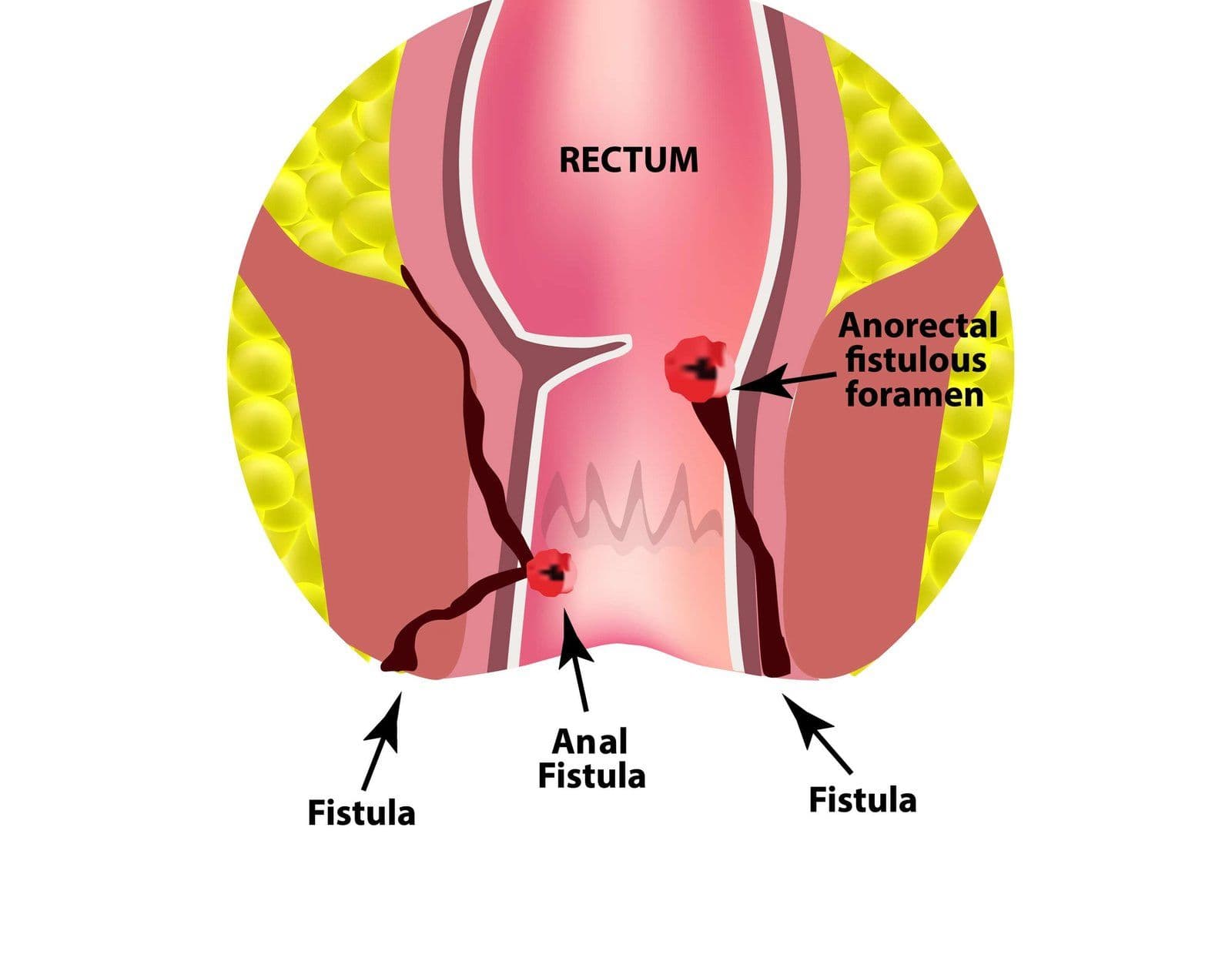
An anal fistula is a small tunnel that develops between the end of the bowel (the rectum) and the skin near the anus.
The anus contains small glands that produce fluid to aid bowel movements. When one of these glands becomes blocked or infected, an abscess (a pus-filled pocket) forms.
If the abscess is drained but the infected gland at its source does not close, a small tunnel forms between the gland and the skin.
This tunnel is the fistula, and it will not close as long as the internal opening remains active.
Externally, a fistula typically appears as a small opening near the anus, sometimes with surrounding redness or swelling.
Most people notice a persistent or intermittent discharge of pus or blood from this opening, along with pain and irritation in the anal area.
Unlike haemorrhoids, which cause bleeding during bowel movements without a persistent external opening, a fistula produces continuous or intermittent discharge from a small hole near the anus. That external opening is the distinguishing sign.
What you are feeling
Anal fistula symptoms
An anal fistula can cause several symptoms, all stemming from the ongoing infection and inflammation the fistula tract produces.
Persistent discharge near the anus
A recurring discharge of pus, blood, or clear fluid from a small opening near the anus is the most characteristic symptom of an anal fistula.
Pain, swelling, and tenderness
When a fistula creates a pathway from an infected internal gland to the skin surface, the surrounding tissue becomes inflamed. This presents as persistent or throbbing pain in the anal area, often accompanied by a tender lump near the anus.
Skin irritation
Continuous leakage of pus or fluid from the fistula opening irritates the surrounding skin, causing itching, redness, and general discomfort in the perianal area.
Foul odour
Drainage from a fistula tract often carries an unpleasant odour, a direct result of infected material passing through the tunnel.
Where it starts
What causes an anal fistula
Several factors can lead to the formation of an anal fistula, most beginning with an infection in the anal glands.
This is one of the most common causes of anal fistulas. A significant proportion of patients who have had an anal abscess go on to develop a fistula.
Crohn's disease
Crohn's disease is a chronic inflammatory bowel condition that weakens intestinal tissue, causing sores that can develop into fistulas over time.
Ulcerative colitis and tumours
Ulcerative colitis affects the lining of the colon and rectum. Chronic inflammation in these areas can cause ulcers that may develop into fistulas if they become infected.
Tumours in the rectum or anus can compress surrounding tissues, leading to infection and abscess formation. These abscesses may develop into fistulas if they do not resolve.
Anal fistulas are more likely to develop in:
- Men aged 20 to 60
- Patients with a history of perianal abscess
- Patients with Crohn's disease
- Patients who are immunocompromised, such as those with diabetes or HIV
The classification
Simple and complex anal fistulas
Anal fistulas are classified by their relationship to the anal sphincter muscles. The higher the fistula tract passes through the sphincter complex, the more complex the surgery required to treat it safely.
Intersphincteric
This is the most common type. In these cases, the tract runs between the internal and external sphincter muscles without passing through the external sphincter.
This classification is generally treatable with fistulotomy, carrying a low risk to continence.
Transsphincteric
Transsphincteric fistula tracts pass through both the internal and external sphincter muscles, making them more complex.
Fistulotomy alone carries a risk of incontinence at this level, so sphincter-preserving techniques, such as the LIFT procedure or seton placement, are typically preferred.
Suprasphincteric and extrasphincteric
These complex fistulas are the rarest. Suprasphincteric fistulas pass above the sphincter complex, while extrasphincteric tracts extend outside it entirely.
Both require staged surgical approaches, MRI-guided planning, and specialist colorectal expertise to manage safely.
Superficial
Superficial fistulas sit below the sphincter muscles entirely. They carry the lowest surgical risk and are generally straightforward to treat.
| Comparison | Low fistula | High fistula |
|---|---|---|
| Fistula Type | Intersphincteric, Superficial | Transsphincteric, Suprasphincteric, Extrasphincteric |
| Sphincter Involvement | Minimal or none | Partial to full |
| Preferred Surgery | Fistulotomy | Seton, LIFT, advancement flap, or staged procedures |
| Risk to Continence | Low | Moderate to high without specialist technique |
- Intersphincteric, the simple tract
- Transsphincteric
- Suprasphincteric
- Extrasphincteric
Confirming it
How an anal fistula is diagnosed
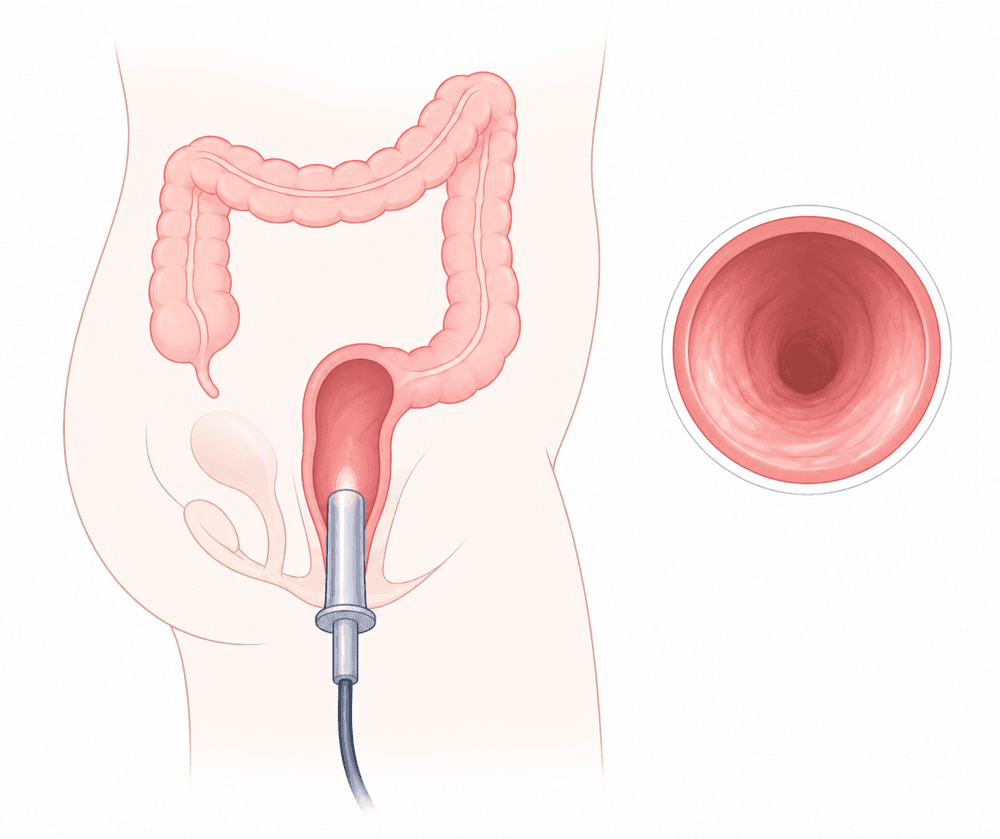
Diagnosing an anal fistula involves confirming the tract's location, depth, and relationship to the sphincter muscles before any treatment decision is made.
Medical history and physical examination
The process begins with a detailed medical history, focusing on symptoms and previous perianal infections or abscesses. A physical examination, including a digital rectal examination (DRE), is then conducted to identify abnormal openings, tenderness, or palpable tracts near the anus.
MRI fistulogram
Magnetic Resonance Imaging (MRI) is the gold standard for mapping complex anal fistulas, particularly high and recurrent cases. It shows the full extent of the tract, its relationship to the sphincter muscles, and any secondary extensions, which are all critical information before surgical planning begins.
Endoanal ultrasound
Endoanal ultrasound provides detailed real-time images of the fistula tract and the surrounding sphincter tissues. It is particularly useful for mapping lower, simpler fistulas in a clinic setting.
Examination under anaesthesia (EUA)
For fistulas that are difficult to assess fully in the clinic, an EUA offers a thorough mapping of the tract before deciding on the surgical approach.
After the operation
Recovery
Recovery after anal fistula surgery varies by procedure type. While most patients can go home the same day after simple procedures, complex or staged procedures may require more time and closer follow-up.
Fistulotomy
Day surgery
LIFT, advancement flap, VAAFT
Day or overnight surgery
Seton placement
Staged
Recovery timelines are indicative only and will vary depending on the complexity of the fistula, the procedure performed, and individual healing. A professional consultation is necessary to determine the expected recovery.
Looking after the wound
After fistula surgery, your specialist will provide detailed wound care instructions before discharge.
Contact the clinic immediately if you experience fever, heavy bleeding, worsening pain, or difficulty passing urine after surgery.
Staying clear of it
Preventing recurrence
Preventing anal fistulas involves addressing their underlying causes and following through with aftercare post-surgery.
Treat perianal abscesses early
The way to lower the risk of a fistula is to seek prompt treatment for a perianal abscess. Early surgical drainage reduces the risk of a fistula tract forming, so do not allow an abscess to self-rupture or leave it untreated.
Manage IBD and underlying conditions
For patients with Crohn's disease or ulcerative colitis, keeping the underlying condition well controlled reduces the risk of fistula formation.
Maintaining good anal hygiene and a high-fibre diet also lowers the risk of abscess formation.
Post-surgery aftercare to prevent recurrence
Following your surgeon's wound care instructions carefully is the most important factor in reducing recurrence risk. Attend regular follow-up appointments so that new tracts can be detected early.
Paying for it
Anal fistula surgery cost in Singapore, MediSave and insurance
Anal fistula surgery is MediSave-claimable (source: CPF Board, using MediSave for hospitalisation, opens in a new tab), and an Integrated Shield Plan can offset much of the rest. The figures below are MOH’s published benchmarks and 2023 bills (source: Ministry of Health, Singapore, fee benchmarks and bill information for SF833A, opens in a new tab). Your written estimate comes before the date is set.
Anal fistula surgery cost in Singapore
- MediSave can cover, up toFor a simple fistula: the $1,120 operation limit (source: Ministry of Health, MediSave withdrawal limits, opens in a new tab) under Table 2B (source: Ministry of Health, Singapore, Table of Surgical Procedures, updated 1 June 2026, opens in a new tab), plus up to a further $830 a day of day-surgery charges.
- $1,950
- MOH surgeon fee benchmarkFistulotomy or fistulectomy for a simple fistula, TOSP SF833A.
- $2,200 to $3,600
- Anaesthetist fee benchmark
- $700 to $1,000
- Private hospital day-surgery fees benchmark
- $2,300 to $3,500
- Typical total bill, day surgeryMOH's median of bills actually paid at private hospitals in 2023. Half of patients paid between $7,301 and $9,330.
- $8,082
- Typical total bill, with an overnight stayRange $10,114 to $14,297.
- $11,559
- MediSave operation limit, Table 3CPlus the same $830 a day of day-surgery charges, so up to $2,750 for a day-surgery episode.
- $1,920
- MOH surgeon fee benchmarkHigh, complex and recurrent fistulectomy (source: Ministry of Health, Singapore, fee benchmarks and bill information for SF832A, opens in a new tab). A staged repair, such as a seton followed by LIFT or a flap, is two episodes, not one.
- $3,500 to $4,800
- Anaesthetist fee benchmark
- $850 to $1,400
- Typical total bill, day surgeryRange $9,778 to $11,529.
- $10,629
- Typical total bill, with an overnight stayRange $12,570 to $19,240.
- $14,776
Complex or recurrent fistula, TOSP SF832A
Benchmarks are before GST; total bills include GST.
MediSave
up to $1,950
Typical total bill, day surgery: $8,082.
Common questions
Questions about anal fistula surgery.
Which doctor treats an anal fistula in Singapore?
Can an anal fistula heal without surgery?
Will fistula surgery affect my bowel control?
How long does recovery take?
How do I look after the wound after fistula surgery?
After fistula surgery, your specialist will provide detailed wound care instructions before discharge.
Sitz baths (warm water soaking for 10 to 15 minutes) two to three times daily are recommended to keep the area clean and reduce discomfort.
Daily wound checks at the clinic may also be required in the weeks following fistulotomy.
A high-fibre diet and adequate fluid intake help keep stools soft and reduce straining at the wound site. Laxatives may be prescribed for the short-term if needed.
Can I exercise while I have a fistula?
Can an anal fistula come back after surgery?
Is it dangerous to leave an anal fistula untreated?
Can children get anal fistulas?
Do you offer laser treatment for anal fistula?
How much does anal fistula surgery cost in Singapore?
An overnight stay, staged operations such as a seton followed by LIFT or a flap, and the hospital you choose all move the figure.
Contact our clinic for a written fee estimate before any date is set.
Is anal fistula surgery MediSave claimable?
Anal fistula surgery is a MediSave-claimable procedure for Singaporeans and Permanent Residents. The claimable amount depends on the TOSP surgical code assigned to your procedure: SF833A for a simple fistula, SF832A for a complex or recurrent one.
Our clinic staff will advise on your specific code and applicable withdrawal limits at consultation.
Does my Integrated Shield Plan cover anal fistula surgery?
Most Integrated Shield Plans cover anal fistula surgery when medically necessary.
Our clinic is on the panel of most major insurers. Where your plan is accepted, cashless billing is arranged through pre-authorisation with your insurer.
Get it looked at
A persistent discharge, or an abscess that keeps coming back? Get it assessed.
If you have a persistent discharge near the anus, a recurring abscess in the same location, or a previous fistula that has not fully resolved, a specialist assessment is the right next step. Dr Sulaiman will assess the fistula and recommend a surgical treatment plan that prioritises bowel control.
- Self-referrals and GP-referred patients
- Same-week appointments
- Second opinions for complex or recurrent cases
- Patients under Medisave and Integrated Shield Plans
Consult Dr Sulaiman for a thorough assessment and a personalised treatment plan.