Anal and perianal
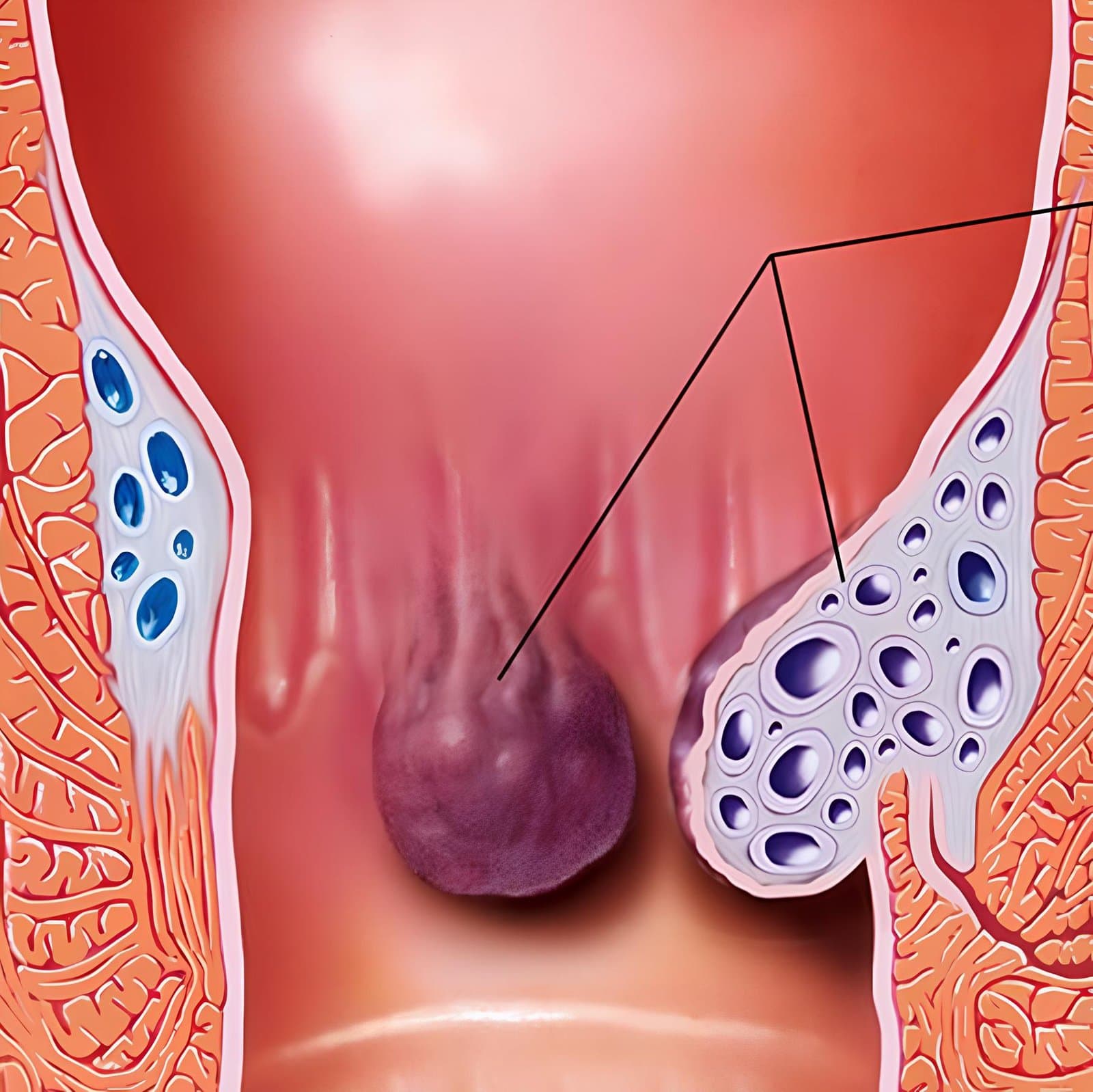
Haemorrhoids (piles) are common, under-treated, and very treatable.
Haemorrhoids, also spelled hemorrhoids and commonly called piles, are swollen vascular cushions in the anal canal. Rectal bleeding should never be self-diagnosed: it is also a symptom of polyps, inflammatory bowel disease and colorectal cancer.
In short
1-4
Grades
Internal haemorrhoids are graded by prolapse, and the grade determines the treatment.
5
Minutes
Rubber band ligation takes under five minutes and needs no anaesthesia.
4-5
Out of 10
Honest first-week pain after conventional haemorrhoidectomy, settling to 2 to 3 by week two.
No
Self-diagnosis
Rectal bleeding is also a symptom of polyps, inflammatory bowel disease and colorectal cancer.
Meet Dr Sulaiman
Why Dr Sulaiman became a colorectal surgeon
Before you trust someone with something this personal, hear in his own words why he does this work, and how he looks after the people in his care.
- MBChB (Sheffield), M.Med (Surgery), FRCSEd (General Surgery)
- Consults in English and Malay
- MOH Fellowship, Peter MacCallum Cancer Centre, Melbourne
- Singapore Health Quality Service Star Award 2023
- Dean's Honour Roll for Teaching
Five clinics across Singapore
ORCHARD / NAPIER
Gleneagles Medical Centre
6 Napier Road #06-08, Singapore 258499
NOVENA
Mount Elizabeth Novena
38 Irrawaddy Road, #10-48/49, Singapore 329563
JOO CHIAT / EAST COAST
Parkway East Hospital
#05-08, 319 Joo Chiat Place, Singapore 427989
THOMSON
Mount Alvernia Hospital
#08-62, Medical Centre D, 820 Thomson Road, Singapore 574623
FARRER PARK
Farrer Park Medical Centre
#14-12, 1 Farrer Park Station Road, Singapore 217562
Before you self-treat
When to see a doctor
Rectal bleeding should never be self-diagnosed. I have seen patients treat themselves for haemorrhoids for months when the cause was something else entirely. A clinical assessment is the only reliable way to confirm the diagnosis before any treatment begins.
Dr Sulaiman's perspective
Haemorrhoids are one of the most common conditions I treat, and one of the most under-treated, because patients wait far longer than they should before coming in.
Almost every week, a patient sits across from me having spent months managing symptoms quietly with pharmacy creams, convinced it is minor or too embarrassed to have it properly assessed.
Two things matter when you come to see me. First: are we actually dealing with haemorrhoids? Rectal bleeding, discomfort, and incomplete emptying are also symptoms of polyps, inflammatory bowel disease, and colorectal cancer. I will not assume. Second: what is the least disruptive treatment that genuinely solves the problem, not just manages it temporarily.
I offer the full range, from office ligation to laser, stapled haemorrhoidopexy, and conventional haemorrhoidectomy. Choosing between them is not a simple ladder where you start at the bottom and work up. Each technique suits a specific patient, and the decision depends on your grade, anatomy, and circumstances.
One thing I tell every surgical patient honestly: the more definitive the treatment, the more uncomfortable the initial recovery. That is information you deserve before you decide.
What you are feeling
What haemorrhoids feel like
Symptoms depend on whether haemorrhoids are internal or external, and their grade. The most common include:
- Bright red rectal bleeding on tissue paper or in the toilet bowl
- Itching or irritation around the anal area
- Discomfort or pressure during or after bowel movements
- A soft lump or swelling near the anus
- Mucus discharge after bowel movements
- A feeling of incomplete evacuation
How these symptoms tend to present in women, including during pregnancy and after childbirth, is covered in the guide to haemorrhoids in women.
The decision key
How haemorrhoid grading works, 1 to 4
Haemorrhoids, commonly called piles and spelled hemorrhoids in American English, are swollen vascular cushions in the anal canal.
Internal piles are graded 1 to 4 based on prolapse. The grading determines treatment.
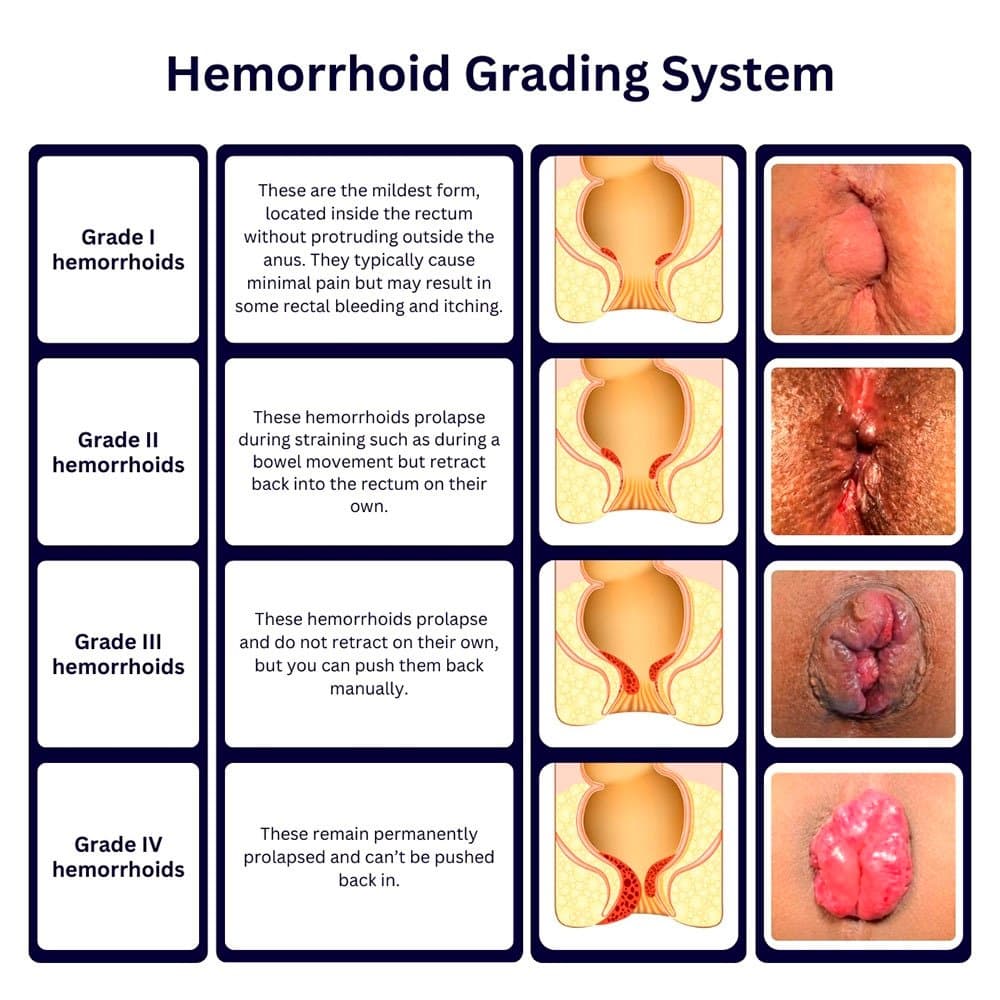
External piles sit outside this grading and are classified separately. When thrombosed, meaning a blood clot forms within the tissue, they cause acute pain and swelling that often requires prompt intervention. A lump that appears with straining is sometimes not piles at all but a rectal prolapse, which is assessed and treated differently.
Office treatment
Treating haemorrhoids without surgery
Non-surgical options work well for Grade 1 and Grade 2 haemorrhoids. For higher grades, they manage symptoms but will not resolve the underlying problem.
Creams, fibre and stool softeners
Topical piles treatment creams and ointments reduce itching and inflammation. They do not shrink or remove the haemorrhoid. Stool softeners, fibre supplements, and adequate hydration address the root cause (straining) and are useful as part of a broader management plan.
Appropriate for Grade 1 haemorrhoids. Billed as standard outpatient fees. Not MediSave-claimable.
Rubber band ligation
Rubber band ligation is my first-line office procedure for Grade 1 and Grade 2 internal haemorrhoids. A small elastic band is placed at the base of the haemorrhoid, cutting off its blood supply. The tissue shrinks and detaches within one to two weeks. The procedure takes under five minutes and requires no anaesthesia. Most patients return to normal activity the same day. There is typically mild pressure or discomfort for 24 to 48 hours afterwards.
Ligation has one important limitation: haemorrhoids that are too large to band effectively, or that have failed ligation previously, are not good candidates for repeat ligation. That is where laser haemorrhoidoplasty becomes relevant.
Billed as an outpatient clinic procedure. Generally not MediSave-claimable.
The operations
Surgical treatment, and what it costs
Surgery is considered when haemorrhoids are large, prolapsed, thrombosed, or have not responded to non-surgical management. All procedures are performed under anaesthesia as day surgery. The piles surgery page sets out the same three operations alongside their recovery and their published costs.
Laser haemorrhoidoplasty
Laser haemorrhoidoplasty fills a specific clinical gap. It is the right option for patients whose haemorrhoids are too large or symptomatic for rubber band ligation (where ligation has failed or is unlikely to work) but who do not yet have the degree of prolapse that makes conventional surgery necessary.
A small opening is made to introduce the laser fibre into the haemorrhoidal tissue, which coagulates and shrinks it from within. This wound typically heals within seven to ten days. During this period, patients may experience some discomfort and a small amount of bleeding, both of which are normal and expected.
Post-operative discomfort is significantly less than conventional haemorrhoidectomy, and most patients return to normal activity within a few days.
I use laser haemorrhoidoplasty primarily for Grade 2 to Grade 3 haemorrhoids in this middle range. For patients with significant prolapse, I prefer stapled haemorrhoidopexy or conventional haemorrhoidectomy: they have superior long-term outcomes for that presentation. Laser is not the right tool for every case, and I will tell you clearly if it is not right for yours.
Laser haemorrhoidoplasty is billed under the same MOH table code as conventional haemorrhoidectomy (TOSP SF836A (source: Ministry of Health, Singapore, fee benchmarks and bill information for SF836A, opens in a new tab)). Cost figures reflect private hospital day surgery.
| Cost Component | Amount |
|---|---|
| MOH recommended surgeon fee | $3,000 to $3,800 |
| Anaesthetist fee | $700 to $1,000 |
| Hospital fees | $3,000 to $4,300 |
| Typical total bill | $10,200 |
| Total bill range | $8,894 to $11,590 |
Before MediSave and MediShield Life payouts. Actual out-of-pocket costs may be lower depending on Integrated Shield Plan coverage.
Stapled haemorrhoidopexy
Stapled haemorrhoidopexy is a technique I particularly favour for haemorrhoids that have prolapsed around the full circumference of the anal canal (what is clinically referred to as circumferential prolapse), combined with significant Grade 3 prolapse. A circular stapling device repositions the prolapsed tissue back into the anal canal and reduces its blood supply, rather than removing it entirely. The result is less post-operative pain and a faster recovery than conventional haemorrhoidectomy.
For the right patient, this is an excellent procedure. Some studies report higher long-term recurrence rates compared to conventional haemorrhoidectomy, and I discuss that trade-off openly before you decide.
When it comes to the final choice of surgical technique: under general anaesthesia, the sphincter muscles relax completely, allowing me to assess your anatomy accurately in a way that is simply not possible in clinic. That assessment is what determines whether stapled haemorrhoidopexy or conventional haemorrhoidectomy is the right choice for you. I will explain both options at consultation so you understand what to expect either way.
Cost figures are drawn from MOH recommended fees and transacted bill data (TOSP SF837A (source: Ministry of Health, Singapore, fee benchmarks and bill information for SF837A, opens in a new tab)), reflecting private hospital day surgery.
| Cost Component | Amount |
|---|---|
| MOH recommended surgeon fee | $3,400 to $4,200 |
| Anaesthetist fee | $700 to $1,000 |
| Hospital fees | $4,300 to $5,100 |
| Typical total bill | $10,837 |
| Total bill range | $10,134 to $11,556 |
Before MediSave and MediShield Life payouts. Actual out-of-pocket costs may be lower depending on Integrated Shield Plan coverage.
Conventional haemorrhoidectomy
Conventional haemorrhoidectomy (hemorrhoidectomy in American spelling) is the most durable of the excisional options in the published trial evidence. It carries a lower long-term recurrence rate than stapled haemorrhoidopexy and than transanal dearterialisation, though against laser haemorrhoidoplasty the pooled recurrence rates are not significantly different. I use LigaSure vessel-sealing technology in place of conventional diathermy, and the Cochrane review of twelve randomised trials found that means less pain on the first day after surgery and a return to work about five days earlier. It is the procedure I recommend for Grade 3 to Grade 4 haemorrhoids, large or thrombosed external piles, and cases where other treatments have not provided lasting relief.
Cost figures are drawn from MOH recommended fees and transacted bill data (TOSP SF836A (source: Ministry of Health, Singapore, fee benchmarks and bill information for SF836A, opens in a new tab)), reflecting private hospital day surgery.
| Cost Component | Amount |
|---|---|
| MOH recommended surgeon fee | $3,000 to $3,800 |
| Anaesthetist fee | $700 to $1,000 |
| Hospital fees | $3,000 to $4,300 |
| Typical total bill | $10,200 |
| Total bill range | $8,894 to $11,590 |
Before MediSave and MediShield Life payouts. Actual out-of-pocket costs may be lower depending on Integrated Shield Plan coverage.
The honest part
Haemorrhoid surgery recovery, honestly
I want to be direct about recovery.
Most patients rate the first week at 4 to 5 out of 10. By the second week it is usually down to 2 to 3, and what lingers after that, 1 to 2 out of 10, shows up mainly with bowel movements. The wound also produces a yellowish mucoid discharge for two to three weeks. That is normal healing, not a setback.
Post-haemorrhoidectomy pain is real. Part of what drives it is sphincteric spasm, something most patients have no prior experience with. Knowing what to expect makes recovery meaningfully easier than being surprised by it.
Paying for it
MediSave and insurance
Surgical procedures are MediSave-claimable (source: CPF Board, using MediSave for hospitalisation, opens in a new tab) and may be covered under Integrated Shield Plans. Non-surgical options including creams and rubber band ligation are generally not MediSave-claimable and are billed as outpatient fees. Confirm your specific coverage with your insurer before the procedure.
Common questions
Questions about piles.
Can haemorrhoids go away on their own?
Grade 1 and some Grade 2 haemorrhoids can settle with dietary changes, hydration, and topical treatment. Haemorrhoids that are prolapsing, persistently bleeding, or causing significant discomfort are unlikely to resolve without intervention. More importantly, persistent rectal bleeding should always be assessed by a specialist before assuming it is haemorrhoid-related.
Why can't you tell me which operation I need before surgery?
Under general anaesthesia, the sphincter muscles relax completely, allowing accurate assessment of anatomy that is not achievable in clinic. That assessment determines whether stapled haemorrhoidopexy or conventional haemorrhoidectomy is the better option for your specific case. A surgeon who commits firmly to one technique before that assessment either has extensive prior knowledge of your specific presentation or is not giving you the full picture.
Is laser better than conventional surgery?
It depends on your presentation. Laser haemorrhoidoplasty works best for patients whose haemorrhoids are beyond what ligation can manage but do not yet have significant prolapse. For patients with prolapse, stapled haemorrhoidopexy or conventional haemorrhoidectomy delivers superior long-term outcomes. Laser is a genuinely useful technique for the right patient, not the right answer for every patient.
How do I know my bleeding is haemorrhoids and not something more serious?
You cannot know without a clinical assessment. Rectal bleeding, changes in bowel habit, and discomfort are symptoms shared by haemorrhoids and by conditions requiring a very different response. A consultation is the only way to establish what is actually going on.
What can I do to treat piles at home?
Fibre, enough water, and not straining or sitting long on the toilet address the root cause. Topical creams settle itching and swelling, and warm sitz baths ease discomfort. Home care suits the early grades; bleeding that persists, or a lump that stays out, needs assessment rather than another cream.
Get it looked at
Been managing symptoms quietly for months? Get a clear assessment.
The right haemorrhoid treatment requires a proper clinical assessment of your grade, anatomy, symptoms, and circumstances. A website, including this one, is a starting point, not a substitute. Haemorrhoids can affect daily life in ways that are hard to talk about, from persistent discomfort to the quiet fear that it might be something more serious. If you have been googling your symptoms and are not sure what to do next, that is exactly when a consultation helps most. A clear assessment tells you what you are dealing with, what your options are, and what you do not need to worry about.