Colon polyps, explained by a colorectal surgeon
What colon polyps are, why they matter, and how they are removed.
If a colonoscopy has turned up a polyp, the question you want answered is how serious it is, and that depends entirely on the type. Most polyps are benign and pose no real cancer risk; a smaller share are precancerous, which is why every polyp found is removed and sent for pathology.
Written by Dr Sulaiman Bin Yusof, Colorectal and General Surgeon. MBChB (Sheffield), M.Med (Surgery), FRCSEd (General Surgery).
Most weeks in clinic, I sit with a patient whose colonoscopy turned up a polyp they did not expect, and the first question is almost always the same: should I be worried. The honest answer is that it depends on the type, and the type we confirm after the polyp has been removed and examined under the microscope.
+65 8491 1525
The reassuring part comes first, because it is the larger part.
Colon polyps are among the most common findings at routine colonoscopy. The majority are harmless, cause no symptoms, and most people who carry them would never know without screening. That part is reassuring, and I say it first.
A smaller share of polyps are precancerous, and over years some of those can progress to colorectal cancer. That is the reason we look for them, remove them, and base your follow-up interval on what the pathology shows.
What are colon polyps?
Colon polyps are abnormal growths that develop from the inner lining of the colon (the large intestine) or rectum. They form when cells in that lining divide more than they should, producing a small projection of tissue where the wall should be smooth.
They vary in shape and size. Some are flat against the lining, some sit on a broad base (sessile), and others hang from a stalk (pedunculated). A polyp can range from a couple of millimetres to several centimetres.
The polyp itself is a finding, not yet a diagnosis. What it means for you comes from the pathology after removal.
10 to 15
Years a polyp usually takes to turn cancerous
Source: HealthHub, Singapore
A polyp forms
Small, and it causes no symptoms
It grows slowly
Usually over 10 to 15 years
Removed at colonoscopy
That polyp cannot become a cancer
Types of colon polyps.
How serious a polyp is depends on what type it turns out to be. Clinical classification divides polyps into two broad groups, non-neoplastic and neoplastic, and the difference shapes your follow-up plan.
Non-neoplastic polyps
Non-neoplastic polyps are generally harmless and unlikely to become cancerous. The main types are:
- Hyperplastic polyps, the most common variety, usually small and found in the lower colon, with very low cancer risk
- Inflammatory polyps, which occur in patients with Crohn’s disease or ulcerative colitis, and although they are not cancerous in themselves, they signal chronic inflammation that raises overall colorectal risk. Each form of inflammatory bowel disease has its own page: Crohn's disease and ulcerative colitis.
- Hamartomatous polyps, associated with rare genetic syndromes such as Peutz-Jeghers, typically single and harmless in children but higher risk when multiple
Even non-neoplastic polyps are typically removed during colonoscopy. The reason is straightforward: I cannot tell what a polyp is by looking at it through the scope, so complete removal followed by histology is standard practice.
Neoplastic (precancerous) polyps
Neoplastic polyps carry malignant potential, which is the reason their detection and removal matter. They include:
- Adenomatous polyps (adenomas), the most clinically significant group, including tubular adenomas, tubulovillous adenomas, and villous adenomas
- Serrated polyps, including sessile serrated lesions (SSLs) and traditional serrated adenomas (TSAs)
| Type | Group | What it means |
|---|---|---|
| Hyperplastic | Non-neoplastic | The most common variety; usually small and found in the lower colon; very low cancer risk. |
| Inflammatory | Non-neoplastic | Not cancerous in themselves; they occur with Crohn's disease or ulcerative colitis and signal chronic inflammation that raises overall colorectal risk. |
| Hamartomatous | Non-neoplastic | Associated with rare genetic syndromes such as Peutz-Jeghers; typically single and harmless in children, higher risk when multiple. |
| Adenomatous (adenomas) | Neoplastic | The most clinically significant group: tubular, tubulovillous and villous adenomas. Precancerous. |
| Serrated | Neoplastic | Sessile serrated lesions (SSLs) and traditional serrated adenomas (TSAs). Precancerous. |
10mm
The size at which a polyp is called advanced
Source: Dr Sulaiman Bin Yusof, clinical practice
Classification matters because it dictates follow-up. The 2020 consensus of the US Multi-Society Task Force on Colorectal Cancer sets the next colonoscopy at 7 to 10 years after one or two small tubular adenomas, 3 to 5 years after three or four, 3 years after five to ten, and 3 years after any adenoma of 10 mm or more or any with villous features or high-grade dysplasia, against 10 years after a normal colonoscopy in someone at average risk (Gupta et al., Gastroenterology, 2020). The interval is set by what the pathologist finds, which is why the report matters as much as the removal.
Colon polyp symptoms, and why there usually are none.
The majority of colon polyps produce no symptoms at all, which is the principal reason regular colonoscopy screening in Singapore is worth the effort. Polyps are typically found because someone went looking, not because they made themselves known.
When symptoms do appear, they are more often associated with larger polyps, or polyps that have undergone significant change. The symptoms worth bringing to a consultation are:
- Rectal bleeding, or blood in your stool, which may appear as red streaks on toilet paper, or cause stools to look dark and tarry
- Persistent changes in bowel habits lasting more than a week, including new constipation or diarrhoea
- Mucus in the stool in larger-than-usual amounts, particularly alongside other symptoms
- Unexplained fatigue or shortness of breath, which can point to iron-deficiency anaemia from slow, occult bleeding
- Lower abdominal pain or cramping, particularly if a larger polyp is causing partial obstruction
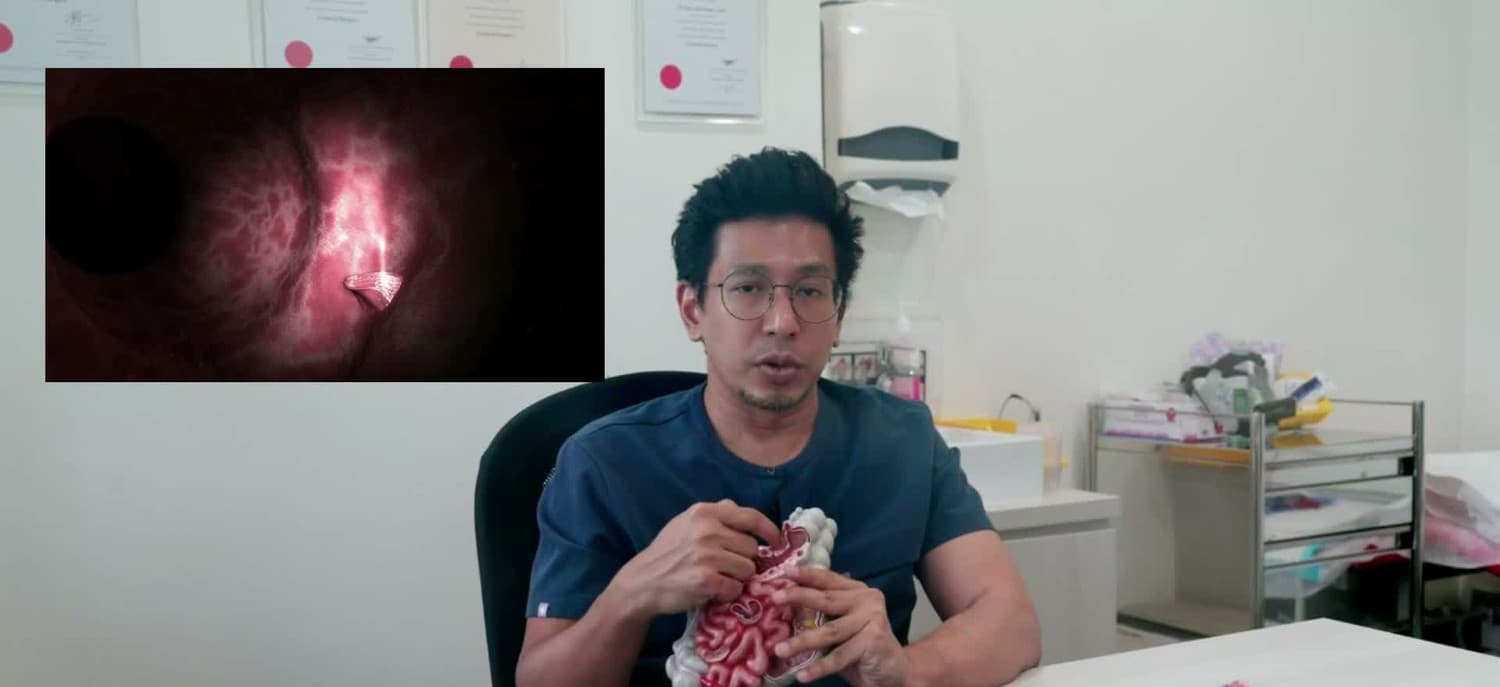
None of these symptoms are diagnostic on their own. They are reasons to have the colon properly assessed, not to assume.
What the test involves, and what the day looks like, is on the colonoscopy page.
Do colon polyps need to be removed?
Complete removal is standard practice for every polyp we detect at colonoscopy. I cannot reliably judge a polyp’s malignant potential by appearance alone, even with high-definition equipment, and the answer for any given polyp is one only pathology can give.
Found at colonoscopy
Usually while looking for something else
Removed the same sitting
No separate procedure is required
Sent for pathology
Which is what names the type
Your interval is set
From what the pathology shows
Colon polyp removal, or polypectomy, is almost always performed during the same colonoscopy in which the polyp is found, with no separate procedure required. The technique depends on the size and shape:
- Small polyps are removed using biopsy forceps
- Larger polyps are removed with a wire snare loop, often with electrocautery to seal the base
- Very large polyps that cannot be safely removed endoscopically may require laparoscopic surgery, or in a small number of cases, open surgery
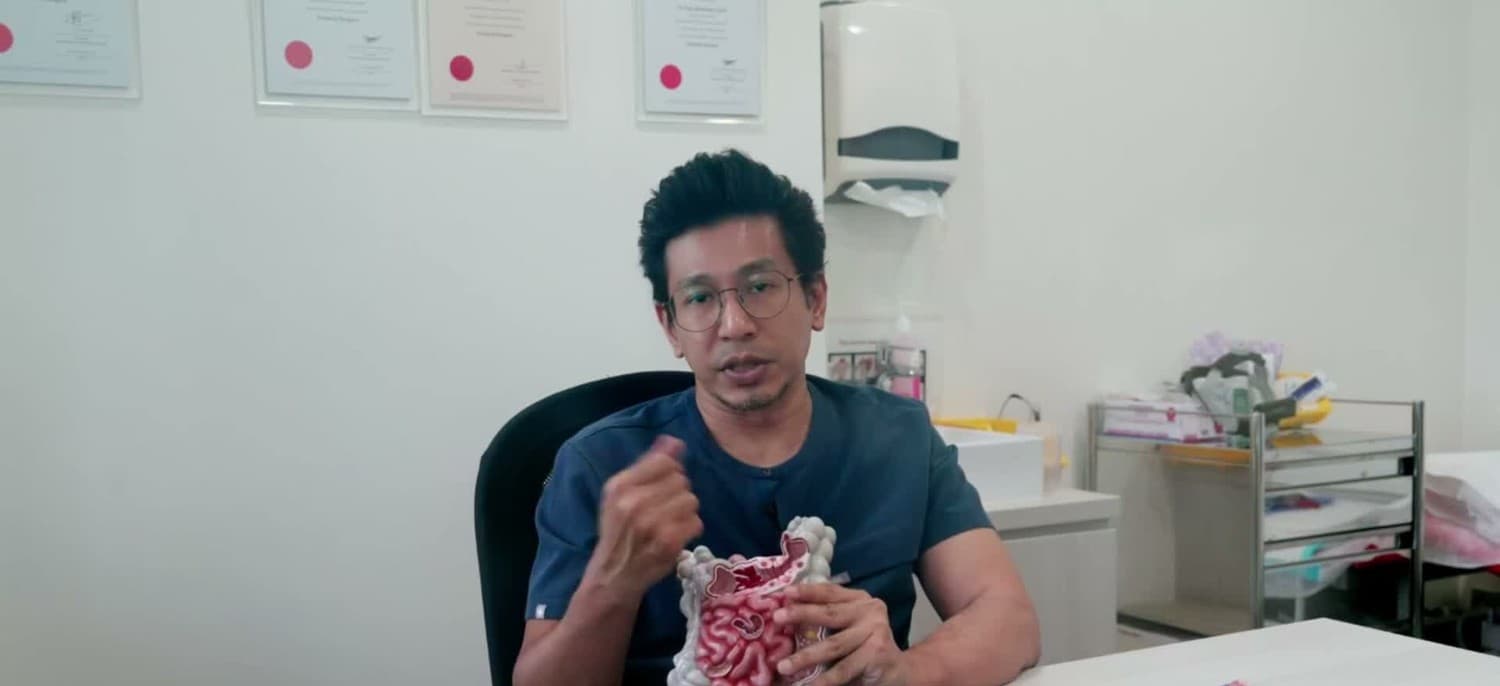
Every polyp removed is sent for pathology. The result is what determines what happens next.
After colon polyp removal: recovery and follow-up.
Colon polyp removal recovery is straightforward for most patients. Polypectomy at colonoscopy is a day procedure, and most patients return to normal activities within 1 to 2 days. Mild bloating or cramping after the procedure is normal and settles quickly.
1 to 2
Days back to normal activities, for most patients
Source: Dr Sulaiman Bin Yusof, clinical practice
| What was done | What recovery looks like |
|---|---|
| Polypectomy at colonoscopy | A day procedure. Most patients return to normal activities within 1 to 2 days; mild bloating or cramping afterwards is normal and settles quickly. |
| Endoscopic mucosal resection of a larger polyp | Recovery is longer. The specific instructions your surgeon gives you take precedence over general guidance. |
| Laparoscopic or open surgery | Recovery is longer in these cases too. Follow your treating surgeon's instructions. |
What to eat after colon polyp removal
In the first 24 hours, I generally advise a soft, low-fibre diet to let the polypectomy site settle. Clear fluids, soft-cooked foods, and avoiding spicy, high-fibre, or rough foods for a short period support healing.
One caveat worth keeping in mind: follow your treating doctor’s specific guidance rather than any general recommendation. Advice varies with the size and number of polyps removed, and with the technique used. What suits a single small hyperplastic polyp is not what suits an endoscopic resection of a large adenoma.
Can polyps regrow after removal?
A polyp that has been completely removed does not regrow in the same place. The tissue is gone, the site heals over, and that polyp is not coming back. What can happen is that new polyps develop elsewhere in the colon over time, which is the reason your follow-up colonoscopy interval matters.
The qualification is measured, not pedantic: in the CARE study (Pohl et al., Gastroenterology, 2013), 10.1% of neoplastic polyps removed at colonoscopy were incompletely resected, and the rate rose with polyp size and for sessile serrated polyps. Complete removal is the condition the reassurance above rests on.
The intervals I work with sit roughly in this range:
- Low-risk findings: 3 to 5 years between colonoscopies
- High-risk findings: 1 to 3 years between colonoscopies
Years to the next colonoscopy, one mark per year
- Low-risk findings
- 3 to 5 years
- High-risk findings
- 1 to 3 years
Source: Dr Sulaiman Bin Yusof, clinical practice
The marks show the middle of each range and the figures beside them are the range itself. Your own interval is not read off a chart.
The exact interval is determined by your pathology results, along with the number, size, and type of polyps removed. For some patients, a single hyperplastic polyp means we are back to the standard screening cycle. For others, a high-grade adenoma or multiple advanced polyps means a closer watch.
The questions patients ask after a polyp is found.
How serious are polyps in the colon?
That depends entirely on the type. Most polyps are benign and pose no real cancer risk. Adenomatous polyps and serrated polyps are precancerous, and although the majority will never progress to cancer, some do over the course of years. The seriousness comes from not knowing in advance which polyp belongs to which category, which is why I send every polyp removed for pathology.
At what age should I start screening for colon polyps in Singapore?
For someone of average risk, screening colonoscopy from age 50 is the standard recommendation. For those with a family history of colorectal cancer or polyps, I generally start earlier, around age 40, or 10 years before the youngest affected relative was diagnosed, whichever comes first. The right age is a conversation, not a fixed rule.
Are colon polyps hereditary?
Most are not. Most polyps develop sporadically over time, related to age, lifestyle, and chance. A meaningful minority are linked to inherited conditions, such as familial adenomatous polyposis (FAP) and Lynch syndrome. A family history of polyps or colorectal cancer is a reason to screen earlier and more often, and worth flagging when we plan your assessment.
Does every polyp have to be taken out?
Every polyp removed is sent for pathology. The result is what determines what happens next.
How long does recovery take after a polyp is removed?
For most people, one to two days. Removing a polyp at colonoscopy is a day procedure, and mild bloating or cramping afterwards is normal and settles quickly. The picture changes if a larger polyp required endoscopic mucosal resection, or if laparoscopic surgery was needed. Recovery is longer in those cases, and the specific instructions your surgeon gives you take precedence over anything written here in general terms.
What should I eat after colon polyp removal?
For the first 24 hours, soft and low in fibre, so the site where the polyp came off is left alone to settle. Clear fluids and soft-cooked foods are the usual advice, and it is worth avoiding spicy, high-fibre or rough food for a short period. Follow your treating doctor's specific guidance rather than any general recommendation, because advice varies with the size and number of polyps removed, and with the technique used.
What percentage of colon polyps are cancerous?
Most polyps found at colonoscopy are not cancer. The ones that matter are adenomas, which are not cancerous when removed but can become cancer over years if left in place, which is why they are taken out at the same sitting and sent for examination. The pathology report, not the appearance of the polyp on screen, tells you what it was and how soon you need to be checked again.
Do I need another colonoscopy after polyps are removed?
Usually yes, and the pathology result sets the interval. The 2020 US Multi-Society Task Force consensus puts the next colonoscopy at 7 to 10 years after one or two small tubular adenomas, 3 to 5 years after three or four, and 3 years after five or more, after any adenoma of 10 mm or larger, or after one with villous features or high-grade dysplasia. A normal colonoscopy in someone at average risk is repeated at 10 years. Your surgeon gives you a date for your own report rather than a general one.
Related reading
Where this leads next.
The author
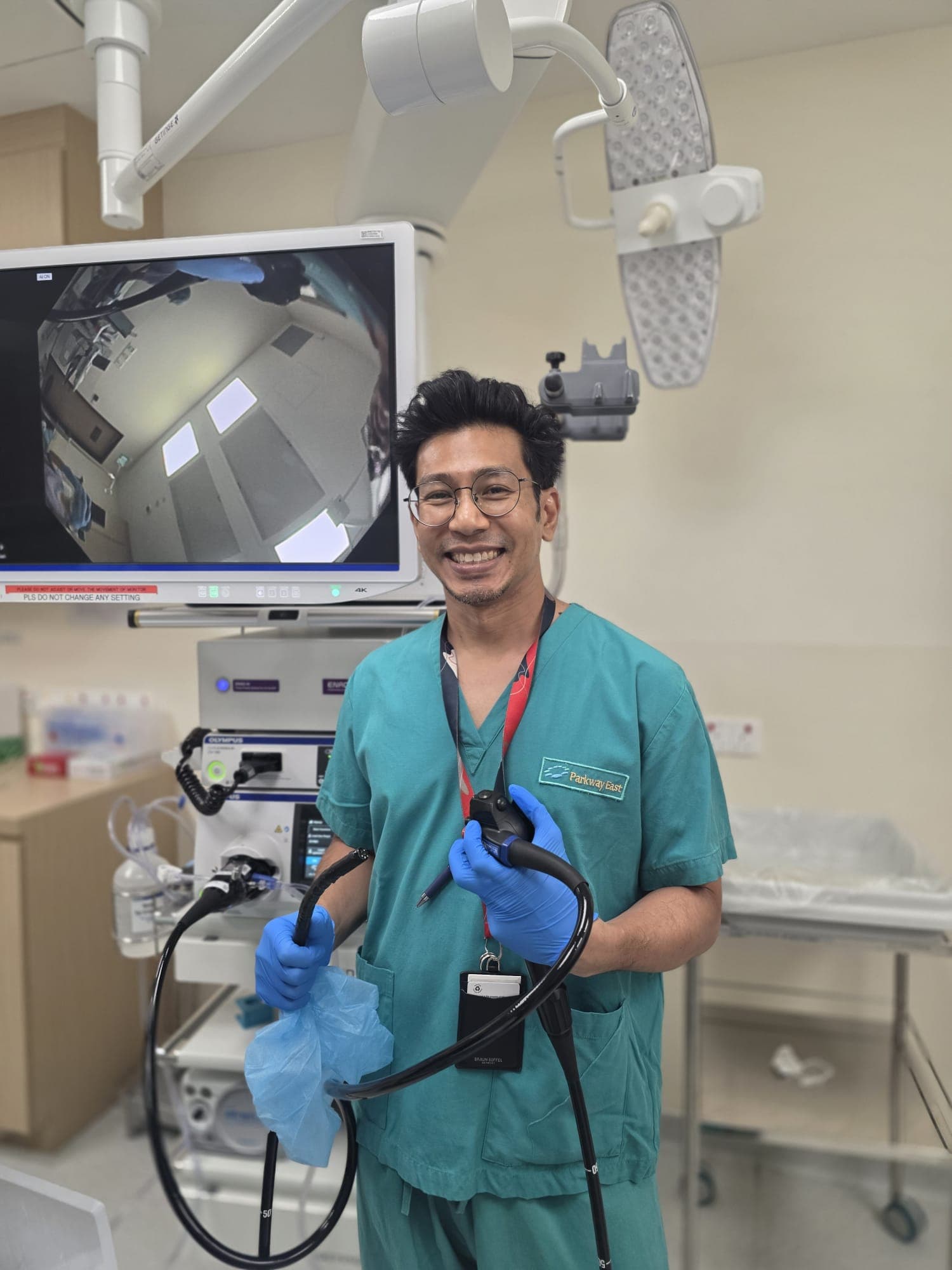
Dr Sulaiman Bin Yusof
Senior Consultant Colorectal and General Surgeon, with over 20 years in surgery.
In his own words
I am a Senior Consultant Colorectal and General Surgeon in Singapore, practising at Gleneagles, Mount Elizabeth Novena, Parkway East, Mount Alvernia, and Farrer Park. I perform the colonoscopy as part of a full assessment, remove polyps where found, send them for pathology, and set your follow-up interval based on the result.
He wrote this article and is responsible for its clinical content.
- Qualifications
- MBChB (Sheffield)
- M.Med (Surgery)
- FRCSEd (General Surgery)
- Fellowship
- Peter MacCallum Cancer Centre, Melbourne
- Previously
- Former Director of Endoscopy, Changi General Hospital
- Also
- Visiting Consultant, Changi General Hospital
Disclaimer: The information here is for general informational purposes only and does not replace consultation, diagnosis, or treatment by a qualified medical professional. Symptoms vary between individuals; if any of the warning signs above apply to you, seek a clinical evaluation.
Getting seen
Most polyps are harmless. The type is what decides, and only pathology can name it.
If you have been told you have polyps, or you are due a screening colonoscopy, consult a colorectal doctor in Singapore to have it properly assessed.
Contact us on WhatsApp to arrange a consultation.
+65 8491 1525