Anal and perianal
Perianal abscess surgery and treatment by a colorectal surgeon.
A perianal abscess, also called an anal abscess, is a pus-filled swelling beside the anus. It does not clear on antibiotics alone and rarely settles by itself, because the pus has to be physically released.
In short
1
Working day
What the clinic aims for on an urgent perianal case, across five locations.
1-2
Weeks
Usual recovery once the abscess has been drained.
38
Degrees
A fever at or above this alongside the pain means A&E, not a clinic appointment.
No
Referral
Self-referrals are accepted. A GP referral is welcome but not required.
The surgeon
Perianal abscess surgeon, Dr Sulaiman Bin Yusof
Colorectal surgeon with over 20 years of surgical experience, seeing patients at five clinics in Singapore.
- MBChB (Sheffield), M.Med (Surgery), FRCSEd (General Surgery)
- Consults in English and Malay
- MOH Fellowship, Peter MacCallum Cancer Centre, Melbourne
- Singapore Health Quality Service Star Award 2023
- Dean's Honour Roll for Teaching
Five clinics across Singapore
ORCHARD / NAPIER
Gleneagles Medical Centre
6 Napier Road #06-08, Singapore 258499
NOVENA
Mount Elizabeth Novena
38 Irrawaddy Road, #10-48/49, Singapore 329563
JOO CHIAT / EAST COAST
Parkway East Hospital
#05-08, 319 Joo Chiat Place, Singapore 427989
THOMSON
Mount Alvernia Hospital
#08-62, Medical Centre D, 820 Thomson Road, Singapore 574623
FARRER PARK
Farrer Park Medical Centre
#14-12, 1 Farrer Park Station Road, Singapore 217562
Before you decide
A&E tonight, or a clinic appointment tomorrow.
A perianal abscess can escalate quickly, and the difference between these two answers is worth getting right before you settle in for the night.
Go to A&E now
Any one of these suggests the infection may be spreading beyond the abscess:
- A fever above 38°C alongside pain around the anus
- Redness spreading outward from the swelling
- Swelling that has grown noticeably within hours
- Chills, confusion, or a racing heartbeat
Nearest departments: SGH, NUH, Changi General
An urgent clinic appointment is enough
If the pain and swelling are severe but you have no fever and nothing is worsening by the hour, this is a same-week problem rather than a same-night one. Most perianal abscesses seen at the clinic can be assessed and drained the same day or within 24 hours, and urgent cases are usually seen within one working day across the five locations.
No GP referral is needed. Calling or messaging the clinic directly is the fastest route in.
Do not try to drain it yourself.
Squeezing or lancing a perianal abscess at home releases a fraction of the pus and pushes the rest deeper into the surrounding tissue. It also raises the risk that the abscess turns into a fistula, which is a considerably larger problem than the one you started with. Proper drainage needs a surgical incision, under anaesthesia, in a clinical setting.
What you are feeling
A perianal abscess is a pus-filled swelling beside the anus, and it does not settle.
The symptoms are usually hard to ignore, and they tend to interfere with ordinary things: sitting down, walking, going to the toilet.
Pain and swelling near the anus
Persistent, throbbing pain from the inflamed tissue around the infected area. The pressure is what makes sitting, walking and passing stool so uncomfortable. There is often a visible lump alongside the swelling. Some people look it up as a rectal abscess or a buttock abscess. If the painful swelling is beside the anus, it is worth having examined.
Redness, warmth, a lump you can feel
The skin over it reddens and feels warm to the touch, from the increased blood flow as the body fights the infection.
Discharge of pus
The abscess may drain a little on its own, which relieves the pressure for a while. That relief is temporary. The infection still needs treating properly.
Fever and feeling unwell with it
A fever is the body responding to bacteria, and it can also mean the infection is spreading. Above 38°C alongside the pain, treat it as the emergency signal in section 01 rather than as part of the picture here.
Why an anal abscess gets mistaken for piles, and why that matters.
Haemorrhoids itch, bleed on and off during bowel movements, and give a feeling of fullness near the anus. A perianal abscess gives constant throbbing pain that does not let up between bowel movements, with visible swelling and warmth over it. Haemorrhoids rarely cause a fever. An abscess can.
An anal fissure gives a sharp, tearing pain during and just after passing stool, from a small tear in the lining. Between visits to the toilet it eases. An abscess hurts continuously whether or not you have been.
Perianal conditions are confused with each other constantly, and the cost of getting it wrong is time. If you are not sure which one you have, that is itself a reason to have it looked at rather than to wait and see.
Where it starts
A perianal abscess starts on the inside, not on the skin.
The anal canal carries a ring of small glands that produce mucus to help bowel movements pass. When one of them blocks, bacteria collect and multiply inside it and form a pocket of pus. That is the origin of most perianal abscesses.
The infection then tracks outward through the surrounding tissue until it becomes visible, or until you can feel it as a swelling near the anus. By the time it is a lump you can touch, it has already travelled.
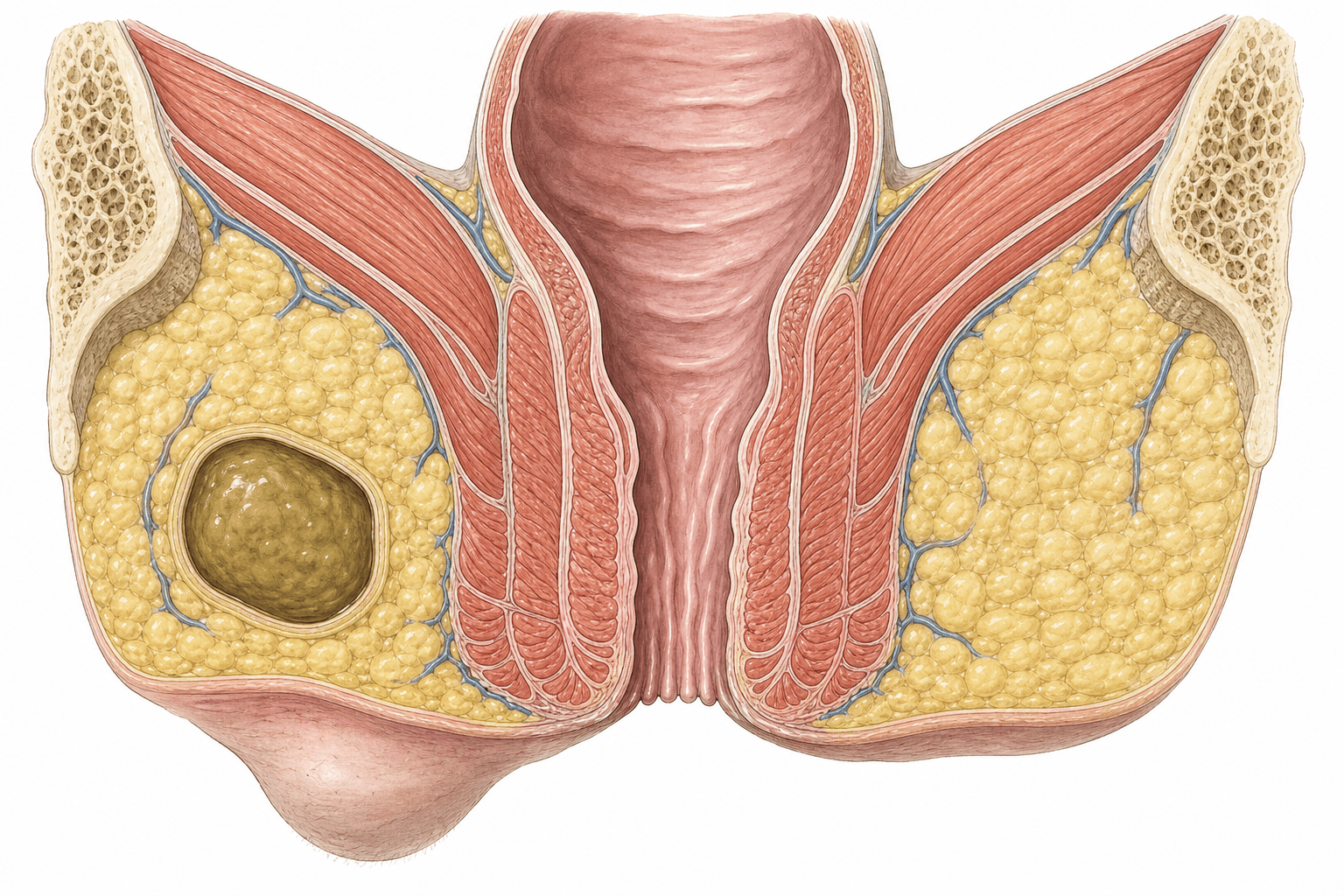
Three types of anorectal abscess, by how deep the pocket sits.
Which one it is changes both the anaesthetic plan and the risk of a fistula afterwards, so identifying it accurately before treatment is part of the work rather than a detail.

Where each type sits
- PerianalJust under the skin, near the anal openingThe most common type, and usually visible as a tender reddened lump. Often drainable under local anaesthetic.
- IschiorectalDeeper, in the fat-filled space beside the sphincter musclesMore severe pain, and typically needs general anaesthesia for drainage.
- IntersphinctericBetween the internal and external sphincter muscle layersMay not be visible from outside at all, so diagnosis leans on examination and imaging rather than on what can be seen.
Illustration, not a photograph or a scan
What makes one more likely.
Crohn's disease and other inflammatory bowel conditions
Chronic inflammation can damage the digestive tract and cause tears or open sores. Patients with Crohn's disease have a considerably higher risk of perianal abscesses and of fistulas afterwards, and recurrence is more common in this group. Dr Sulaiman manages both the perianal disease and its surgical consequences.
Diabetes, or anything that suppresses the immune system
Both reduce the body's ability to clear a bacterial infection, which raises the risk of an abscess forming around the anus.
Everyday factors that add to the risk
Prolonged sitting, constipation and previous anal surgery all contribute. So can skin irritation and moisture around the area, though that is a contributing factor rather than the cause: most abscesses start with a blocked gland on the inside.
At the appointment
Most perianal abscesses are diagnosed by looking. Some need a scan.
Three steps, in this order, and most perianal abscesses do not need all three.
Step 01
Examination
The colorectal specialist inspects the area for the redness, swelling, warmth and tenderness that indicate infection. Where the abscess sits deeper and cannot be seen from the surface, a digital rectal examination assesses how far it extends internally before any drainage is planned.
Step 02
Imaging, when it is needed
Ultrasound or MRI finds abscesses that are not visible on the surface, and settles how far one extends when examination alone cannot. MRI is the reference standard for mapping deep or recurrent abscesses and for spotting an associated fistula tract ahead of surgery. CT has a place in acute presentations, and endoanal ultrasound gives a real-time read of the sphincter anatomy where that is the question.
Step 03
Blood tests
A raised white cell count or inflammatory markers confirm infection and give a sense of how severe it is. They support the picture rather than make the diagnosis on their own.
The procedure
Perianal abscess treatment is drainage surgery, and the relief is immediate.
Draining the pus is the definitive treatment. Everything else supports it.
The operation is short, and its whole purpose is the removal of the pus rather than of any tissue. Dr Sulaiman makes a small incision over the abscess to release the pus, cleans the cavity, and where it is indicated leaves a small wick in place so it keeps draining over the following days. Most patients feel relief the moment the pus is released, because what has been hurting is pressure.

Small and superficial
Local anaesthetic, home the same day
The area around the abscess is numbed before the incision is made. You stay awake and comfortable throughout, and it is done as an outpatient procedure with same-day discharge.
Larger, or deeper
General anaesthetic, in hospital
An ischiorectal abscess or an intersphincteric one needs a theatre and a general anaesthetic, with intraoperative imaging available where it is needed. An overnight stay is likely, depending on how extensive the infection is and on your general health, and patients are usually discharged the following day with written wound care instructions and a follow-up already booked.
The anaesthetic plan is decided at your consultation, not by you in advance
Antibiotics do not replace the drainage.
They are prescribed after drainage where the infection is more widespread, or where an underlying condition such as diabetes raises the risk of complications. On their own, with the pus still in place, they are generally ineffective: the infection tends to persist until it is physically released.
Recovery
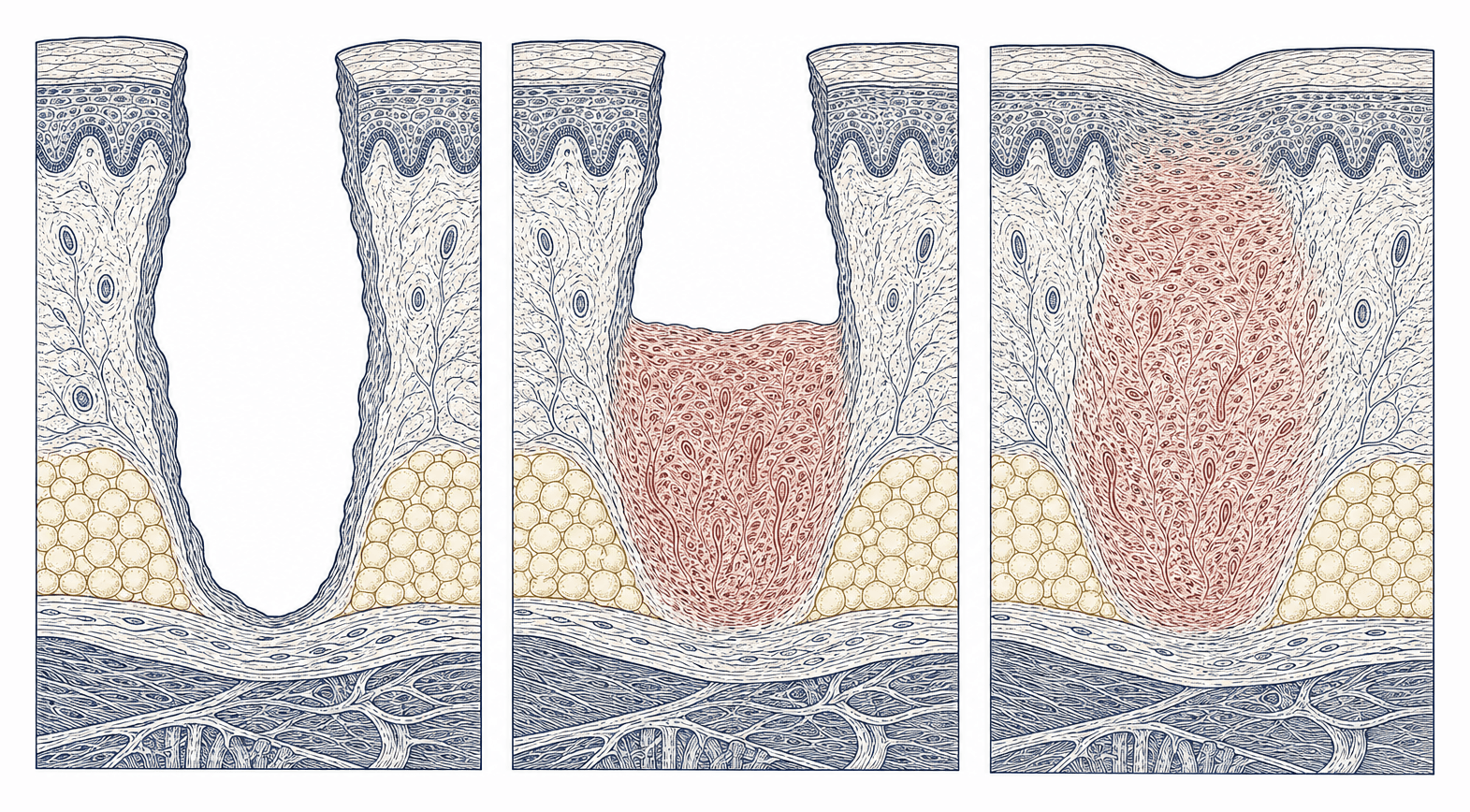
After perianal abscess surgery, the wound heals from the inside out in one to two weeks.
The wound is left partly open on purpose. Closing it over a cavity that is still draining would trap the infection underneath, so it is dressed rather than stitched and allowed to fill in from the base upward.
What to do at home
- Keep the wound clean. Shallow warm-water soaks, two or three times a day, reduce the discomfort and keep the area clean.
- Change the dressings as instructed. His team provides written wound care instructions at discharge.
- Eat enough fibre and drink enough water, so stools stay soft and there is less to strain against.
- Avoid strenuous activity and heavy lifting for the first week.
- Showering is fine. Do not submerge the wound in a bath or a pool until healing is confirmed.
The follow-up is not optional
Dr Sulaiman schedules an appointment to check the wound is healing and to look for early signs that a fistula is forming. A fistula is far easier to identify while the wound is still relatively fresh, and considerably easier to deal with than a second abscess in the same place.
If new discharge, swelling or pain appears before that date, contact the clinic rather than waiting for the appointment.
What comes next
The abscess is the first half. The fistula is the half nobody warns you about.
Draining the abscess clears the acute infection. What patients do not expect is that the gland that started it may not heal, and when it does not, a fistula can form. A real proportion of perianal abscesses go on to do this.
If the abscess later becomes a fistula, you are not referred on to somebody else. The same surgeon handles both, from the drainage through to fistula surgery if it comes to that.
What a fistula actually is
It forms when an abscess drains incompletely or when the infected gland does not heal after drainage. The tunnel then lines itself with tissue and keeps producing discharge, which is why it will not resolve on its own and why antibiotics or another simple drainage do not settle it.
Signs, in the weeks after drainage
- Persistent pus or blood-stained discharge from a small opening near the anus
- Recurring pain or swelling in the same spot
- A new abscess forming in the same place

A second abscess in the same spot is rarely a coincidence.
In most cases it means a tract was there and was not identified at the first drainage. Dr Sulaiman assesses recurrent cases with MRI to map the anatomy before recommending anything surgical, and where it is appropriate will discuss fistula surgery, including fistulotomy or a seton drain, to interrupt the cycle.
You do not need a separate referral for any of that. The same surgeon who drained the abscess treats the fistula, which means the person deciding what to do next already knows what the first cavity looked like from the inside.
Fistulas need their own assessment and their own surgery
Reducing the odds
Some of this is in your hands. Not all of it.
Most perianal abscesses start with a gland blocking on the inside, which is not something hygiene reaches. What the three habits below do is lower the pressure on those glands and treat small irritations early, before they become something that needs draining.
Cleaning, gently
Thorough but gentle cleaning after each bowel movement reduces the bacterial load on the skin. Fragrance-free products are kinder to it. A bidet or moist wipes are worth considering over dry tissue if your skin is easily irritated.
Keeping IBD under control
If you have Crohn's disease or another inflammatory bowel condition, working with both your gastroenterologist and your colorectal surgeon to keep it stable matters here. Active disease increases how often and how badly perianal complications occur. Good control reduces that risk. It does not remove it.
Fibre and fluid
Vegetables, wholegrains, legumes and fruit keep stools soft and regular, so there is less need to strain. Straining raises the pressure on the anal glands and can contribute to the blockage that starts the whole thing. Around 25 to 30g of fibre a day, with enough water alongside it.
Paying for it
Medisave and insurance for perianal abscess surgery, sorted out before the procedure date.
Perianal abscess drainage and surgery are Medisave-claimable (source: CPF Board, using MediSave for hospitalisation, opens in a new tab) for eligible Singaporeans and Permanent Residents. Most Integrated Shield Plans and corporate policies also cover it where it is medically needed. The team arranges pre-authorisation and cashless billing with your insurer before the procedure date.
Contact the clinic to confirm your own coverage
Common questions
Questions people ask at two in the morning.
Which doctor treats a perianal abscess?
A colorectal surgeon or a proctologist. Dr Sulaiman Bin Yusof treats perianal abscesses at five private clinic locations in Singapore and keeps urgent slots for acute presentations. No GP referral is needed, and self-referrals are accepted.
Does the drainage hurt?
The drainage itself is done under anaesthesia: local for small superficial abscesses, general for larger or deeper ones. Most patients feel immediate relief once the pus is released, because the pain of an abscess is pressure. Discomfort afterwards is manageable with over-the-counter pain relief in most cases.
How quickly can I be seen?
The clinic aims to see urgent perianal abscess cases within one working day. Call or WhatsApp the clinic directly for the fastest access. If you have a fever or your symptoms are worsening by the hour alongside the swelling, go to A&E first rather than waiting for an appointment.
Will it clear up on its own?
A perianal abscess usually does not resolve by itself. Without drainage the infection tends to persist and can worsen, and one of the things it can progress to is a fistula. Antibiotics alone are generally ineffective while the pus is still there.
What happens if I wait?
Delaying treatment raises the risk of complications, the most common of which is a fistula: an abnormal tunnel running from the anal canal to the skin near the anus. It is also the reason a small abscess drained early is a smaller procedure than the same abscess drained late.
How long does recovery take?
Usually one to two weeks. The wound is left partially open so it drains and heals from the inside out, which is why it is dressed rather than closed. Keeping the area clean and avoiding straining matter more to the timeline than anything else you can do.
Can it come back?
Yes, particularly for patients with an underlying condition such as Crohn's disease. A second abscess in the same spot is rarely a coincidence and usually points to a fistula tract that was not addressed the first time, which is why the follow-up appointment matters.
Get it looked at
Painful lump near the anus? Do not sit on it.
If you have a painful lump or swelling near the anus, it is worth having it looked at today rather than at the weekend. Urgent cases are usually seen within one working day. If you also have a fever or the pain is worsening by the hour, go to A&E instead of waiting for an appointment.