Anal and perianal
A small tear. A disproportionate amount of pain.
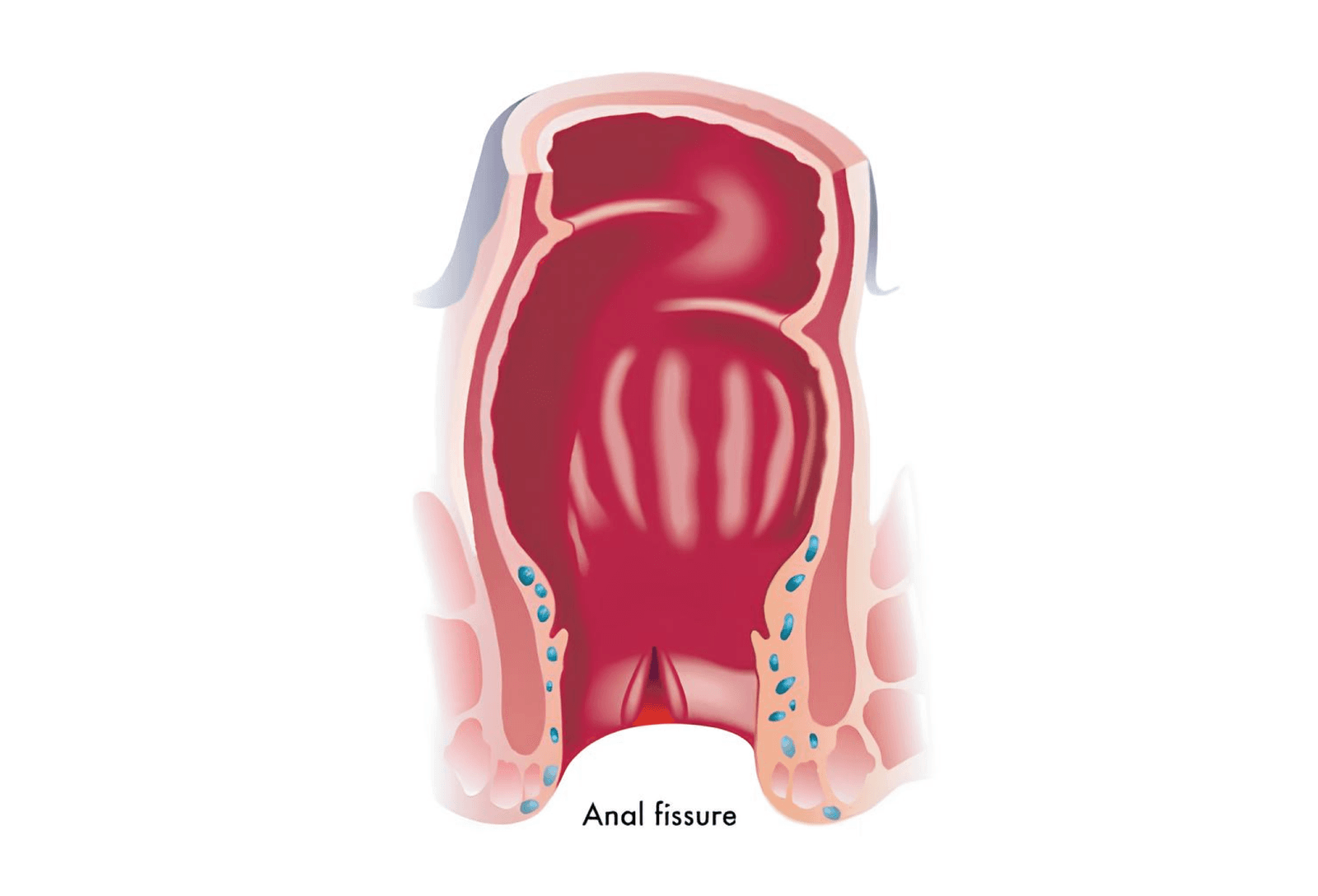
An anal fissure is a small tear in the lining of the anal canal, the short passage between the rectum and the outside of the body. Even a minor fissure can cause pain that feels disproportionate to its size, particularly during and after a bowel movement. Rectal bleeding should always be assessed, because fissures and more serious conditions can look the same.
In short
50
Per cent
Of acute fissures heal with conservative measures alone, and more when symptoms are under a month old.
6
Weeks
Past this a fissure is chronic, which changes both the treatment and the timeline.
2-4
Days
Most desk-based patients are back at work this soon after sphincterotomy.
No
Referral
You do not need a referral. Same-day and same-week appointments are available.
The surgeon
Dr Sulaiman Bin Yusof
Senior Consultant Colorectal and General Surgeon, seeing patients at five clinics in Singapore.
- MBChB (Sheffield), M.Med (Surgery), FRCSEd (General Surgery)
- Consults in English and Malay
- MOH Fellowship, Peter MacCallum Cancer Centre, Melbourne
- Singapore Health Quality Service Star Award 2023
- Dean's Honour Roll for Teaching
When to act
When to see a doctor
Important: Rectal bleeding should always be assessed by a doctor, even when the cause seems obvious. Anal fissures and colorectal cancer can produce similar symptoms. If you are over 50, have a family history of bowel cancer, or notice any change in your bowel habit alongside the bleeding, a colonoscopy should be considered to ensure nothing more serious is missed.
- Pain with bowel movements lasting more than two to three weeks despite conservative measures
- Rectal bleeding that is unexplained, heavier than expected, or accompanied by any change in bowel habit
- Known history of Crohn's disease with new anal symptoms
- A lump near the anus that does not resolve
- Conservative measures have not improved symptoms within four weeks
Dr Sulaiman's perspective
Anal fissure is one of the most painful conditions I see in clinic. The sharp pain during a bowel movement is only part of the picture: the sphincter spasm that follows can persist for hours, making it genuinely difficult to work, sit comfortably, or go about your day.
Patients often delay seeking help because the condition feels embarrassing to discuss. My advice is always: come early. Assessment is straightforward, treatment starts quickly, and the sooner we begin, the less likely a simple acute fissure becomes a chronic problem requiring surgery.
The six-week line
Acute and chronic, and why it decides treatment
Not all anal fissures behave the same way, and the distinction between acute and chronic shapes how they are managed.
Acute fissures are tears present for fewer than six weeks. The tissue is fresh, the edges are clean. With proper stool management and topical treatment, approximately 50% of acute fissures healwithout surgery, with higher success rates when symptoms have been present for less than one month.
Chronic fissures have been present for more than six weeks, or keep recurring. Over time, the base of the tear develops exposed fibres of the internal anal sphincter, the edges become thickened and scarred, and a small external lump, called a sentinel pile or sentinel skin tag, often forms at the lower edge. This tag is a reliable sign that a fissure has become chronic.
The reason chronic fissures resist healing is a self-perpetuating cycle: the internal anal sphincter goes into persistent spasm, which reduces blood flow to the area, which prevents healing, which perpetuates the pain and spasm. Breaking this cycle is the goal of treatment.
If you have had pain with bowel movements for more than six weeks, or your symptoms have improved and returned more than once, your fissure is likely chronic. This changes both the treatment approach and the timeline for recovery.
The options
Treatment
Treatment is stepped. The approach starts with the least invasive measures and escalates based on response.
Conservative measures
Addressing the underlying cause is essential before any medication. If constipation is driving the fissure, no topical cream achieves lasting healing without first normalising stool consistency.
- High-fibre diet: Aim for 25 to 35g of dietary fibre daily through fruits, vegetables, and wholegrains. Soluble fibre (oats, psyllium husk) is particularly effective.
- Adequate hydration: At least 1.5 to 2 litres of fluid daily.
- Stool softeners: Lactulose or macrogol (Movicol) can be used short-term while dietary changes take effect.
- Sitz baths: Soaking the anal area in warm water for 10 to 15 minutes two to three times daily relaxes sphincter spasm and improves local blood flow.
- Avoid straining and prolonged toilet sitting: Both increase anal canal pressure and delay healing.
For acute fissures, these measures achieve healing in approximately 50% of cases within four to six weeks, with higher success rates when symptoms have been present for less than one month.
Topical treatment
Topical agents work by reducing internal anal sphincter spasm, breaking the ischaemia cycle that prevents healing.
Glyceryl trinitrate (GTN) 0.2% ointment: Applied to the anal canal twice to three times daily, GTN releases nitric oxide which relaxes the internal sphincter and improves blood flow. Healing rates approximately 50%. Main side effect is headache (30% of patients).
Diltiazem 2% cream: A calcium channel blocker with comparable efficacy to GTN (healing rates around 68%) with significantly lower headache rates, a useful alternative for patients who do not tolerate GTN.
Nifedipine 0.3% cream: Another calcium channel blocker showing healing rates of 70 to 90% in recent studies. A 2025 network meta-analysis found nifedipine may have the highest healing rate among topical agents.
Dr Sulaiman's perspective
GTN ointment is my mainstay of topical treatment. I review patients at two weeks to assess early healing and tolerance. Around 50 to 60% of patients show meaningful improvement with GTN over a full treatment course. For those who do not improve, or where the fissure is chronic from the outset, I move to the next step promptly rather than prolonging the same treatment indefinitely.
If GTN headaches are a problem, diltiazem cream is a practical alternative with similar efficacy. Where available, nifedipine is another excellent option with potentially higher healing rates.
Botox injection
For fissures that have not responded adequately to topical treatment, or for patients presenting with a chronic fissure where topical treatment alone is unlikely to succeed, a Botox injection into the internal anal sphincter is an effective next step.
Botox temporarily paralyses the sphincter muscle, eliminating the chronic spasm that prevents healing. Initial healing rates are 60 to 80%, though long-term sustained healing is lower (around 30 to 45% at three years; Arroyo et al. 2005, Lin et al. 2016) compared to surgery, and recurrence occurs in up to 42% of patients. Despite this, Botox remains valuable as it avoids permanent structural change and can be repeated if needed.
The procedure is performed as a day case, typically under a short general anaesthetic to ensure accurate placement. Most patients find their pain improves significantly within one to two weeks.
Dr Sulaiman's perspective
I particularly favour Botox over surgery as a first interventional step in women. The reason is anatomical: women have shorter anal sphincters than men, which means that any surgical division of the sphincter carries relatively greater functional consequence. Botox achieves temporary sphincter relaxation without any permanent structural change, which makes it my preferred choice in women with chronic fissures, or in any patient where sphincter strength is a concern.
Patients should understand that while Botox is effective, long-term sustained healing is lower than with surgery, and some patients may require repeat treatment or eventually proceed to surgery. In men with a chronic or recurrent fissure that has not responded to Botox, I would typically recommend proceeding to LIS.
Lateral internal sphincterotomy (LIS)
LIS is the gold-standard surgical procedure for chronic and recurrent anal fissures, with published healing rates of 88% or higher.
A small, precise incision is made in the lower portion of the internal anal sphincter. This permanently reduces resting sphincter pressure, eliminates chronic spasm, and restores blood flow to the fissure, allowing it to heal. The procedure is performed as day surgery under general anaesthesia and takes less than 30 minutes.
Tailored sphincterotomy technique: Modern evidence supports a tailored approach, limiting the sphincterotomy to the apex of the fissure rather than extending it to the dentate line. Three randomized trials totalling 259 patients demonstrated healing rates of 95% or higher. In the one trial that reported incontinence rates, these were significantly lower with the tailored technique (2% versus 11% with conventional technique).
Recovery: Most patients return to desk-based work within two to four days. Physical work or heavy lifting should be avoided for two to three weeks. The fissure heals progressively over four to six weeks post-procedure.
Dr Sulaiman's perspective
LIS is the most reliable long-term treatment for patients with recurrent or chronic fissures. In my practice, I perform a tailored sphincterotomy to the apex of the fissure rather than a fixed length. In women, this corresponds to division of less than 25% of total sphincter length (typically under 8mm).
The concern patients most commonly raise is incontinence, and it is one I take seriously and discuss openly before every procedure.
For patients where I have any concern about baseline sphincter function, a history of obstetric injury, previous anorectal surgery, or known Crohn's disease, I will either recommend Botox or advancement flap as the preferred surgical option, or arrange anorectal manometry to formally assess sphincter function before proceeding.
Risk disclosure: LIS carries a small but real risk of faecal incontinence. Older pooled analyses put overall rates at 8 to 11%; the largest analysis of randomized trials (Nelson et al., Techniques in Coloproctology, 2017) reports 3.4 to 4.4%. Reported rates of difficulty controlling wind range from 5 to 25%, with stool urgency less common. With tailored sphincterotomy, incontinence rates are significantly lower (2% versus 11% with conventional technique in the trial that reported rates). Permanent significant incontinence is rare in appropriately selected patients. This risk is higher in women, patients with a history of obstetric injury, those with pre-existing sphincter weakness, and patients with Crohn's disease. Dr Sulaiman will discuss your individual risk profile at consultation before recommending any surgical procedure.
Anocutaneous advancement flap
For patients at higher risk of incontinence after LIS, particularly women with obstetric injury history, patients with baseline sphincter weakness, or those with Crohn's disease, an anocutaneous advancement flap is a sphincter-preserving alternative.
A small flap of healthy perianal skin is advanced to cover the fissure after excision, promoting healing without dividing the sphincter. Published healing rates are at least 81%, with fecal incontinence rates of only 0 to 6% (typically 2 to 2.5%), significantly lower than LIS.
Fissurectomy
In selected cases, particularly where there is extensive surrounding scar tissue, a large sentinel skin tag, or a chronic fissure in a patient not suitable for LIS, fissurectomy is performed. This involves surgically removing the fissure and any associated scarred or unhealthy tissue, creating a clean wound that heals fresh. It is sometimes combined with a partial sphincterotomy or advancement flap depending on operative findings.
What it is
What an anal fissure is
Most anal fissures are entirely treatable. Approximately half of acute cases heal with conservative measures within a few weeks. When they do not, effective medical and surgical options exist, and with the right treatment at the right time, outcomes are consistently good.
What you are feeling
What an anal fissure feels like
The symptom pattern of an anal fissure is distinctive:
Sharp pain during bowel movements: most patients describe a cutting, tearing, or burning sensation at the moment of passing stool. The pain peaks during the movement and typically continues as a dull ache or spasm for 30 minutes to several hours afterwards. This delayed spasm is caused by the internal anal sphincter contracting in response to the tear.
Bright red blood on toilet paper or the surface of stools: usually small in volume but vivid in colour. Blood mixed into the stool, or a darker colour, warrants further investigation to rule out other sources.
Itching or irritation around the anus: particularly as the fissure edges dry or become inflamed between episodes.
A small lump near the anus: if present, this sentinel skin tag indicates the fissure has become chronic.
Where it starts
What causes a fissure
Several factors can cause a tear in the anal canal lining:
Constipation and hard stools
The most common cause. Hard stools stretch the anal canal beyond its normal capacity, causing a tear in the lining.
Straining
Repeated straining increases pressure on the anal lining with each bowel movement, making tears more likely.
Prolonged diarrhoea
Repeated passage of loose stools irritates the lining and prevents recovery between episodes.
Childbirth
The pressure and stretching of vaginal delivery is a recognised cause, particularly following prolonged labour.
Inflammatory bowel disease
Conditions such as Crohn's disease weaken the anal lining chronically. Fissures in Crohn's patients often behave differently from standard fissures and require a tailored treatment approach.
Confirming it
Diagnosis
Diagnosis is clinical and does not require complex investigations in most cases.
History and symptom review: The pattern of pain during and after bowel movements, alongside any history of constipation, diarrhoea, or childbirth, gives a strong indication before any examination takes place.
External inspection: In most cases the fissure is visible externally as a tear at the posterior midline of the anus (the 6 o'clock position). The presence of a sentinel skin tag confirms chronicity.
Anoscopy: If the fissure is not externally visible, a small lighted instrument is used to examine the lower anal canal. This is performed gently and avoids the discomfort of a full rectal examination, which can be very painful in acute cases with significant spasm.
A note on examination: If your pain is severe, a full internal examination may not be possible at the first visit. This is normal and does not prevent a diagnosis or the start of treatment. A thorough examination under anaesthesia can be arranged at the time of any surgical procedure if needed.
Staying clear of it
Preventing another fissure
A fissure that has healed can return if the underlying risk factors are not addressed. The most important long-term habits:
- Maintain a high-fibre diet consistently, not only during episodes
- Stay well hydrated
- Do not strain and do not sit on the toilet longer than needed
- Address constipation early, do not wait for a tear to develop
- If early symptoms return, restart conservative measures immediately rather than waiting
Paying for it
MediSave and insurance
Surgical treatment of anal fissures, including LIS and fissurectomy, is a MediSave-claimable procedure under the Ministry of Health's Table of Surgical Procedures. Most Integrated Shield Plans provide coverage for these procedures performed as day surgery at private hospitals.
Please speak to our clinic team before your consultation. We can advise on the relevant procedure codes and assist with pre-authorisation if required. For Singaporeans, Singapore Permanent Residents and Foreigners. Please speak to our friendly clinic staff about using your insurance plans.
Who treats it
About Dr Sulaiman
Dr Sulaiman's practice is built around complex colorectal surgery, with robotic-assisted technique as his primary surgical platform for colectomy and anterior resection. He has contributed eight peer-reviewed publications.
Patients consult Dr Sulaiman for his depth of experience in colorectal cancer and perianal conditions, as well as for consultations that are thorough, unhurried, and focused on giving patients a clear understanding of their options.
Former Director of Endoscopy, Changi General Hospital
Dr Sulaiman served as Director of Endoscopy at Changi General Hospital and brings that public-sector depth of experience to his private practice. In this role, he led a high-volume diagnostic endoscopy service encompassing colonoscopy and gastroscopy across a broad and diverse patient population.
Five clinics across Singapore
- Gleneagles Medical Centre: 6 Napier Road #06-16, Singapore 258499
- Mount Elizabeth Novena Hospital: 38 Irrawaddy Road, #10-48/49, Singapore 329563
- Parkway East Hospital: #05-08, 319 Joo Chiat Place, Singapore 427989
- Mount Alvernia Hospital: #08-62, Medical Centre D, 820 Thomson Road, Singapore 574623
- Connexion, Farrer Park Medical Centre: #14-12, 1 Farrer Park Station Road, Singapore 217562
Common questions
Questions about anal fissures.
Can an anal fissure heal on its own?
Yes, approximately 50% of acute fissures (present for fewer than six weeks) heal with conservative measures: dietary changes, stool softeners, sitz baths, and topical creams, with higher success rates when symptoms have been present for less than one month. Chronic fissures, present for more than six weeks or recurring repeatedly, are much less likely to heal without medical or surgical intervention.
How long does an anal fissure take to heal?
Acute fissures typically heal within four to six weeks with proper treatment. Chronic fissures take longer, expect eight to twelve weeks with medical treatment, and four to six weeks of progressive improvement following surgery. Surgical wound healing after LIS usually completes within four to six weeks.
Is fissure surgery painful?
The procedure is performed under general anaesthesia. You will feel nothing during it. Post-operative discomfort is usually mild and manageable with standard oral analgesia. Most patients are surprised by how well-tolerated the recovery is. Bowel movements in the first week can be tender, which is why stool softeners are prescribed as standard post-operatively.
How soon can I go back to work?
Most patients with desk-based jobs return within two to four days. Jobs involving heavy lifting, prolonged standing, or physical labour should be avoided for two to three weeks.
Will sphincterotomy affect my bowel control?
Yes, and this is something Dr Sulaiman discusses honestly with every patient before surgery. Older pooled analyses put overall postoperative incontinence after LIS at 8 to 11%; the largest analysis of randomized trials (Nelson et al., Techniques in Coloproctology, 2017) reports 3.4 to 4.4%. Reported rates of difficulty controlling wind range from 5 to 25%, with stool urgency less common. With tailored sphincterotomy, incontinence rates are significantly lower (2% versus 11% with conventional technique). Permanent significant incontinence is rare in carefully selected patients. Patients with obstetric injury history, Crohn's disease, or previous anal surgery carry higher individual risk and are assessed individually.
Can a fissure come back after surgery?
Recurrence after LIS is low, typically 3 to 6% in published series. This compares favorably to Botox injection, which has recurrence rates of 28 to 42%. Recurrence is more likely if the underlying cause (constipation, straining habits, low fibre intake) is not addressed after surgery.
Can an anal fissure turn into cancer?
No. Anal fissures are benign tears and do not cause or increase the risk of cancer. However, rectal bleeding, even when a fissure is present, should always be properly assessed, because other conditions including colorectal cancer can produce similar symptoms. If you are over 50, or if your symptoms are not fully explained by the fissure, a colonoscopy may be recommended.
Is anal fissure surgery claimable under MediSave?
Yes. Surgical treatment of anal fissures (LIS and fissurectomy) is claimable under MediSave at the prevailing MOH withdrawal limits for day surgery procedures. Most Integrated Shield Plans also cover these procedures. Contact our clinic for guidance on your specific plan.
What is the difference between a fissure, a fistula and piles?
Three distinct conditions affecting the same region, frequently confused. A fissure is a tear in the anal lining. A fistula is an abnormal tunnel between the anal canal and the skin around the anus, usually arising from a previous abscess. A pile (haemorrhoid) is a swollen vascular cushion in the anal canal. All three can cause bleeding and discomfort. Treatment is entirely different for each, which is why a proper examination and diagnosis matters.
Evidence disclosure
Evidence Disclosure: Clinical information on this page reflects Dr Sulaiman's practice and is informed by published evidence including: 2023 ASCRS Clinical Practice Guidelines for Anal Fissure (Davids et al.); 2021 ACG Guidelines on Benign Anorectal Disorders (Wald et al.); 2025 network meta-analysis on topical agents (Wang et al.); 2024 meta-analysis on Botox vs LIS (Bonyad et al.); 2022 network meta-analysis on anal fissure treatments (Jin et al.); 2017 analysis of LIS outcomes across 148 randomized trials (Nelson et al., Techniques in Coloproctology); long-term Botox healing follow-up data (Arroyo et al. 2005; Lin et al. 2016); systematic review data on tailored sphincterotomy outcomes (healing 95% or higher, incontinence 2% versus 11% with conventional technique); prospective data on safe division limits in women (under 8mm, under 25% sphincter length).
Get it looked at
Pain with every bowel movement for more than six weeks? Come early.
Consult Dr Sulaiman for an assessment and a personalised treatment plan. Book a consultation with Dr Sulaiman today. Same-day and same-week appointments available.