Gastrointestinal bleeding
Gastrointestinal bleeding is a symptom. The cause is what matters.
Gastrointestinal bleeding is blood loss anywhere in the digestive tract, from the oesophagus to the rectum. It is typically a symptom of an underlying condition such as an ulcer, inflammation or a polyp, so the first job is finding where it is coming from and why.
Former Director of Endoscopy, CGHFive clinics in Singapore
- Upper GI tract
The oesophagus, the stomach and the upper small intestine
Vomit containing blood, or black tarry stools
Upper endoscopy
- The small intestine
The stretch that sits beyond the reach of either scope
Bleeding neither scope has accounted for
Capsule endoscopy
- Lower GI tract
The colon and the rectum
Bright red blood in or on the stool
Colonoscopy
In short
A symptom
Not a diagnosis in itself
GI bleeding is typically a symptom of an underlying condition such as an ulcer, inflammation or a polyp. Identifying that condition is the point of the assessment.
Anywhere
From oesophagus to rectum
Blood loss can arise at any point along the digestive tract, and the severity ranges from mild spotting to serious blood loss depending on the location and the cause.
Red or black
What the colour points to
Bright red blood suggests bleeding lower down. Black tarry stools, or vomit containing blood, point higher up the tract instead.
Or invisible
When there is nothing to see
Slow ongoing loss may show up only as light-headedness, fatigue or breathlessness, or as a low haemoglobin on a blood test, with no visible blood at all.
What every patient should know
What every patient should know
A symptom
Of something else, every time
Source: Dr Sulaiman Bin Yusof, clinical practice
Locate it
Which part of the tract is bleeding
Identify the cause
An ulcer, inflammation, a polyp, a tumour
Treat it at the source
Often during the same procedure
Every level
Of the tract can be examined
Source: Dr Sulaiman Bin Yusof, clinical practice
Anaemia
What slow bleeding leaves behind
Source: Dr Sulaiman Bin Yusof, clinical practice
His story
Dr Sulaiman Bin Yusof
Senior Consultant Colorectal and General Surgeon, seeing patients at five clinics in Singapore.
- MBChB (Sheffield), M.Med (Surgery), FRCSEd (General Surgery)
- Consults in English and Malay
- MOH Fellowship, Peter MacCallum Cancer Centre, Melbourne
- Singapore Health Quality Service Star Award 2023
- Dean's Honour Roll for Teaching
What you may notice
What it looks like depends on where it is coming from.
The symptoms of GI bleeding vary depending on the location and the severity. These are the ones that bring people in.
Blood in the stool, or in vomit
Bright red blood may suggest bleeding in the lower GI tract, while black tarry stools, or vomit containing blood, more often indicate bleeding higher up, in the upper GI tract.
Abdominal pain or discomfort
Persistent or severe abdominal pain can accompany GI bleeding, especially when related to ulcers or inflammation.
Dizziness or fatigue
Ongoing blood loss may lead to anaemia, with symptoms such as light-headedness, fatigue, or shortness of breath.
Unexplained weight loss
Significant weight loss, especially when paired with other GI symptoms, may point to a more serious underlying condition, such as a tumour in the digestive tract.
None of these symptoms names its own cause. Several of the conditions behind them are common and treatable, and a few are not, and the only way to tell them apart is to look.
Rectal bleeding in particular is often assumed to be piles. Piles are common and they are treatable, and what they are and how they are managed is on the haemorrhoids page. It is still an assumption, and it is worth checking rather than trusting.
Causes and risk factors
Different conditions, each affecting a different part of the tract.
Various conditions and factors can cause gastrointestinal bleeding, each affecting a different part of the digestive tract. These are the ones seen most often.
Ulcers
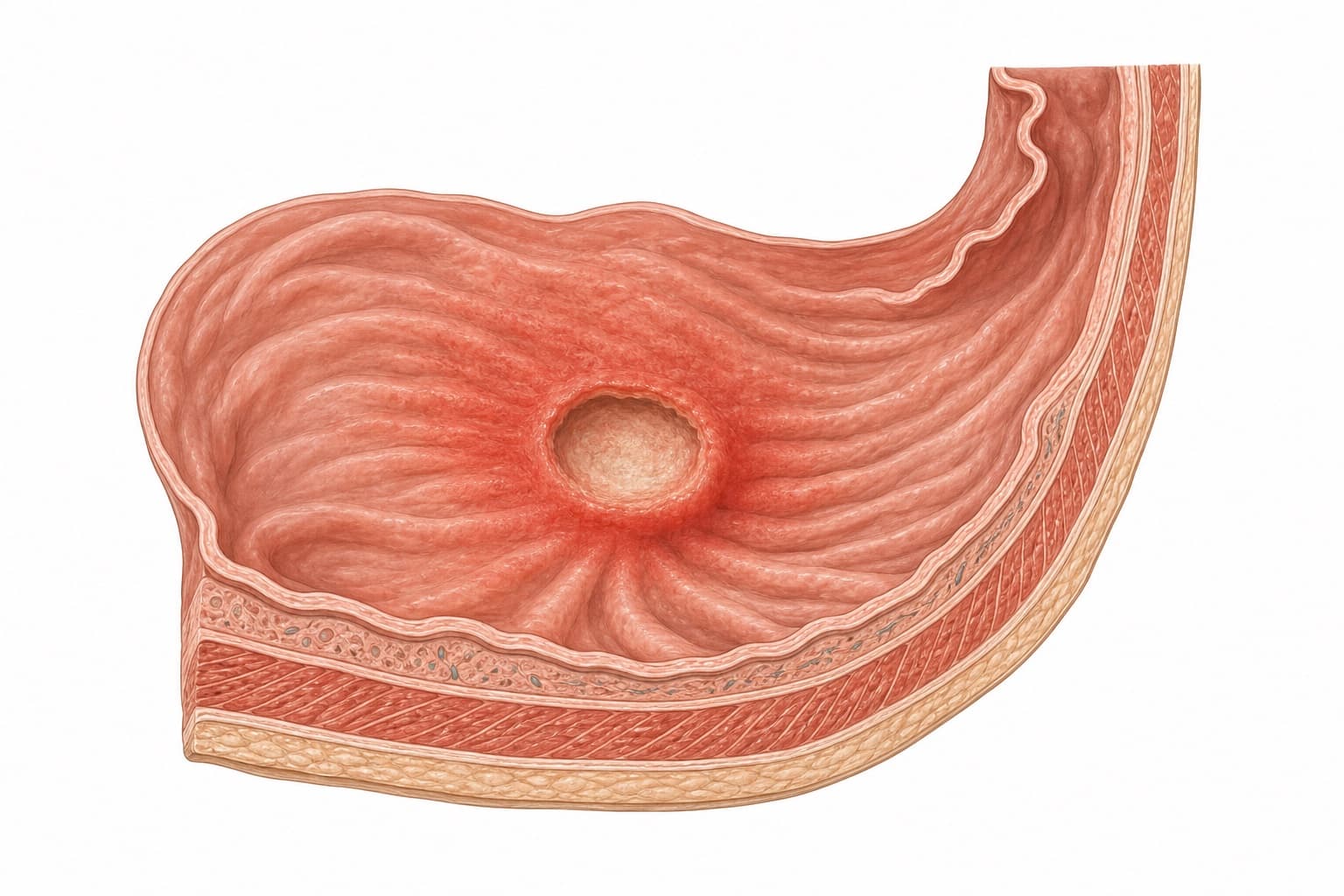
Ulcers in the stomach lining or upper small intestine are a common cause of upper GI bleeding. They can be caused by infections like H. pylori or long-term use of non-steroidal anti-inflammatory drugs, which can irritate the stomach lining.
Diverticulosis
Diverticulosis occurs when small pouches (diverticula) form in the colon wall, common in older adults. If these pouches become inflamed or infected (diverticulitis), they can cause lower GI bleeding, sometimes leading to significant blood loss.
Polyps
Non-cancerous growths in the colon or rectum may bleed, especially if they grow large or become irritated. Polyps may increase the risk of colorectal cancer, making removal necessary to prevent further bleeding and complications.
Inflammatory bowel disease
Conditions such as Crohn's disease and ulcerative colitis cause chronic inflammation in the digestive tract, which can damage blood vessels and result in intermittent bleeding.
Tumours
Benign or malignant tumours may cause bleeding anywhere in the GI tract. Early detection is necessary, as bleeding can sometimes be an early sign of colorectal or gastric cancer.
The last of those is the reason bleeding is not left to settle on its own. What colorectal cancer is, how it is staged and what treatment involves is set out on the colorectal cancer page.
Finding the source
Locating the bleeding, then establishing what is causing it.
A variety of diagnostic tools can help locate and determine the cause of GI bleeding. Which one is used depends on where the bleeding is thought to be coming from.
Same sitting
When the test can also treat
Source: Dr Sulaiman Bin Yusof, clinical practice
Upper endoscopy
An upper endoscopy involves using a thin, flexible tube with a camera to examine the oesophagus, stomach, and upper small intestine. This procedure allows direct visualisation of the lining, helping to locate areas of bleeding or lesions and, in some cases, immediate treatment if needed.
Colonoscopy
A colonoscopy provides a detailed view of the entire colon and rectum, helping identify potential sources of bleeding, such as polyps, diverticula, or inflammation. During the procedure, small tissue samples (biopsies) may be taken for further analysis. Colonoscopy can also enable the removal of small polyps that may be contributing to bleeding.
Capsule endoscopy
Capsule endoscopy involves swallowing a pill-sized camera that captures images as it travels through the GI tract. This technique is especially useful for detecting bleeding in areas beyond the reach of traditional endoscopy, such as the small intestine. The images are recorded and later analysed to identify sources of bleeding or other abnormalities.
CT scans and angiography
CT scans and angiography help to visualise the digestive tract and pinpoint bleeding sites. These methods are particularly useful for identifying active or severe bleeding, especially when endoscopy is not feasible. Angiography may also allow targeted treatment by delivering medication directly to the bleeding vessel.
Blood tests and stool tests
Blood tests, including a complete blood count, and stool tests provide information on the extent of blood loss and may reveal signs of anaemia or infection. A low haemoglobin level, for instance, can indicate chronic blood loss related to GI bleeding. Stool tests can detect hidden blood or signs of infection that may contribute to symptoms.
What a colonoscopy actually involves, from the preparation through the sedation to the recovery, is set out on the colonoscopy page. The published colonoscopy price, possible additions and MediSave limits are on the colonoscopy cost page.
Treatment options
Treatment follows the cause, the severity and the location.
The treatment for gastrointestinal bleeding is determined by the underlying cause, severity, and location. These are the options, from the least invasive upward.
Medication
Treating the condition underneath the bleeding
Endoscopic treatment
Controlling the bleeding at its source
Surgery
When the earlier steps are not sufficient
Medication
Medications can be used to address the underlying cause of GI bleeding. Proton pump inhibitors (PPIs) or other acid-reducing medications are used to lower stomach acid levels, helping protect the stomach lining from further irritation. Antibiotics may be prescribed to treat infections like H. pylori, while anti-inflammatory medications can reduce digestive tract inflammation in conditions like IBD.
Endoscopic treatment techniques
During an endoscopy, techniques like cauterisation, banding, or clipping may be used to control bleeding at its source. Polypectomy, the removal of bleeding polyps, is often performed as an interventional procedure during a colonoscopy to prevent future bleeding and reduce the risks of complications. These methods allow for targeted treatment, often avoiding the need for more invasive procedures.
Replenishing iron and blood levels
For patients who have developed anaemia due to chronic GI bleeding, iron supplements can aid in restoring haemoglobin levels, necessary for oxygen transport. In cases of severe blood loss, blood transfusions may be required to rapidly increase blood volume and improve oxygen delivery to tissues.
Laparoscopic or robotic-assisted surgery
Minimally invasive techniques, such as laparoscopic or robotic-assisted surgery, may be used to remove tissues causing recurrent bleeding, such as polyps or tumours, when endoscopic treatments are ineffective. These methods involve small incisions, which generally lead to faster recovery and reduced post-operative discomfort. Robotic assistance can further enhance precision, making it a suitable option for complex cases.
Resection of damaged areas
For sections of the GI tract that are severely damaged or contain tumours, resection may be necessary to remove the affected portion and prevent recurrent bleeding. This procedure is typically reserved for cases where other treatments are insufficient. Minimally invasive techniques are often used for resections to promote a faster and more comfortable recovery.
Prevention
Managing the risk factors, and knowing your own history.
To prevent GI bleeding, managing risk factors and making lifestyle adjustments are necessary.
Three
Irritants worth avoiding
Source: Dr Sulaiman Bin Yusof, clinical practice
If you already have a diagnosis
Regular monitoring of conditions such as ulcers, diverticulosis, and inflammatory bowel disease, along with prescribed medications, may reduce the risk of bleeding.
Periodic check-ups may be recommended to catch early signs of recurrence, especially for those with a history of GI bleeding.
Treating an episode of bleeding settles the immediate problem. It is the condition underneath that decides whether there is another one.
Common questions
The questions that come up in consultation.
What is recovery like after an endoscopy or a colonoscopy?
Most patients recover within a day or two, with only mild discomfort like bloating or a sore throat, which usually subsides quickly. Aftercare instructions, including any dietary or activity restrictions, help ensure a smooth recovery. Patients are generally advised to rest for the remainder of the day after the procedure.
Once the bleeding has been treated, will it come back?
Treating GI bleeding stops the immediate issue but does not always prevent future episodes. Depending on the cause, managing underlying conditions such as ulcers or diverticulosis may be necessary to reduce recurrence.
What happens if gastrointestinal bleeding is left untreated?
Untreated GI bleeding, especially when chronic, can lead to severe anaemia, organ strain, and in extreme cases, shock due to blood loss. Chronic bleeding can also indicate an underlying serious condition, like cancer, which may progress without appropriate treatment.
Can the bleeding be treated during the same procedure that finds it?
Often, yes. An endoscopy allows the lining to be seen directly, which both locates the bleeding and, in some cases, allows immediate treatment during the same procedure. Techniques such as cauterisation, banding or clipping control bleeding at its source, and a polyp that is contributing to the bleeding can be removed during a colonoscopy in the same sitting. These methods allow for targeted treatment, often avoiding the need for more invasive procedures.
Can I use my insurance for this?
Speak to our clinic staff about using your plan. The practice works with a range of partnered programmes and insurance plans, including corporate insurance and Integrated Shield Plans, for Singaporeans, Singapore Permanent Residents and foreigners. It is worth settling that before your appointment rather than afterwards, so the paperwork is not being sorted out on the day.
Book a consultation
Bleeding is the symptom. Finding what is causing it is the work.
If you have seen blood in your stool or in vomit, or you have been unusually tired and light-headed with no clear explanation, book a consultation for an assessment and a treatment plan built around your own case. Appointments are available across five clinic locations in Singapore, and self-referrals are welcome.