Colon polyps
Most colon polyps are benign, and are removed as they are found.
A polyp is a growth in the lining of the colon or the rectum. The colonoscopy that finds one removes it in the same sitting, so that polyp cannot go on to become a cancer.
FRCSEd (General Surgery)Five clinics in Singapore

In short
Most
Are not cancer
Most colon polyps are benign, meaning non-cancerous. A smaller number are precancerous, which is why a polyp is removed and sent for analysis rather than left alone.
Silent
How they usually behave
Colon polyps are often asymptomatic, especially when they are small. Most are found because somebody went looking, not because something felt wrong.
10 to 15
Years of warning
How long a polyp usually takes to turn cancerous, and most never do. A colonoscopy finds and removes it inside that window. Source: HealthHub, Singapore.
50
Screening age in Singapore
People at average risk are advised to start at 50, with a stool test once a year or a colonoscopy every five to ten years. Earlier with a family history. Source: Ministry of Health, Singapore.
What every patient should know
Colon polyps, what every patient should know
10 to 15
Years of warning
How long a polyp usually takes to turn cancerous, and most never do. That slow start is the whole reason screening works: the same colonoscopy that finds a polyp takes it out, well inside the window.
Source: HealthHub, Singapore (source: HealthHub, Singapore, colorectal cancer, opens in a new tab)
A polyp forms
Small, and it causes no symptoms
It grows slowly
Usually over 10 to 15 years
Removed at colonoscopy
That polyp cannot become a cancer
The test that finds a polyp is usually the same test that removes it, in one sitting.
50
Screening age in Singapore
The age at which people at average risk in Singapore are advised to begin screening for colorectal cancer, either with a stool test once a year or a colonoscopy every five to ten years. If you have a family history or other risk factors you may need to start earlier and be scoped more often, and your surgeon will set the interval that fits your own case.
Source: Ministry of Health, Singapore
His story
Dr Sulaiman Bin Yusof
Senior Consultant Colorectal and General Surgeon, seeing patients at five clinics in Singapore.
- MBChB (Sheffield), M.Med (Surgery), FRCSEd (General Surgery)
- Consults in English and Malay
- MOH Fellowship, Peter MacCallum Cancer Centre, Melbourne
- Singapore Health Quality Service Star Award 2023
- Dean's Honour Roll for Teaching
Five clinics across Singapore
ORCHARD / NAPIER
Gleneagles Medical Centre
6 Napier Road #06-08, Singapore 258499
NOVENA
Mount Elizabeth Novena
38 Irrawaddy Road, #10-48/49, Singapore 329563
JOO CHIAT / EAST COAST
Parkway East Hospital
#05-08, 319 Joo Chiat Place, Singapore 427989
THOMSON
Mount Alvernia Hospital
#08-62, Medical Centre D, 820 Thomson Road, Singapore 574623
FARRER PARK
Farrer Park Medical Centre
#14-12, 1 Farrer Park Station Road, Singapore 217562
When to act
Most polyps are silent. These are the things worth acting on.
Colon polyps are often asymptomatic, especially when they are small. When symptoms do occur, they are a reason to be assessed rather than a reason to wait and see whether they settle.
Blood in the stool, or a change in bowel habit that has lasted more than a few weeks, should be assessed rather than watched.
- Blood in the stool, whether it is bright red or dark
- A change in bowel habit, or in the consistency of your stool, that does not settle
- Cramping or abdominal discomfort that keeps returning
- Feeling unusually tired or weak, or a blood test showing low iron
Every one of these overlaps with conditions that are far more common and far less serious. Having one of them does not mean you have a polyp. It means the question is worth answering properly rather than carrying around.
A colonoscopy is what answers it, and it answers it in one sitting because anything it finds it can also remove. What the test involves, and what the day looks like, is on the colonoscopy page.
What polyps are
A colon polyp is a growth in the lining of the bowel.
Colon polyps are growths that develop on the inner lining of the colon, the large intestine, or of the rectum.
They are usually small, typically under 1 centimetre in diameter, but they vary in size and in number. Most colon polyps are benign, meaning non-cancerous, but some can develop into colorectal cancer over time, and that is what makes finding them and removing them early worth the trouble.
There are several types of colon polyp, each with different characteristics and different risks. Which one you had is not something anybody can tell you in the room.
Adenomatous polyps
The most common precancerous type of polyp. Not all adenomas become cancerous, but they have the potential to do so if they are left untreated, which is why they are removed when they are found and why the laboratory result then sets how closely you are followed up.
Hyperplastic polyps
Usually small, and found in the lower part of the colon and the rectum. Small hyperplastic polyps down there are almost always harmless. Larger ones of 1 centimetre or more, or ones found higher up in the colon, are followed up more closely than that, so your surgeon will tell you what your own result means rather than leave you to assume.
Sessile serrated lesions
Less common, and also precancerous. Because they are flat and pale rather than raised, they are easier to miss during a colonoscopy. That is why careful inspection and a good bowel preparation matter so much, and why these polyps are the ones linked to cancers that appear between scopes.
Inflammatory polyps
Seen in people with inflammatory bowel disease such as ulcerative colitis or Crohn's disease. These polyps are not precancerous themselves. But long-standing inflammatory bowel disease does raise the risk of colorectal cancer, so surveillance colonoscopy still follows the schedule your specialist sets for you.
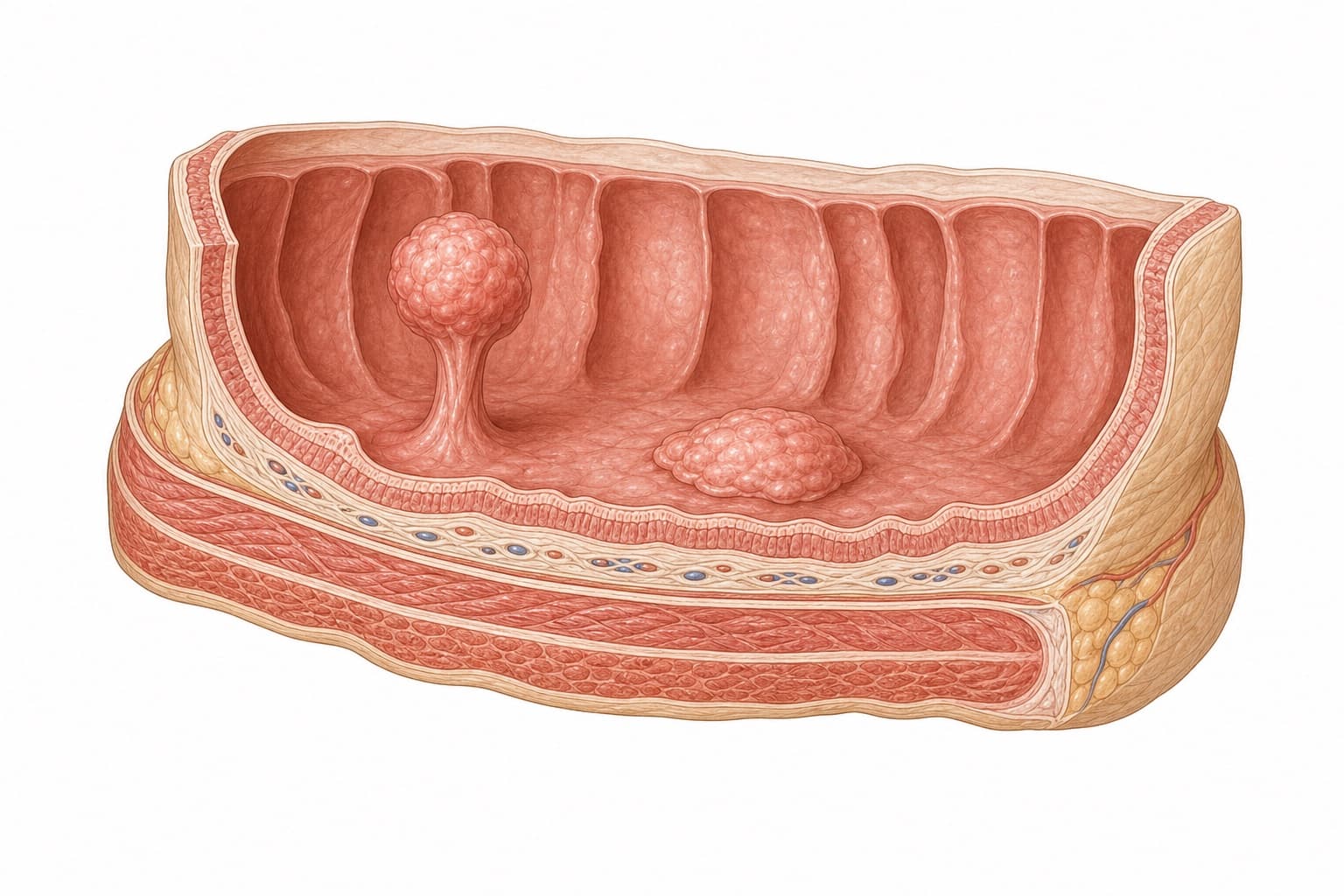
The type is not something you or your surgeon can settle by looking. Any polyp that comes out goes to the laboratory, and that report is what decides what happens next.
How polyps relate to colorectal cancer, and why the interval between them is long enough to be useful, is set out on the colorectal cancer page.
Symptoms and bleeding
Do polyps bleed, and what else would you actually notice?
They can bleed, and most of them do not. Colon polyps are often asymptomatic, especially when they are small, which is why so many are found at screening rather than because somebody noticed something. When symptoms do occur, they may include the following.
Rectal bleeding
Yes, polyps can bleed. Stool passing over a polyp can irritate or damage the delicate lining of the colon or rectum, and that is what causes the bleeding. It may be visible in the bowl or on the paper, or it may be invisible and picked up only by a stool test. What matters as much is the other direction: most polyps do not bleed at all, so an absence of blood is not evidence that there is nothing there.
A change in bowel habit
Larger polyps can obstruct the passage of stool, which causes diarrhoea or constipation, and can change the consistency of the stool as well as its frequency.
Abdominal pain
Large polyps can cause cramping or discomfort by getting in the way of food and waste passing through. The colon has to work harder to push stool around the polyp, and that extra work is what is felt as cramps.
Tiredness and weakness from low iron
Slow bleeding from a polyp can drain your body's iron stores over months without you noticing anything at all. If iron runs low enough, your body cannot make enough healthy red blood cells to carry oxygen, and you may feel very tired, weak, or short of breath. Iron that turns up low on a routine blood test, with no obvious explanation, is worth taking seriously for exactly this reason.
None of these is specific to a polyp. Each of them is a reason to have the colon looked at properly, not a diagnosis in itself.
Bleeding in particular has a long list of far more common causes, and haemorrhoids lead that list by a distance. The difficulty is that the two feel identical from the outside, and only one of them can be ruled out by assumption.
How they are found
Screening is how most polyps are found, because most cause nothing.
Colon polyps often cause no symptoms, which is what makes regular screening necessary for early detection. Three tests are in common use in Singapore, and they do not do the same job as each other.
23.8%
Of advanced polyps found by a stool test
In the largest head to head comparison, a stool test found nearly three quarters of colorectal cancers and under a quarter of advanced precancerous lesions. The reason is simple: most polyps do not bleed, so there is nothing for the test to find. A negative stool test is reassuring about cancer today. It is not a clear colon.
Source: Imperiale et al., New England Journal of Medicine, 2014
What a stool test picks up
- Colorectal cancer
- 73.8%
- Advanced polyps
- 23.8%
Source: Imperiale et al., New England Journal of Medicine, 2014
Colonoscopy
The most effective method for inspecting the entire colon. A colonoscope, a long flexible tube with a camera on the end, lets the doctor examine the lining of the colon for anything abnormal. If polyps are found they can be removed during the same procedure, and each one is then analysed to determine whether it is benign, precancerous, or cancerous.
Stool tests
Stool tests such as the faecal immunochemical test look for blood you cannot see. They are good at picking up colorectal cancer, but most polyps do not bleed, so a stool test misses many of them. That is why it has to be repeated every year, and why it is a screening step rather than an answer. If blood is found, you need a colonoscopy to find out what is causing it.
CT colonography
Also called virtual colonoscopy. This imaging test uses a CT scanner to take detailed three-dimensional pictures of the colon and rectum. It helps detect polyps but it does not allow for their removal, so if a polyp is found on the scan you will still need a colonoscopy to take it out.
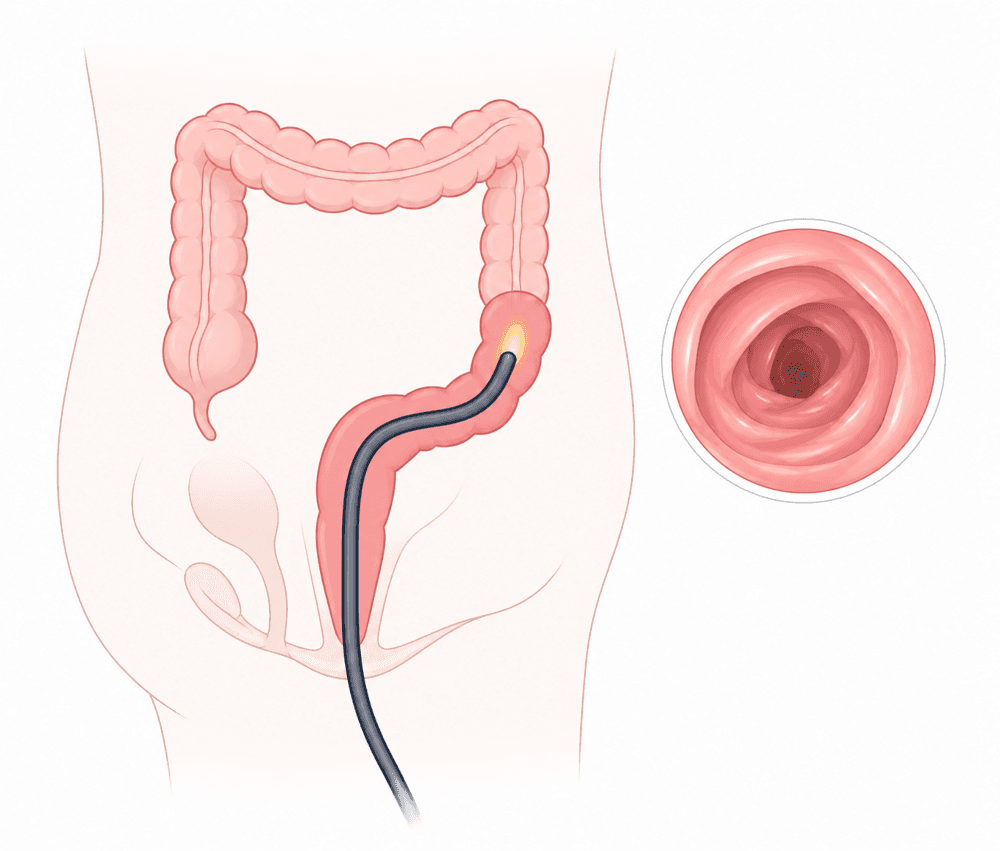
A positive stool test is common, and it is not a diagnosis on its own. It does not tell you whether the blood came from a polyp, a cancer, or something harmless like piles.
The only way to tell them apart is to look, and what looking involves, from the preparation to going home afterwards, is on the colonoscopy page. A plainer walk-through of what colon polyps are, their symptoms and how removal works is in the blog.
How they are removed
Almost all colon polyps come out through the scope.
How a polyp is removed depends on its size, its shape, and where in the colon it sits. The great majority are taken out during the same colonoscopy that found them, with no cut to the abdomen at all.
Polypectomy
Most polyps, taken during the scope
Endoscopic resection
Larger or flatter ones, still through the scope
Surgery
Only when the scope cannot do it safely
Polypectomy
The polyp is removed during a colonoscopy or a flexible sigmoidoscopy, using a wire loop or another instrument passed down the scope to cut it away from the colon lining. It is done through the scope with no cuts to the abdomen, under sedation, and most people go home the same day. Some bloating or mild cramping afterwards is normal.
Endoscopic mucosal resection
Used to remove larger or more complex polyps. A liquid is injected underneath the polyp to lift it off the colon wall, so that it can be taken away cleanly during the colonoscopy. It is still done through the scope and there is still no incision, and it carries a higher risk of bleeding or of a tear in the bowel wall than a straightforward polypectomy does.
Removing a segment of the colon
Most polyps, including large ones, can be removed through the scope. Surgery to take out a section of the colon is only considered when a polyp cannot be removed safely that way, when it already contains cancer, or when there are simply too many to remove one by one. It can be performed laparoscopically or through open surgery, and it needs a longer recovery period.
Removing all or most of the colon
This involves the removal of all or part of the colon and requires a significant recovery period. It is recommended for those who have a genetic predisposition to multiple or recurrent polyps, such as people with familial adenomatous polyposis, where the sheer number of polyps makes removing them one at a time impossible.
Keyhole surgery
Where a section of colon does have to come out, it is usually done laparoscopically: small incisions, and a camera to guide the removal of the affected section. In randomised trials patients who had keyhole surgery went home sooner and needed painkillers for fewer days than those who had open surgery, with the same cancer outcomes at three years (Nelson et al., New England Journal of Medicine, 2004). How your bowels work afterwards depends mainly on how much bowel is removed and from where, which your surgeon will go through for your own case.
Size on its own does not send anybody to surgery. What decides it is whether the polyp can be taken out whole and safely through the scope, and for most polyps it can.
After removal
The laboratory report is what decides when you come back.
Removal is not quite the end of it. What the laboratory finds in the polyp, together with how many there were and how big they were, is what sets your own surveillance interval, and that interval is not the same for everybody.
1 in 100
Bleeding after a polyp removal
Bleeding and a tear in the bowel wall are the two real risks of taking a polyp out. Across all polyp removals, bleeding happens in roughly 1 in 100 people and a tear in fewer than 1 in 1,000. Removing larger or more difficult polyps carries a higher risk than that, so your surgeon will go through your own figures with you before you agree to the procedure rather than quote you the average.
Source: Reumkens et al., American Journal of Gastroenterology, 2016
Every polyp that is removed is analysed to determine whether it was benign, precancerous, or cancerous. That result is the reason the procedure is worth doing at all: it turns a growth nobody could classify by eye into a specific finding, with a specific plan attached to it.
Guidelines then set the interval to your next colonoscopy anywhere from one year to ten, based on how many polyps you had, how large they were, and what the histology showed. Your surgeon gives you your own date before you leave, so it is worth not assuming it is ten. Source: US Multi-Society Task Force on Colorectal Cancer, 2020.
New polyps can develop even after removal. That is the reason follow-up exists, rather than a sign that anything went wrong the first time, and it is why the date you are given matters more than the one you had before.
The clinic team works through your Integrated Shield Plan or corporate insurance with you before the appointment rather than on the day.
What a colonoscopy costs in Singapore, and what may be claimable against it, is set out on the colonoscopy cost and MediSave page.
Who is at higher risk
What raises the risk of colon polyps, and what lowers it.
Colon polyps develop when the normal working of the cells lining the colon or rectum is disrupted. Some of what drives that is outside your control and some of it is not, and the two are worth keeping apart.
2.1x
Adenomatous polyps in current smokers
Pooled across 42 observational studies, current smokers were around twice as likely to have adenomatous polyps as people who had never smoked, and former smokers sat in between the two. The association is stronger for the higher risk adenomas than for the low risk ones, which is the direction that matters.
Source: Botteri et al., Gastroenterology, 2008
Age
The chance of developing colon polyps goes up steadily with age, as repeated cell divisions and exposure to environmental factors make these changes more likely to accumulate. In Singapore, routine screening is offered from age 50 for people at average risk, and earlier if you have a family history or other risk factors.
A family history
A family history of polyps or of colorectal cancer can increase your risk, through genetic changes that run in the family. It is worth telling your doctor about, because it is the single thing most likely to change when your own screening should start.
An inherited polyposis syndrome
A small number of families carry an inherited condition that causes polyps to form early and in large numbers. This is not the same thing as having one relative with colorectal cancer, which is much more common. Conditions such as familial adenomatous polyposis and Lynch syndrome involve mutations in the genes responsible for regulating cell growth and DNA repair, and they need a dedicated surveillance programme rather than routine screening.
Diet
Diets high in red and processed meat and in refined sugar, and low in fibre, are linked to a higher risk of colon polyps and of colorectal cancer. Eating more fibre and wholegrains and less red and processed meat lowers that risk. It lowers it, it does not remove it, so it is not a substitute for being screened.
Smoking and alcohol
Smokers are around twice as likely to have adenomatous polyps as people who have never smoked, and the link is stronger for the higher risk polyps than for the low risk ones. Heavy alcohol use is also linked to colorectal cancer. Stopping smoking and cutting down on alcohol lowers your risk, though again it does not remove it.
Weight and activity
Staying active and keeping to a healthy weight are both linked to a lower risk of colorectal cancer. Being fit and slim does not make you low risk on its own, because age is still the biggest factor of all, so screening still applies to you.
Healthy habits lower your risk. Screening is what actually finds and removes polyps before they can turn into cancer, so the two work together and neither one replaces the other.
Regular screening is advised in particular for people over 50, and for anybody with a family history of colon polyps or of colorectal cancer. Those with a genetic predisposition need colonoscopy more often than that, and for people with Lynch syndrome there is randomised trial evidence that long-term aspirin lowers the risk of colorectal cancer (Burn et al., The Lancet, 2020). That is a decision for a specialist rather than something to start on your own.
Common questions
The questions that come up after a polyp is found.
How often should I have a colonoscopy?
Screening frequency depends on your age, your family history, and your personal risk factors. In Singapore, people at average risk are advised to start screening at 50, either with a stool test once a year or a colonoscopy every five to ten years. If you have a family history or other risk factors you may need to start earlier and be scoped more often, and your surgeon will set the interval that fits your own case. Source: Ministry of Health, Singapore.
Can new polyps grow back after they have been removed?
Yes, new polyps can develop even after removal, and that is the reason follow-up matters rather than a sign that anything went wrong the first time. How soon you come back depends on what was found. Guidelines set intervals anywhere from one year to ten years, based on how many polyps you had, how big they were, and what the laboratory found in them. Your surgeon will give you your own date before you leave, so do not assume it is ten years. Source: US Multi-Society Task Force on Colorectal Cancer, 2020.
My father had colorectal cancer. When should I start?
Discuss your family history with your doctor, who may recommend earlier and more frequent screening and consider genetic counselling if that is appropriate. In Singapore, if a parent, brother, sister or child has had colorectal cancer, screening usually starts at 40, or ten years before the age at which your youngest affected relative was diagnosed, whichever comes first. Source: Singapore Medical Journal, 2017.
Do all polyps have to be removed?
In practice almost all of them are, because the type cannot be known by looking. A polyp that is removed goes to the laboratory, and that report is what tells you whether it was benign, precancerous, or cancerous. Small hyperplastic polyps in the lower colon and rectum turn out to be almost always harmless. Adenomas and sessile serrated lesions are the ones that can progress if they are left, and neither announces itself on the screen, so the safe course is to take the polyp out and let the laboratory sort them apart afterwards.
A polyp was found. Does that mean I have cancer?
No. Most colon polyps are benign, meaning non-cancerous. Some can develop into colorectal cancer over time, which is exactly why they are removed rather than watched, and removing one closes off that particular path. What the laboratory finds in it is what decides whether anything further is needed and when you should be scoped again. Dr Sulaiman will go through your own report with you rather than leave you to read it alone.
Is a colonoscopy and polyp removal claimable on insurance?
The clinic works with Integrated Shield Plans and corporate insurance plans, for Singaporeans, permanent residents and foreigners alike. What applies to you depends on your own policy, your riders and whether your specialist is on your insurer's panel, and panel lists change, so check with your insurer and with the clinic team before your appointment rather than on the day.
Book a consultation
Polyps are found by looking for them, not by waiting for symptoms. That is the whole point of screening.
If a stool test has come back positive, if you have been putting off a colonoscopy, or if a polyp has been found and you are not sure what happens next, consult an SMC-registered specialist surgeon for an assessment and a treatment plan built around your own case. Appointments are available across five clinic locations in Singapore.