Stomach ulcer
Stomach ulcer symptoms and causes, and why some ulcers never hurt
You may have a burning ache high in your tummy that eases after a meal and comes back at night.
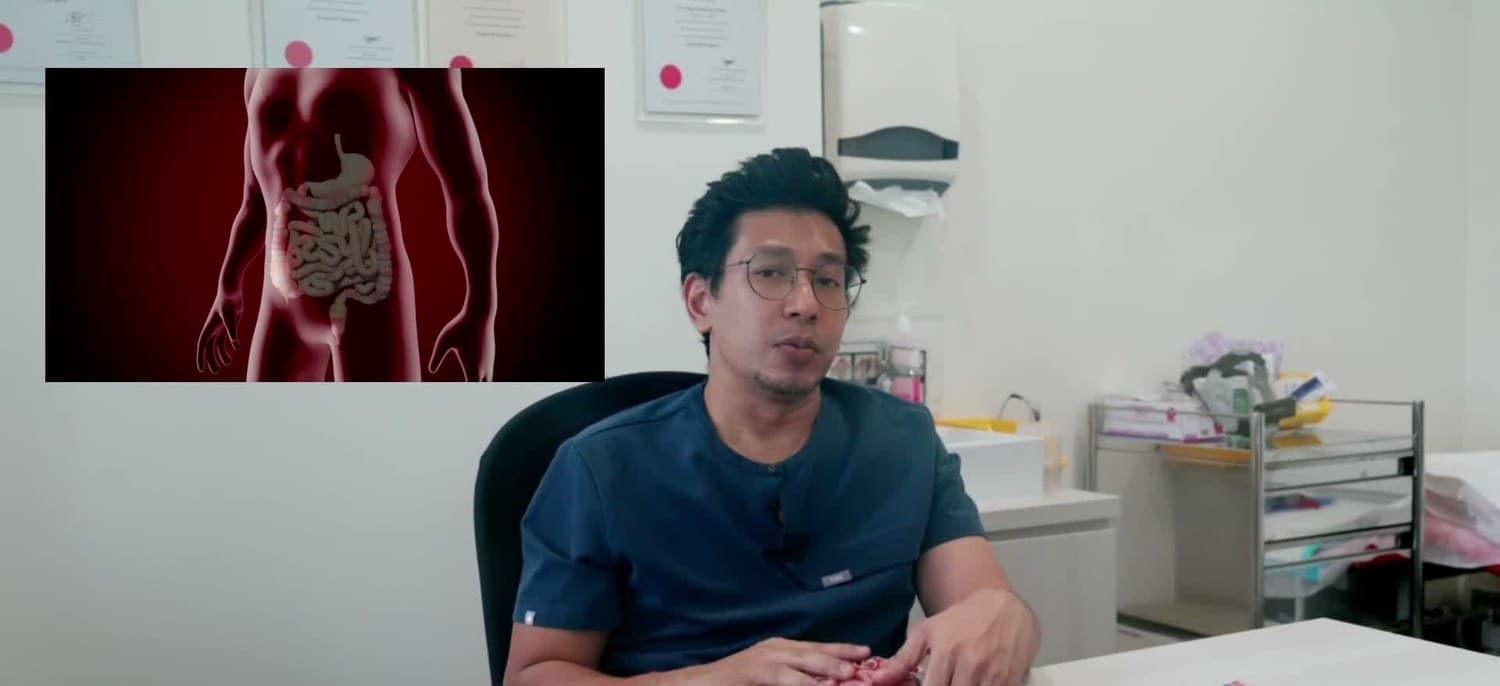
Why this matters
Or you may have noticed your stool has turned black, and you are not sure whether it matters.
Both can point to a stomach ulcer. The second is an emergency: call 995 or go to A&E.
This article sets out the stomach ulcer symptoms to watch for, the two causes behind most ulcers, why some ulcers cause no pain until they bleed, and how a gastroscopy finds them.
If you are vomiting blood, your vomit looks like coffee grounds, your stool has blood in it or is black, sticky and very smelly, or you have severe or sudden tummy pain or a tummy that is painful to touch, do not wait for a clinic appointment. Call 995 or go to the nearest A&E. These are among the warning signs the NHS lists for emergency care, and they can mean an ulcer is bleeding.
Key points
Key points
- Most stomach ulcers have one of two causes: an infection called H. pylori, or anti-inflammatory painkillers (NSAIDs) such as aspirin and ibuprofen.
- The usual symptom is a burning pain in the upper tummy. Many people with an ulcer have no symptoms at all until a complication appears.
- Black, tar-like stool can mean bleeding from the stomach or duodenum. That is an emergency, not a reason to wait and see.
A gastroscopy is the test that looks at the ulcer directly. Breath, stool and blood tests only tell you whether H. pylori is present.
- Treatment depends on the cause, so finding the cause matters as much as healing the sore.
What a stomach ulcer is, and how it differs from gastritis
A stomach ulcer is an open sore in the lining of the stomach. When the same kind of sore forms in the duodenum, the first part of the small intestine just past the stomach, it is called a duodenal ulcer. Both come under the name peptic ulcer disease. The US National Institute of Diabetes and Digestive and Kidney Diseases (NIDDK) defines a peptic ulcer simply as a sore on the lining of the stomach or duodenum.
Gastritis is inflammation of that same lining, without a break in it. The two are related, and the same causes can sit behind both. If your discomfort sounds more like a constant gnawing or a sore, unsettled stomach, the article on gastric pain and gastritis covers that side in detail.
| Term | Where | What it is |
|---|---|---|
| Stomach (gastric) ulcer | The lining of the stomach | An open sore |
| Duodenal ulcer | The duodenum, the first part of the small intestine just past the stomach | The same kind of sore |
| Gastritis | That same lining | Inflammation, without a break in it |
Stomach ulcer symptoms most people notice first
The most common stomach ulcer symptom is pain in the upper part of the tummy. People often describe it as burning. The NHS lists indigestion, heartburn, bloating, and feeling or being sick alongside the pain. NIDDK adds feeling full quickly and belching.
The timing of the pain can be a clue, though not a reliable one. According to NIDDK, some people feel it when the stomach is empty or at night, and it eases for a short time after they eat. For others, eating makes it worse.
| Symptom | What it can feel like | Named by |
|---|---|---|
| Upper tummy pain | Burning or aching, anywhere between the belly button and the breastbone | NHS, NIDDK |
| Indigestion or heartburn | A burning feeling that rises into the chest | NHS |
| Bloating and belching | A tight, full tummy and frequent burping | NHS, NIDDK |
| Feeling full quickly | Struggling to finish a normal-sized meal | NIDDK |
| Nausea or vomiting | Feeling sick, sometimes being sick | NHS, NIDDK |
None of these symptoms belongs to an ulcer alone.
Gastritis and reflux can produce much the same list.
A checklist can raise the question. It cannot answer it.
Why some stomach ulcers cause no symptoms at all
This is the part most people do not expect. NIDDK states that many people with peptic ulcers have no symptoms, and may not develop any until the ulcer leads to a complication. In other words, the first sign can be bleeding, not pain.
The same silence applies to the infection behind many ulcers.
10 to 15%
Of people infected with H. pylori who develop a peptic ulcer
When the 2005 Nobel Prize in Physiology or Medicine went to the two researchers who identified H. pylori, the Nobel Assembly noted that most people who carry the bacterium have no symptoms, and that about 10 to 15% of those infected develop a peptic ulcer at some point.
Source: The Nobel Assembly at Karolinska Institutet, 2005 press release
The H. pylori article explains why a silent infection still matters.
An ulcer can cause no pain at all. If you take anti-inflammatory painkillers regularly, have had an ulcer before, or have tested positive for H. pylori, mention it to your doctor even if your stomach feels fine.
When black stool is a sign that a stomach ulcer is bleeding
Bleeding is one of the complications NIDDK names for peptic ulcers, and peptic ulcers come first in its list of causes of bleeding in the upper digestive tract. NIDDK notes that black or tarry stool suggests bleeding in the upper digestive tract. Doctors call this melaena (also spelt melena). The NHS describes it as stool that is black, sticky and very smelly.
Not every dark stool is blood, though.
Two common medicines darken stool harmlessly, and one of them is part of H. pylori treatment.
| What you notice | What it can mean | What to do |
|---|---|---|
| Black, sticky, tar-like stool that smells very bad | Possible bleeding from the stomach or duodenum (NHS, NIDDK) | Emergency. Call 995 or go to A&E |
| Vomiting blood, or vomit that looks like coffee grounds | Possible bleeding from the stomach or duodenum (NHS) | Emergency. Call 995 or go to A&E |
| Red or maroon blood mixed with stool | Bleeding somewhere in the digestive tract (NHS, NIDDK) | Emergency. Call 995 or go to A&E |
| Darker stool while taking iron tablets | A common iron side effect, usually nothing to worry about (NHS) | Mention it to your doctor; seek urgent care if it is sticky and smelly, or you feel faint |
| Dark stool or tongue while taking bismuth | Harmless darkening that usually clears a few days after stopping (MedlinePlus) | As above |
Bismuth is relevant because bismuth-based combinations are a first-line H. pylori treatment in the American College of Gastroenterology guideline (Chey and colleagues, American Journal of Gastroenterology, published 2024). If you are on that course, dark stool is expected. Black, sticky stool with dizziness is not.
Watch for signs of significant blood loss as well. NIDDK lists dizziness or fainting and a rapid pulse among the reasons to seek care right away. Confusion, pale skin, cold hands and feet, and sweating can be signs of shock, which NIDDK calls life-threatening. The Singapore Civil Defence Force lists excessive bleeding and loss of consciousness among the emergencies that call for 995.
A bleeding ulcer is a hospital emergency, not a clinic booking.
Within 24 hours
A gastroscopy, for people admitted with upper digestive bleeding
The American College of Gastroenterology guideline (Laine and colleagues, American Journal of Gastroenterology, published 2021) suggests a gastroscopy within 24 hours for people admitted with upper digestive bleeding, and recommends treating an actively bleeding ulcer through the scope. That happens in a hospital, after you have been assessed in A&E.
Source: Laine and colleagues, American Journal of Gastroenterology, 2021 (opens in a new tab)
The wider picture of where digestive bleeding comes from, upper and lower, is set out on the gastrointestinal bleeding page.
What causes stomach ulcers, and what does not
Two causes sit behind most ulcers. The NHS and NIDDK both name the same pair: infection with H. pylori, and regular use of anti-inflammatory painkillers.
H. pylori
This is a spiral-shaped bacterium that lives in the stomach lining. In 1982, when it was discovered, stress and lifestyle were considered the main causes of ulcers. By the time of the 2005 Nobel Prize, the Nobel Assembly stated that H. pylori causes more than 90% of duodenal ulcers and up to 80% of stomach ulcers. The picture has shifted since. A seminar published in The Lancet in 2017 (Lanas and Chan) describes a rapidly declining prevalence of H. pylori, and notes that ulcers linked to neither H. pylori nor painkillers now pose real diagnostic challenges.
Anti-inflammatory painkillers
NSAIDs include aspirin, ibuprofen and naproxen. NIDDK says your risk is higher if you take them for a long time, take high doses or more than one at once, take them with other medicines that raise ulcer risk, or take them while you also carry H. pylori.
Rarer causes
These include Crohn’s disease and Zollinger-Ellison syndrome, a condition in which the stomach makes too much acid. Both appear in the list of causes that UK guidance asks doctors to rule out when an ulcer does not heal (NICE guideline CG184, recommendation 1.7.8).
Stress and spicy food
These were once blamed, and the H. pylori discovery overturned that view. They are not among the causes the NHS or NIDDK name. The NHS advice on easing symptoms does include managing stress and cutting down on spicy and fatty food, coffee and alcohol, so it is reasonable to go easy on them while an ulcer heals.
31%
H. pylori seroprevalence quoted for Singapore
The infection is still common here. A 2017 paper quotes a seroprevalence of 31% in Singapore, meaning antibodies that show past or present exposure. It was published in the Singapore Medical Journal by doctors at Changi General Hospital (Chew and colleagues).
Source: Chew and colleagues, Singapore Medical Journal, 2017 (opens in a new tab)
Who is more likely to develop a stomach ulcer
NIDDK lists the groups at higher risk:
- people with H. pylori infection
- people who take NSAIDs, especially regularly
- older adults
- people who have had a peptic ulcer before
- people who smoke
The NHS also names smoking and older age. If you take a blood thinner, note that NIDDK lists blood thinners alongside H. pylori and NSAIDs among the factors behind ulcers that bleed. Do not stop a blood thinner or a heart aspirin on your own. Raise it with the doctor who prescribed it.
How a stomach ulcer is diagnosed, and what each test shows
A gastroscopy looks at the ulcer directly. An ulcer may not show clearly on a CT scan or X-ray, a point Dr Sulaiman makes on his gastroscopy page. Other tests answer a narrower question: is H. pylori present?
| Test | What it shows | What to know |
|---|---|---|
| Gastroscopy | The ulcer itself, its size and site, and samples (biopsies) of the lining | A thin, flexible scope passes through the mouth, usually with sedation. Bleeding can sometimes be treated during the same session |
| Urea breath test | Whether H. pylori is present now | Acid-reducing medicine and recent antibiotics can affect the result |
| Stool antigen test | Whether H. pylori is present now | Done on a stool sample |
| Blood antibody test | Whether you have been exposed to H. pylori | Cannot tell a past infection from a current one |
The NHS lists the breath, stool and blood tests and gastroscopy as the ways an ulcer and its cause are checked.
Singapore guidance helps decide which comes first. Writing in the Singapore Medical Journal in 2017, Chew and colleagues state that a “test-and-treat” approach for H. pylori is a reasonable option for people aged 40 and below. People with alarm features should be referred for a gastroscopy whatever their age. Those features are:
- anaemia (a low blood count)
- weight loss or loss of appetite
- symptoms that are new and getting steadily worse
- black, tarry stool or vomiting blood
- difficulty swallowing
Tell your doctor about acid-reducing medicine before an H. pylori test. The same paper advises stopping proton pump inhibitor (PPI) medicine for at least 2 weeks before a breath test, and waiting at least 4 weeks after antibiotics. Do not stop a prescribed medicine without asking first; your doctor will plan the timing with you.
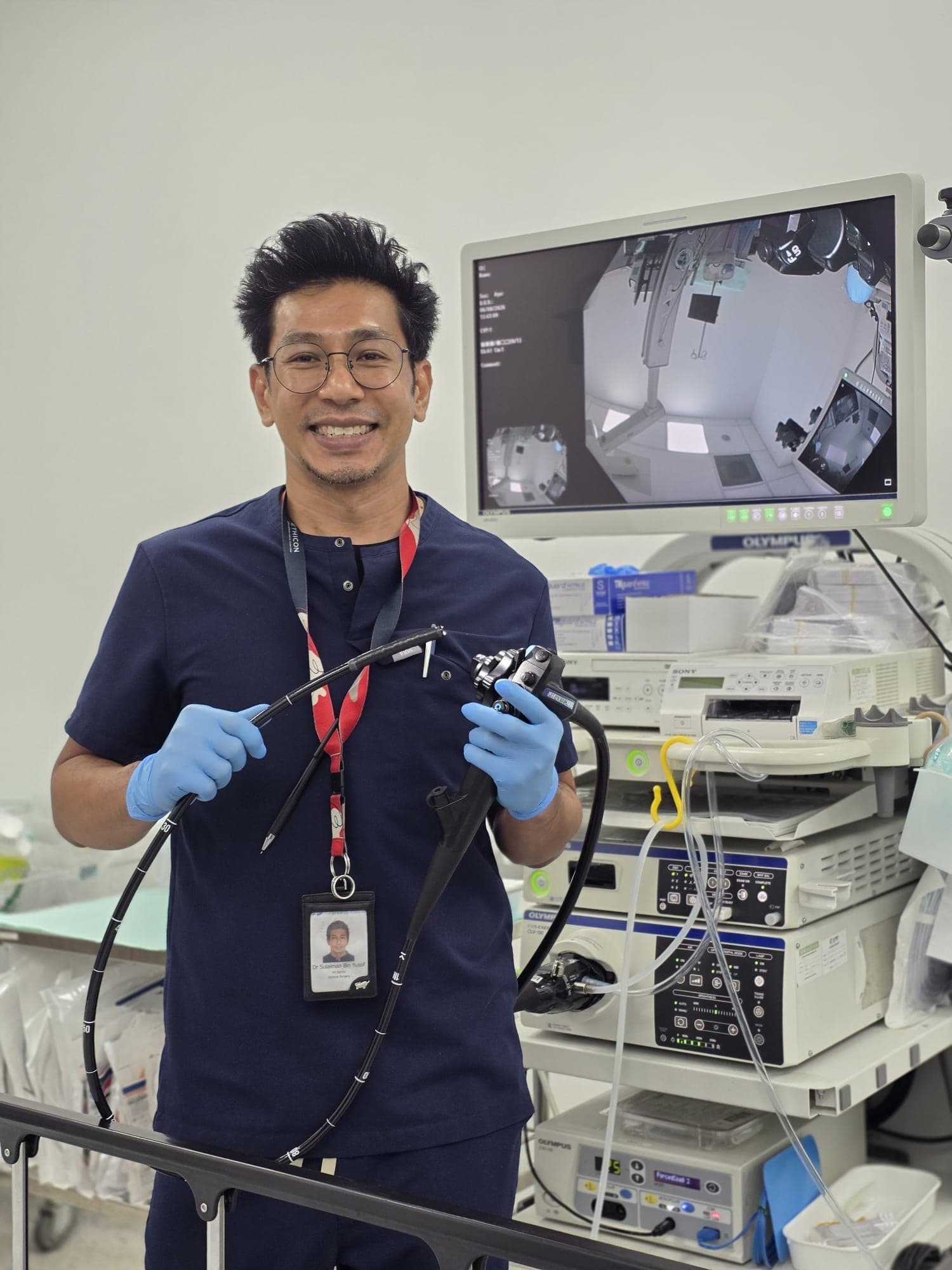
Which specialist performs the camera test? A gastroscopy for this purpose is done by either a gastroenterologist or a general surgeon. Dr Sulaiman Bin Yusof, a Senior Consultant Colorectal and General Surgeon, performs gastroscopy as part of an upper digestive assessment. Risks are uncommon and include a reaction to sedation, bleeding and, rarely, a tear in the gut wall, according to NIDDK. Your doctor will go through them with you. What happens before, during and after the procedure is set out on the gastroscopy page.
How stomach ulcers are treated once the cause is known
Treatment follows the cause. The UK’s NICE guideline CG184 sets out a clear pathway, and the Singapore Medical Journal paper adds the local detail.
Find the cause
H. pylori, NSAIDs, or neither
Treat the cause
Eradication treatment, or stop the NSAID
Heal the sore
Acid-reducing medicine
Confirm
A breath test, or a repeat gastroscopy
| What is found | Usual approach | Follow-up |
|---|---|---|
| Ulcer with H. pylori | Eradication treatment, combining antibiotics with acid-reducing medicine. Your doctor chooses the regimen and its length; do not shorten or stop a course early (Chew and colleagues, 2017; NICE 1.7.1) | A breath test at least 4 weeks after treatment ends, to confirm the infection is gone (Chew and colleagues) |
| Ulcer while taking NSAIDs | Stop the NSAID where possible, and take acid-reducing medicine for 8 weeks (NICE 1.7.2) | If H. pylori is also present, eradication treatment follows |
| Ulcer with neither cause | Acid-reducing medicine for 4 to 8 weeks (NICE 1.7.5) | Look for rarer causes if symptoms persist |
| Stomach (gastric) ulcer with H. pylori | Treatment as above | A repeat gastroscopy 6 to 8 weeks after treatment starts, depending on the size of the ulcer (NICE 1.7.3) |
Why does the cause matter so much? Before H. pylori was understood, ulcers healed with acid-reducing medicine often came back, because the bacteria and the inflammation stayed behind. That is the point the Nobel Assembly made in 2005, and it is why clearing the infection is part of the treatment, not an optional extra.
If an ulcer does not heal, NICE recommendation 1.7.8 asks doctors to look for the reasons: medicine not taken as planned, an H. pylori infection that was missed, painkillers taken without realising, other medicines, cancer, and rare causes such as Zollinger-Ellison syndrome or Crohn’s disease.
When a stomach ulcer needs a procedure or surgery
Most ulcers are treated with medicine, and surgery is the exception. A procedure becomes necessary when an ulcer causes one of the complications NIDDK lists: bleeding, a hole through the wall (perforation), penetration into a nearby organ, or a blockage that stops food passing.
Bleeding
This is usually handled through the gastroscope. The American College of Gastroenterology guideline recommends treating actively bleeding ulcers during the scope, and suggests embolisation, a procedure done through a thin tube (catheter) placed in a blood vessel, if scope treatment fails.
Perforation
A hole lets stomach contents leak into the abdomen and leads to peritonitis, inflammation of the lining of the abdomen. The NHS lists severe tummy pain and a tummy that is painful to touch among the signs to call for emergency help. Repair is an operation, and the standard approach is an omental patch repair, which can be done by keyhole or open surgery, according to a 2023 analysis by surgeons at Tan Tock Seng Hospital and the National University of Singapore published in the Journal of Trauma and Acute Care Surgery (Chan and colleagues). The peritonitis page explains that condition in more depth.
Blockage
NIDDK also lists a blockage that stops food passing through the digestive tract.
Questions people often ask about stomach ulcer symptoms and care
I am worried I might have a stomach ulcer. Which specialist should I see for a camera test?
A gastroscopy can be done by a gastroenterologist or a general surgeon. Either is appropriate for a routine diagnostic scope. Uncommon cases needing an operation are treated in hospital; Dr Sulaiman can explain when surgery is considered. Your GP can refer you, and you can also arrange a specialist consultation directly. If you have black, sticky stool or are vomiting blood, go to A&E instead.
How much does stomach ulcer surgery cost?
Most stomach ulcers do not need surgery; they are treated with medicine. When surgery is needed, it is usually an emergency for a perforation or for bleeding that cannot be controlled through the scope, and the bill depends on the hospital, the length of stay and what is found. A single figure would mislead you. The cost of a diagnostic gastroscopy, which is the usual first step, is set out on the gastroscopy page.
Is black stool always a sign of a bleeding ulcer?
No. Iron tablets and bismuth medicines commonly darken stool, and that is usually harmless. Stool that is black, sticky like tar and very smelly is different, especially with dizziness, a racing heart or fainting. Treat that as an emergency and call 995 or go to A&E.
Can a stomach ulcer turn into cancer?
UK guidance treats this possibility seriously for ulcers in the stomach itself. NICE advises a repeat gastroscopy 6 to 8 weeks after treatment starts for a stomach ulcer with H. pylori, and lists cancer among the causes to rule out when an ulcer does not heal. A repeat scope is how that question gets answered.
Should I stop my painkillers if I think I have an ulcer?
For a confirmed ulcer, NICE advises stopping NSAIDs where possible. Many people take aspirin or a blood thinner for their heart, though, and stopping those carries its own risks. Speak to the doctor who prescribed them before you change anything.
When to speak to a specialist about stomach ulcer symptoms
Most stomach ulcers have a cause that can be tested for, and treatment is usually medicine.
The hard part is that the symptoms overlap with gastritis and reflux, and some ulcers give no warning at all.
If you have had burning upper tummy pain for weeks, take anti-inflammatory painkillers regularly and have stomach symptoms, have tested positive for H. pylori, or have any of the alarm features listed above, it is worth discussing with a doctor, who can advise which test suits you. Dr Sulaiman Bin Yusof performs gastroscopy as part of an upper digestive assessment. Message the clinic on WhatsApp to arrange a consultation.

If you are vomiting blood, or passing black, sticky stool, do not message the clinic first. Call 995 or go to the nearest A&E.
The surgeon
The surgeon.
Dr Sulaiman's practice is built around complex colorectal surgery, with robotic-assisted technique as his primary surgical platform for colectomy and anterior resection. He has contributed eight peer-reviewed publications.
Patients consult Dr Sulaiman for his depth of experience in colorectal cancer and perianal conditions, as well as for consultations that are thorough, unhurried, and focused on giving patients a clear understanding of their options.
Former Director of Endoscopy, Changi General Hospital
He led the endoscopy unit at Changi General Hospital, a high-volume diagnostic service covering colonoscopy and gastroscopy across a broad and diverse patient population, and brings that public-sector depth to his private practice.
Book a consultation
Burning upper tummy pain for weeks. Start with an assessment.
Most stomach ulcers have a cause that can be tested for, and treatment is usually medicine. If you have had burning upper tummy pain for weeks, book a consultation to have it assessed.