A change in bowel habits, sized honestly
A change in bowel habits usually settles. Three weeks is the line.
If your bowels have been behaving differently and you are trying to work out whether it matters, the most useful thing you can do first is count the weeks.
Written by Dr Sulaiman Bin Yusof, Colorectal and General Surgeon. MBChB (Sheffield), M.Med (Surgery), FRCSEd (General Surgery).
Most people have settled on an explanation before they arrive: a change in diet, a stressful period at work, simply getting older. Most of the time they are right. The reason to have a lasting change looked at is not that the odds are bad, but that the odds cannot be read from the symptom.
+65 8491 1525
Most people arrive with the explanation already decided.
Most of the time they are right, and that is said to reassure you rather than to dismiss the symptom.
Patients who have noticed their bowels behaving differently usually have a reason ready before they sit down. A change in diet. A stressful period at work. Simply getting older. Everyday life moves our bowel habits around constantly, and most of the changes people notice turn out to be temporary and benign.
The reason to have a lasting one looked at is not that the odds are bad. It is that the odds cannot be read from the symptom, and a change in bowel habits is one of the few symptoms where being early genuinely changes what happens next.
There is no single normal, which is why the comparison is with yourself.
This has been counted. A prospective study of 1,897 adults, 72.2% of a random stratified population sample, found that the most common habit was once daily and that even so it was a minority practice: a regular 24-hour cycle was apparent in only 40% of men and 33% of women. Another 7% of men and 4% of women had a regular twice or thrice daily habit, and a third of women opened their bowels less often than daily. The authors concluded that conventionally normal bowel function is enjoyed by less than half the population (Heaton et al., Gut, 1992).
So there is no single normal to be measured against, and that is the practical point rather than a piece of trivia. What matters is your own usual pattern, and whether you have drifted away from it.
Frequency is only one part of the picture, and on its own it is the weaker part. Whatever your pattern, stool should be soft and formed, and it should pass without straining and without leaving you feeling that you have not finished. The form of the stool turns out to be the more informative signal: in the study that validated the scale below, stool form tracked whole-gut transit time more closely (correlation of -0.54) than either how often people went (0.35) or how much they passed (-0.41) (Lewis and Heaton, Scandinavian Journal of Gastroenterology, 1997).
| Type | What it looks like | What it suggests |
|---|---|---|
| 1 | Separate hard lumps, like nuts | Slow transit |
| 2 | Sausage-shaped but lumpy | Slow transit |
| 3 | Like a sausage with cracks on the surface | The healthy middle |
| 4 | Like a sausage or snake, smooth and soft | The healthy middle |
| 5 | Soft blobs with clear-cut edges | Faster transit |
| 6 | Fluffy pieces with ragged edges, mushy | Faster transit |
| 7 | Watery, no solid pieces, entirely liquid | Faster transit |
The explanations that account for most of it.
Most changes in bowel habits have a simple cause, and it is worth running down this list before anything else, because a cause you can name is a cause you can test by removing it.
- Not enough fibre or not enough water, usually after a change in routine
- Medicines, including iron supplements, strong painkillers such as opioids, some antidepressants, and certain blood pressure tablets such as calcium-channel blockers
- Travel, especially with a new diet or a new time zone
- A stressful stretch at work, or a run of poor sleep
- A short infection such as gastroenteritis
- A new supplement or protein powder, which patients often do not think of as a medicine
The useful move with any of these is the same. Change the one thing, give it two weeks, and see whether your own normal comes back. If it does, you have your answer. If it does not, the fact that a plausible explanation existed stops being evidence of anything.
What counts as a significant change in bowel habits.
The simplest guide is time. A change that has lasted more than two to three weeks counts as significant, whatever it is. Below that, most things are worth watching rather than investigating. Above it, the explanation you had in mind has run out of road.
The change itself can take any of these forms.
- Stools that have turned thin, like a pencil or a ribbon
- Mucus, a clear or whitish slime, passed with the stool week after week
- A feeling that you have not finished, even after passing motion
- A new urgency to go, or waking at night to open your bowels
- Leaking or losing control when you never used to
- Alternating constipation and looseness that keeps cycling
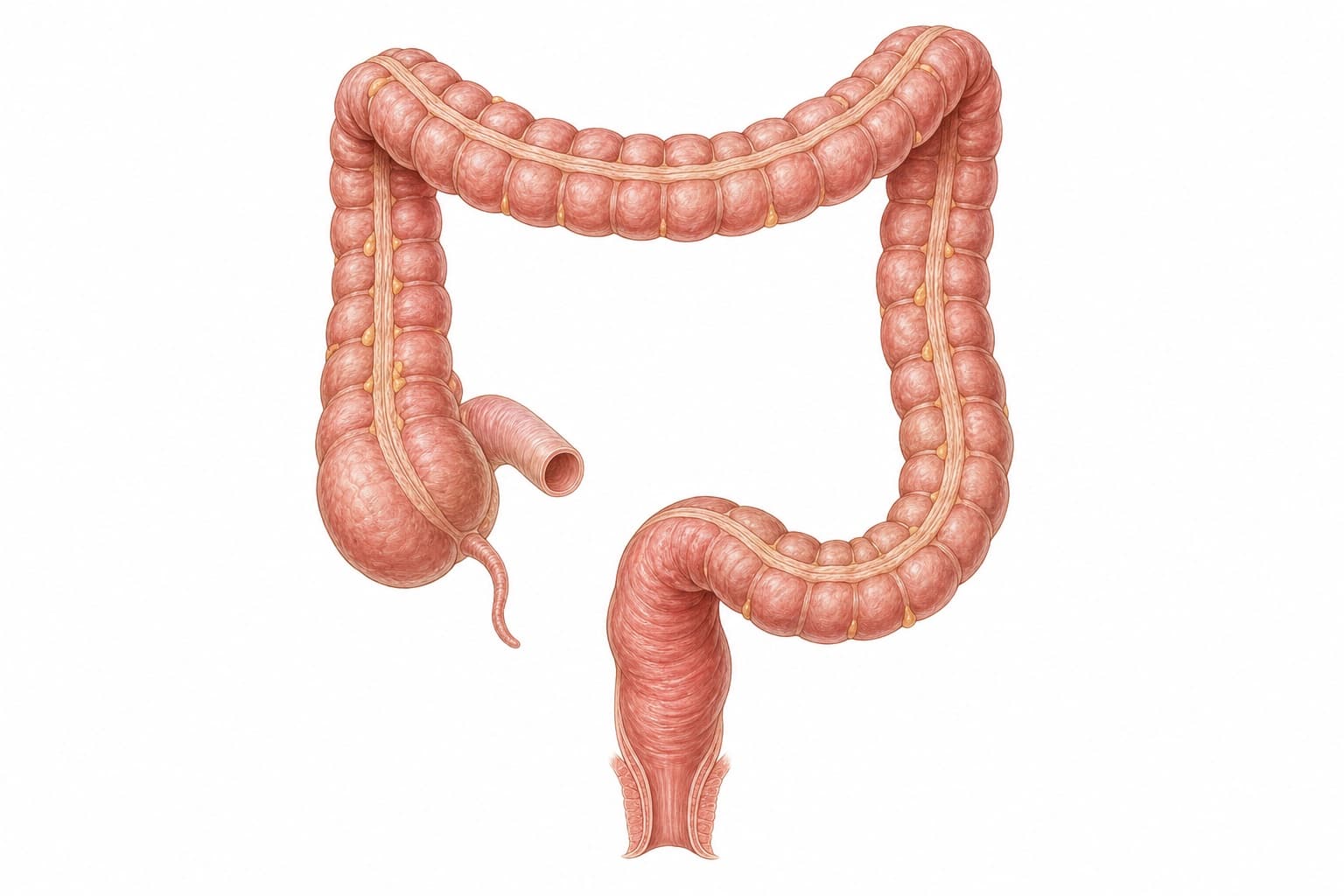
What a change in bowel habits is actually worth as a warning sign.
This has been measured, and the honest version of the answer is more useful than the reassuring one. A case-control study of 5,477 patients with colorectal cancer, matched against 38,314 controls by age, sex and practice, put a number on each symptom (Hamilton et al., BMC Medicine, 2009).
| Symptom | Chance it is cancer | 95% confidence interval |
|---|---|---|
| Rectal bleeding | 4.5% | 3.5 to 5.9 |
| Change in bowel habit | 3.9% | 2.8 to 5.5 |
| Abdominal pain | 1.2% | 1.0 to 1.4 |
| Diarrhoea | 1.2% | 1.0 to 1.5 |
| Weight loss | 0.8% | 0.5 to 1.3 |
| Constipation | 0.7% | 0.6 to 0.8 |
Every figure in this table is from Hamilton et al., BMC Medicine, 2009, and every one is the value for a man aged 80 or over.
Read the ceiling on that table before you read the table. Every figure in it is for a man aged 80 or over, the highest-risk group in the study. The authors state that the values are lower in women and in younger patients. So a 45-year-old woman reading the 3.9% row is looking at a number that is higher than hers, not equal to it (Hamilton et al., BMC Medicine, 2009).
Two things follow, and they pull in opposite directions, which is why both are here. The first is that around 96 in every 100 people in the worst-case group with this symptom do not have cancer. The second is that a change in bowel habit and rectal bleeding are the only two symptoms on that list carrying meaningful risk, and the same study found that only 27% of patients had reported either of them. Most cancers were presenting through the low-risk symptoms in the rows below.
The combination is what matters more than either alone. A systematic review of 23 primary-care studies put the pooled predictive value of rectal bleeding at 8.1% in those aged 50 and over, and found the risk higher again when bleeding arrived together with a change in bowel habit (Astin et al., British Journal of General Practice, 2011). Two symptoms at once is the pattern to act on rather than average out.
27%
of patients later diagnosed with colorectal cancer had reported either of the two higher-risk symptoms. That is the argument for taking a change in bowel habits seriously even when it is the only thing you have noticed.
The changes that do not get the two-week rule.
These are worth an appointment now rather than after a period of watching.
- Blood, in any amount or any colour: bright red, darker blood mixed into the stool, or black and tarry motions
- Weight you are losing without trying, alongside a change in bowel habits
- Abdominal pain that keeps returning over weeks, rather than discomfort after a heavy meal
- A change that started suddenly rather than drifting, particularly with vomiting or a distended abdomen
- Anaemia found on a blood test with no obvious cause
Bleeding is the one people most often talk themselves out of, usually by attributing it to haemorrhoids, which is frequently correct and is not something to establish from the outside. There is a fuller account of the possibilities in blood in your stool and what it usually means.
Who should act on a change in bowel habits sooner than everyone else.
If colorectal cancer runs in the family
A parent, brother, sister or child who has had colorectal cancer raises your own risk, and it also moves your screening forward. For a family history, screening generally starts around age 40, or ten years before the youngest affected relative was diagnosed, whichever comes first. A change in bowel habits on top of that history is not something to give three weeks.
If you have had polyps or inflammatory bowel disease
A previous history of colon polyps, ulcerative colitis or Crohn's disease means a new change in bowel habits has a shortlist of explanations that a first-time symptom does not, and most of them are worth confirming rather than assuming.
If you are 50 or older
For someone of average risk, screening colonoscopy from age 50 is the standard recommendation here, which is where Singapore's own screening guidance sets the line. If you are in that age band and your bowel habits have changed for no clear reason, the two questions merge: you were due a look anyway, and now there is a symptom pointing at the same test.
What actually happens when you bring it in.
The consultation starts with what changed and how long it has been going on, followed by an examination. Where it is needed, that leads to a stool test or a colonoscopy, and the choice between them is not arbitrary.
A faecal immunochemical test looks for blood you cannot see. It is quick, it is done at home, and a positive result is a strong reason to look further. What it cannot do is say where the blood came from, and a clear result does not rule out something that simply did not bleed on the day you collected the sample.
A colonoscopy answers both questions at once, because the lining is examined directly and anything found can be removed in the same session. The part people worry about is not the procedure but the bowel preparation, which is the day before, and which is the part you control.

The questions people ask once they have started counting the weeks.
Whether stress alone explains it, what the cancer risk actually is, whether a stool test is enough, and what happens if it settles on its own.
Can stress alone change my bowel habits?
Yes, and it often does. Stress affects how quickly the bowel moves, so a hard stretch at work or a run of bad sleep can change both how often you go and what the stool looks like. The test is what happens afterwards. If things settle once the pressure lifts, stress was a fair explanation. If the change carries on for another two to three weeks, it needs looking at on its own.
Does a change in bowel habits mean I have cancer?
Almost always not, and there is a number for it. In a case-control study of 5,477 patients with colorectal cancer matched against 38,314 controls (source: Hamilton W, et al. The risk of colorectal cancer with symptoms at different ages and between the sexes. BMC Medicine, 2009, opens in a new tab), a change in bowel habit carried a positive predictive value of 3.9%. That figure is for the highest-risk group in the study, men aged 80 and over, and the authors state that it is lower in women and in younger patients. So around 96 in every 100 people in the worst-case group who report this symptom do not have cancer. The reason to be assessed anyway is that a change in bowel habit is one of only two symptoms in that study that carried meaningful risk, and it is a symptom that responds very well to being caught early.
Is a stool test enough, or do I need a colonoscopy?
A faecal immunochemical test looks for blood in the stool that you cannot see, and it is a useful first step. What it cannot do is tell you where the blood came from, and a clear result does not rule out a growth that simply did not bleed on the day you collected the sample. A colonoscopy lets the bowel lining be examined directly and any polyps removed at the same time. Which one suits you depends on your symptoms, your age, and your family history.
My symptoms settled before my appointment. Should I still come?
If the change lasted less than two to three weeks and everything has gone back to your own normal, that is the pattern of a temporary cause and it is reasonable to leave it. Two things change that answer. The first is blood: any bleeding is worth assessing even if it happened once and stopped. The second is a pattern that keeps returning, because a symptom that settles and comes back is not the same as a symptom that resolved. If you are unsure which of those describes you, keep the appointment and say exactly that.
What should I note down before the consultation?
Three things carry most of the weight. When the change started, as close to a date as you can manage. What specifically changed, meaning frequency, the form of the stool, urgency, or a sense of not finishing. And whether anything else changed at the same time, including new medicines, a new supplement, a trip, or a period of illness. If there has been any bleeding, note when and what it looked like. That is roughly the first five minutes of the consultation, and having it ready means the rest can be spent on the examination.
Related reading
Where this leads next.
The author

Dr Sulaiman Bin Yusof
Senior Consultant Colorectal and General Surgeon, practising at Gleneagles, Mount Elizabeth Novena, Parkway East, Mount Alvernia and Farrer Park. He asks what has changed and how long it has been going on, examines you, and where it is needed arranges a stool test or a colonoscopy to find the cause.
- MBChB (Sheffield)
- M.Med (Surgery)
- FRCSEd (General Surgery)
- Fellowship
- Peter MacCallum Cancer Centre, Melbourne
- Previously
- Former Director of Endoscopy, Changi General Hospital
- Also
- Visiting Consultant, Changi General Hospital
The information here is for general informational purposes only and does not replace consultation, diagnosis, or treatment by a qualified medical professional. Symptoms vary between individuals; if any of the warning signs above apply to you, seek a clinical evaluation.
Getting seen
Most changes are temporary. The ones that are not are the reason the rule is three weeks.
If a change in bowel habits has lasted longer than a few weeks, the consultation is short and it is the step that tells you which explanation is yours.
Contact us on WhatsApp to arrange a consultation.
+65 8491 1525