Haemorrhoids and anal fissures, told apart
Haemorrhoids or an anal fissure? The pain is what tells you.
If you have bleeding and discomfort and you have decided it is piles, the one thing worth checking first is what the pain does after you have finished.
Written by Dr Sulaiman Bin Yusof, Colorectal and General Surgeon. MBChB (Sheffield), M.Med (Surgery), FRCSEd (General Surgery).
Haemorrhoids are common, the symptoms broadly fit, and a cream is easy to buy. The difficulty is that a small tear in the anal canal produces the same two symptoms, and the treatment that settles one does very little for the other.
+65 8491 1525
The instinct is reasonable. It is also wrong about half the time.
Rectal bleeding should never be self-diagnosed. A clinical assessment is the only reliable way to confirm the diagnosis before any treatment begins.
Haemorrhoids are one of the most common conditions Dr Sulaiman treats, and one of the most under-treated, because patients wait far longer than they should before coming in. Almost every week a patient sits across from him having spent months managing symptoms quietly with pharmacy creams, convinced it is minor or too embarrassed to have it properly assessed.
Some of those months are spent treating the wrong thing. A small tear in the anal canal, an anal fissure, produces the two symptoms a patient notices most: blood, and discomfort. From the outside the two conditions look alike. They are not alike at all, and the treatment that settles one does very little for the other.
That matters more with a fissure than it sounds. It is one of the most painful conditions he sees in clinic, and his advice on it is always the same: come early. Assessment is straightforward, treatment starts quickly, and the sooner it begins, the less likely a simple acute fissure becomes a chronic problem requiring surgery.
Two different tissues, two different problems, one table.
Haemorrhoids are swollen blood vessels in and around the anus. An anal fissure is a small tear in the lining of the anal canal, and that tear exposes underlying muscle and nerve tissue, which is why even a minor fissure can cause pain out of all proportion to its size. Both conditions are ordinary rather than rare: anal fissures carry a lifetime prevalence of about 11% (Bonyad et al., Langenbeck's Archives of Surgery, 2024), and haemorrhoids a good deal more, as the figure below sets out.
| Feature | Haemorrhoids | Anal fissure |
|---|---|---|
| What it is | Swollen blood vessels in and around the anus | A small tear in the lining of the anal canal |
| The pain | Often mild or absent; itching, pressure, or a lump you can feel | Sharp and cutting as the stool passes, then an ache or spasm for 30 minutes to several hours |
| The bleeding | Bright red, on the paper or in the bowl, frequently with no pain | Bright red, usually a small amount on the paper or the surface of the stool |
| A lump | Common; may appear or protrude during a bowel movement | Absent in an acute tear; a chronic one forms a small sentinel skin tag |
| What set it off | Straining, low fibre, long hours seated, pregnancy | A hard or large stool, constipation, or repeated diarrhoea |
| Where it sits | Internal above the pain-sensitive zone, external below it | Usually the posterior midline, the 6 o'clock position |
25.92%
of adults worldwide have haemorrhoidal disease at any given moment, on the pooled estimate from the largest review of the question. Lifetime prevalence came out at 27.19%, and it was higher in women, at 27.33%.
Source: Esmaeilnia Shirvani et al., Annals of Medicine, 2026 (opens in a new tab)
Why one of them hurts and the other often does not.
Internal haemorrhoids sit above the pain-sensitive zone of the anal canal. That is the whole reason they can bleed steadily without hurting: there is very little sensation where they are. External haemorrhoids sit below that line, can be felt, and become genuinely tender when a clot forms inside one.
A fissure is the opposite case. The tear exposes muscle and nerve tissue directly, so it hurts at the moment of passing stool. Then the internal anal sphincter contracts in response to the tear, and that spasm is what carries the pain on for 30 minutes to several hours after the reader has finished and left the bathroom.
So the useful question is not how much it hurts. It is when it hurts, and for how long afterwards.
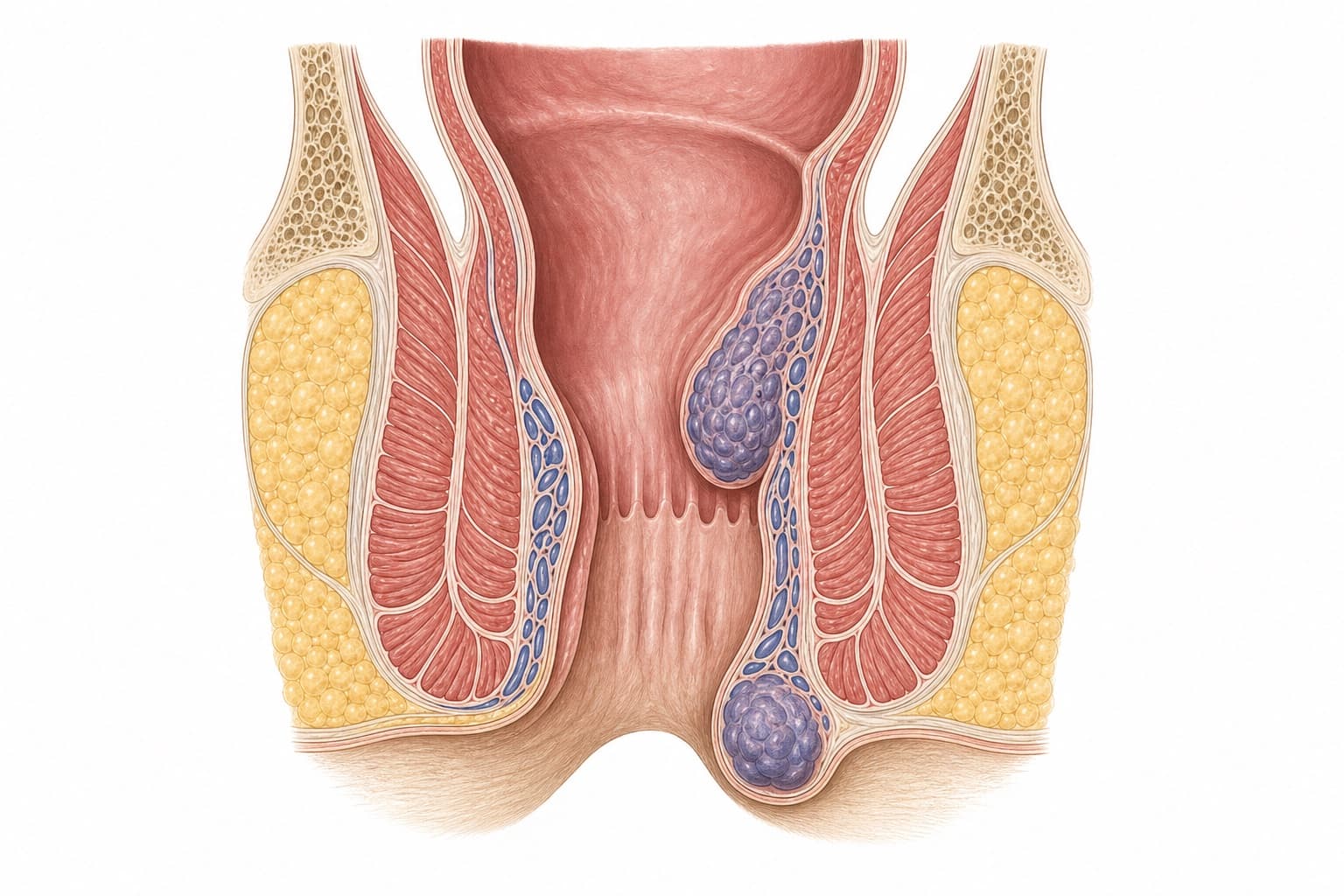
What haemorrhoids feel like, in the words patients use.
Symptoms depend on whether the haemorrhoids are internal or external, and on their grade. The ones described most often in clinic are these.
- Bright red rectal bleeding on tissue paper or in the toilet bowl
- Itching or irritation around the anal area
- Discomfort or pressure during or after bowel movements
- A soft lump or swelling near the anus
- Mucus discharge after bowel movements
- A feeling of incomplete evacuation
Grade is what decides the treatment
Internal haemorrhoids are graded 1 to 4 based on how far they prolapse, and the grade determines what is offered. External haemorrhoids are classified separately; when one thromboses, meaning a blood clot forms within the tissue, it causes acute pain and swelling that often requires prompt intervention. That last case is the one exception to the rule that haemorrhoids hurt less than a fissure, and it is worth knowing about, because a patient who has read that haemorrhoids do not hurt may sit on an acutely painful one for days.
The full grading system, the treatment options at each grade, and what each one costs are set out on the haemorrhoids page. The 2024 clinical practice guidelines from the American Society of Colon and Rectal Surgeons set out the same grade-led approach.
What an anal fissure feels like, and why the timing gives it away.
The description is remarkably consistent between patients, which is what makes it useful. The pain peaks during the movement and then keeps going.
- Sharp pain during bowel movements, described as cutting, tearing, or burning at the moment of passing stool
- A dull ache or spasm that continues for 30 minutes to several hours afterwards
- Bright red blood on toilet paper or on the surface of the stool, usually small in volume but vivid in colour
- Itching or irritation around the anus, particularly as the edges dry between episodes
- A small lump near the anus, the sentinel skin tag, if the fissure has become chronic
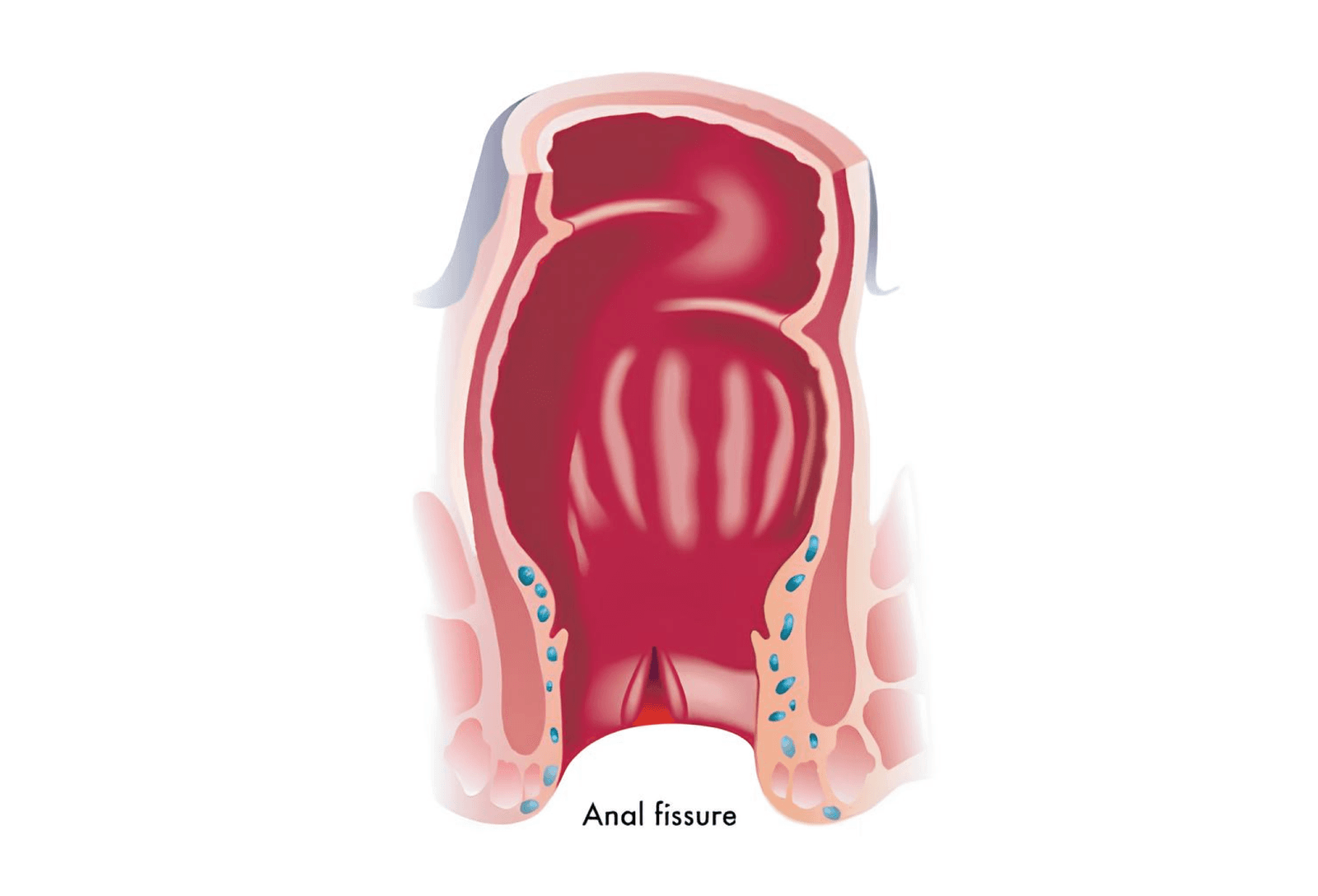
The cycle that keeps an anal fissure open for months.
A fissure is not simply a wound waiting to heal. It is a wound held open by the muscle underneath it, and the loop below is why a tear that should have closed in a fortnight is still there at Christmas.
A hard stool tears the lining
Constipation is the usual reason behind it, though repeated diarrhoea can do the same.
The sphincter goes into spasm
The internal anal sphincter contracts in response to the tear, which is the ache that lasts for hours.
Spasm cuts the blood supply to the tear
A wound with reduced blood flow cannot close, which is why a fissure can sit there for months.
The next bowel movement is dreaded, so it is delayed
Stool sits longer, hardens further, and tears the same spot again.
A tear present for fewer than six weeks is acute: the tissue is fresh and the edges are clean. Past six weeks, or recurring, it is chronic, and the base of the tear develops exposed fibres of the internal sphincter while a small sentinel skin tag forms at the lower edge. That tag is a reliable sign the fissure has become chronic, and it is the single most useful thing a patient can notice themselves. The 2023 anal fissure guidelines from the American Society of Colon and Rectal Surgeons draw the same line at six weeks, and it is one of the sources named on his own anal fissure page.
Why one cream cannot treat both a haemorrhoid and an anal fissure.
A pharmacy haemorrhoid cream reduces itching and inflammation. It does not shrink or remove a haemorrhoid, and it does nothing at all for a tear that is being held open by muscle. Weeks of it buy comfort without progress, which is exactly the pattern that turns an acute fissure into a chronic one.
The prescribed ointments used for fissures do something structurally different: they relax the internal sphincter so blood can reach the tear. The size of that effect has been pooled across 75 randomised trials and 5,031 participants. Glyceryl trinitrate healed 48.9% of fissures against 35.5% on placebo, a real difference and a smaller one than the headline number suggests, and late recurrence followed in around half of those initially cured. The calcium channel blockers, diltiazem and nifedipine, came out equivalent to glyceryl trinitrate with fewer adverse effects, which is why they are the practical alternative when the headaches are not tolerated (Nelson et al., Cochrane Database of Systematic Reviews, 2012). That review is also blunt that no medical therapy comes close to surgery once a fissure is chronic, and that none of them carried surgery's risk to continence.
None of that is available over a pharmacy counter, and none of it is appropriate before an examination has confirmed what is being treated. That is the real cost of self-diagnosis here: not the money spent on the wrong cream, but the weeks the right treatment was not being used.
What haemorrhoids and anal fissures each actually need.
Both start conservatively and both escalate, and that is where the similarity ends. The tissue being treated is different, so the step that works is different at every level.
| Stage | Haemorrhoids | Anal fissure |
|---|---|---|
| First step | More fibre, adequate fluids, no straining, and no sitting on the toilet with a phone | Softening the stool so the tear is not reopened daily, plus warm sitz baths |
| Next step | Rubber band ligation in the clinic for grade 1 and grade 2, under five minutes, no anaesthesia | A prescribed topical that relaxes the sphincter, reviewed at two weeks |
| If that is not enough | Laser, stapled, or conventional surgery, matched to grade and anatomy | Botox into the internal sphincter, or a lateral internal sphincterotomy |
| What settles it | The grade, your anatomy, and how disruptive a recovery you can accept | Whether the tear is acute or chronic, and whether the spasm has been addressed |
In Dr Sulaiman's practice, roughly half of acute fissures heal without surgery once the stool is managed and a topical treatment is started, and the odds are better still when symptoms have been present for less than a month. That is his clinical experience rather than a trial result, and the trials point the same way: medical therapy is worth trying first, and it is far weaker than surgery once a fissure has become chronic (Nelson et al., Cochrane Database of Systematic Reviews, 2012). Both are the argument for coming in early. The full ladders, with recovery times and what each step costs, are on the anal fissure page and the piles surgery page.
The reason a good guess is still not good enough.
Two things matter at a consultation for this. The first is whether we are actually dealing with haemorrhoids at all. Rectal bleeding, discomfort and incomplete emptying are also symptoms of polyps, inflammatory bowel disease, and colorectal cancer. Dr Sulaiman will not assume. The second is what the least disruptive treatment is that genuinely solves the problem rather than managing it temporarily.
Most rectal bleeding does turn out to be benign, and that is worth saying plainly rather than leaving as an implication. The point is not that bleeding is dangerous. It is that bleeding all looks the same from the outside, so the only way to know which case you are is to have someone look. There is a fuller account of the possible causes on blood in your stool and what it usually means.
Bring these to a specialist rather than treating them yourself.
- Bleeding that persists, recurs, or is mixed through the stool rather than sitting on its surface
- Pain that has lasted beyond two weeks despite fibre, fluids, and a pharmacy product
- A change in bowel habit, or stools that have become narrower
- Symptoms that settle with treatment and then return
- Any lump that does not reduce, or that becomes hard and acutely painful
- Weight loss you cannot account for, alongside any of the above
Coming in early usually means the simpler treatment is still available. Rubber band ligation in the clinic, and a fissure that closes on a topical agent, are both outcomes that become less likely the longer a problem is left. Where the bleeding needs looking at from the inside, that is a colonoscopy, and it is a day.
The questions people ask before they book, and after they have tried a cream.
Which one hurts more, whether a cream will do, what a fissure actually feels like, and whether a fissure heals for good.
How do I know whether I have a haemorrhoid or a fissure?
Listen to what the pain does after you have finished. A fissure hurts sharply as the stool passes and then keeps hurting, because the internal sphincter goes into spasm for anything from 30 minutes to several hours afterwards. Haemorrhoids more often bleed without hurting much at all, and when they do cause trouble it tends to be itching, pressure, or a lump you can feel. That pattern is a good first guess and it is not a diagnosis. Both conditions bleed bright red, both are common, and several other things bleed the same way, which is why rectal bleeding should never be self-diagnosed.
Which is more painful, haemorrhoids or an anal fissure?
A fissure, in most cases. Anal fissure is one of the most painful conditions Dr Sulaiman sees in clinic, and the sharp pain during a bowel movement is only part of it: the sphincter spasm that follows can persist for hours, making it genuinely difficult to work or sit comfortably. Haemorrhoids are frequently far less painful, and often bleed with no discomfort at all. The exception is an external haemorrhoid that has thrombosed, where a clot forms inside the tissue and causes acute pain and swelling that often needs prompt attention. How much something hurts is a clue to which condition it is. It is not a measure of how serious it is.
What does an anal fissure actually feel like?
Most patients describe a cutting, tearing, or burning sensation at the moment of passing stool. The pain peaks during the movement and then continues as a dull ache or spasm for 30 minutes to several hours afterwards, caused by the internal anal sphincter contracting in response to the tear. There is usually a small amount of bright red blood on the paper or on the surface of the stool, and often itching or irritation between episodes. If the fissure has become chronic, a small lump called a sentinel skin tag forms at the lower edge of the tear.
Will a haemorrhoid cream heal an anal fissure?
No. A haemorrhoid cream reduces itching and local inflammation, which can make the area more comfortable for a few days. It does nothing about a tear held open by sphincter spasm, and nothing about the constipation that caused the tear. The prescribed ointments used for fissures work differently: glyceryl trinitrate and diltiazem relax the internal sphincter so blood can reach the tear and it can close. Those are prescription medicines with their own side effects, headache being a common one, and they are appropriate only after an examination has confirmed what is being treated.
Do anal fissures ever fully heal?
Yes. In Dr Sulaiman's practice, roughly half of acute fissures, meaning tears present for fewer than six weeks, heal without surgery once the stool is softened and a topical treatment is started. Chronic fissures, present for more than six weeks or recurring, need the sphincter spasm addressed directly, and they heal reliably once that is done rather than once the pain alone is treated. Recurrence is usually a sign that the constipation behind the original tear was never resolved.
Can I have haemorrhoids and a fissure at the same time?
Yes, and it is not unusual. The two conditions share a cause: hard stool and straining. Anything that produces one is capable of producing the other, so a reader who matches both descriptions is not necessarily confused about their symptoms. It is also the situation in which self-diagnosis goes wrong most often, because treating the half you have identified leaves the half you have not. An examination sorts it out in a few minutes.
Related reading
Where this leads next.
The author
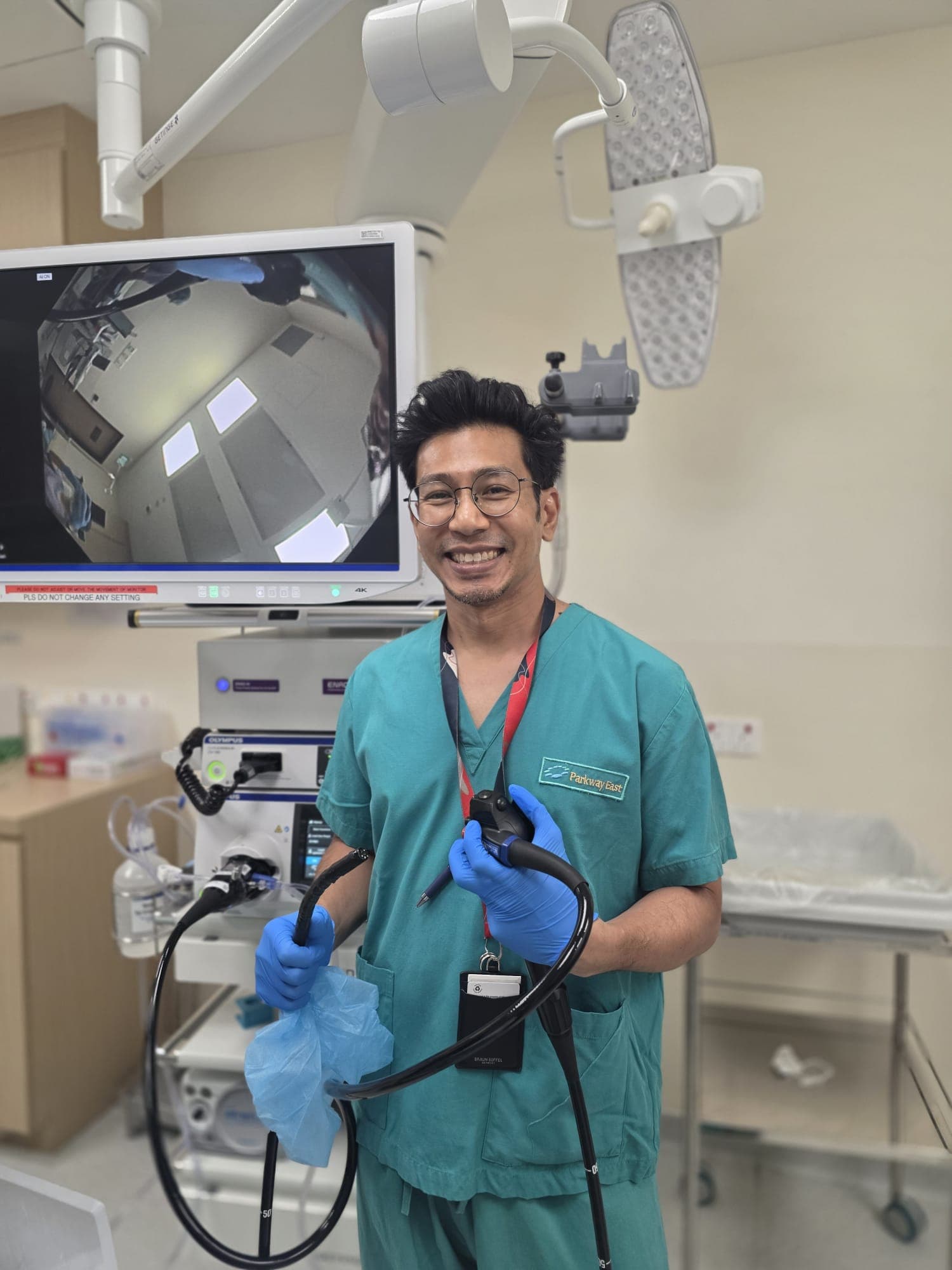
Dr Sulaiman Bin Yusof
Senior Consultant Colorectal and General Surgeon, practising at Gleneagles, Mount Elizabeth Novena, Parkway East, Mount Alvernia and Farrer Park. He examines the area properly, confirms whether the cause is haemorrhoids, a fissure, or something else, rules out the conditions that mimic both, and sets out the options that fit the case.
- MBChB (Sheffield)
- M.Med (Surgery)
- FRCSEd (General Surgery)
- Fellowship
- Peter MacCallum Cancer Centre, Melbourne
- Previously
- Former Director of Endoscopy, Changi General Hospital
- Also
- Visiting Consultant, Changi General Hospital
The information here is for general informational purposes only and does not replace consultation, diagnosis, or treatment by a qualified medical professional. Symptoms vary between individuals; if any of the warning signs above apply to you, seek a clinical evaluation.
Getting seen
Both are common and both are treatable. Which one you have decides everything that happens next.
If you have had bleeding or pain that has not settled, the sensible next step is finding out which condition you are actually treating.
Contact us on WhatsApp to arrange a consultation.
+65 8491 1525