


Robotic vs Laparoscopic Colorectal Surgery: How I Decide Which Approach Is Right for You
For rectal cancer surgery, the challenge is not simply removing the tumour. The challenge is removing it completely — clean margins, within its natural tissue envelope — while preserving the nerves that control bladder and sexual function, all inside a space bounded by bone on three sides.
For many patients, concerns about a permanent stoma, bladder function, or sexual function are as important as removing the cancer itself. These concerns are legitimate, and they are directly shaped by the precision of the surgery.
How I achieve that precision — and which surgical approach I use to do it — is what this article explains.
The Honest Answer to “Is Robotic Better?”
Patients often ask whether robotic surgery is “better” than laparoscopic surgery. The honest answer is: not universally.
The right question is which approach gives the safest, most precise operation for your specific anatomy and disease. For deep rectal surgery, robotic surgery offers meaningful technical advantages. For many colon operations, laparoscopic surgery delivers equivalent outcomes at lower cost.
The decision is always case-specific. The goal is always the operation, not the instrument.
Who Benefits Most from Robotic Surgery?
If any of the following apply to your situation, robotic surgery is likely to be my recommended approach:
- Low rectal tumour requiring deep pelvic dissection
- Male patient with a narrow pelvis
- Obesity, where depth and restricted access compound technical difficulty
- Previous chemoradiotherapy, which alters tissue planes and makes dissection harder
- Prior abdominal surgery, where adhesions add complexity
- Sphincter preservation is the goal, requiring precise distal margin clearance
For right-sided colon surgery and many left-sided colonic resections in patients with favourable anatomy, laparoscopic surgery remains my first choice.
What Both Approaches Have in Common
Both are minimally invasive — performed through small incisions of 5 to 12 millimetres rather than a large open cut. Both offer faster recovery, less pain, shorter hospital stays, and lower wound complication rates compared to open surgery.
The difference is in how I control the instruments and what I can see while I do it.
The Technical Difference That Matters
In laparoscopic surgery, I hold straight instruments through small ports. The instruments pivot at the body wall, constraining my range of movement. In accessible colon surgery this is not a problem. In the deep pelvis, it is.
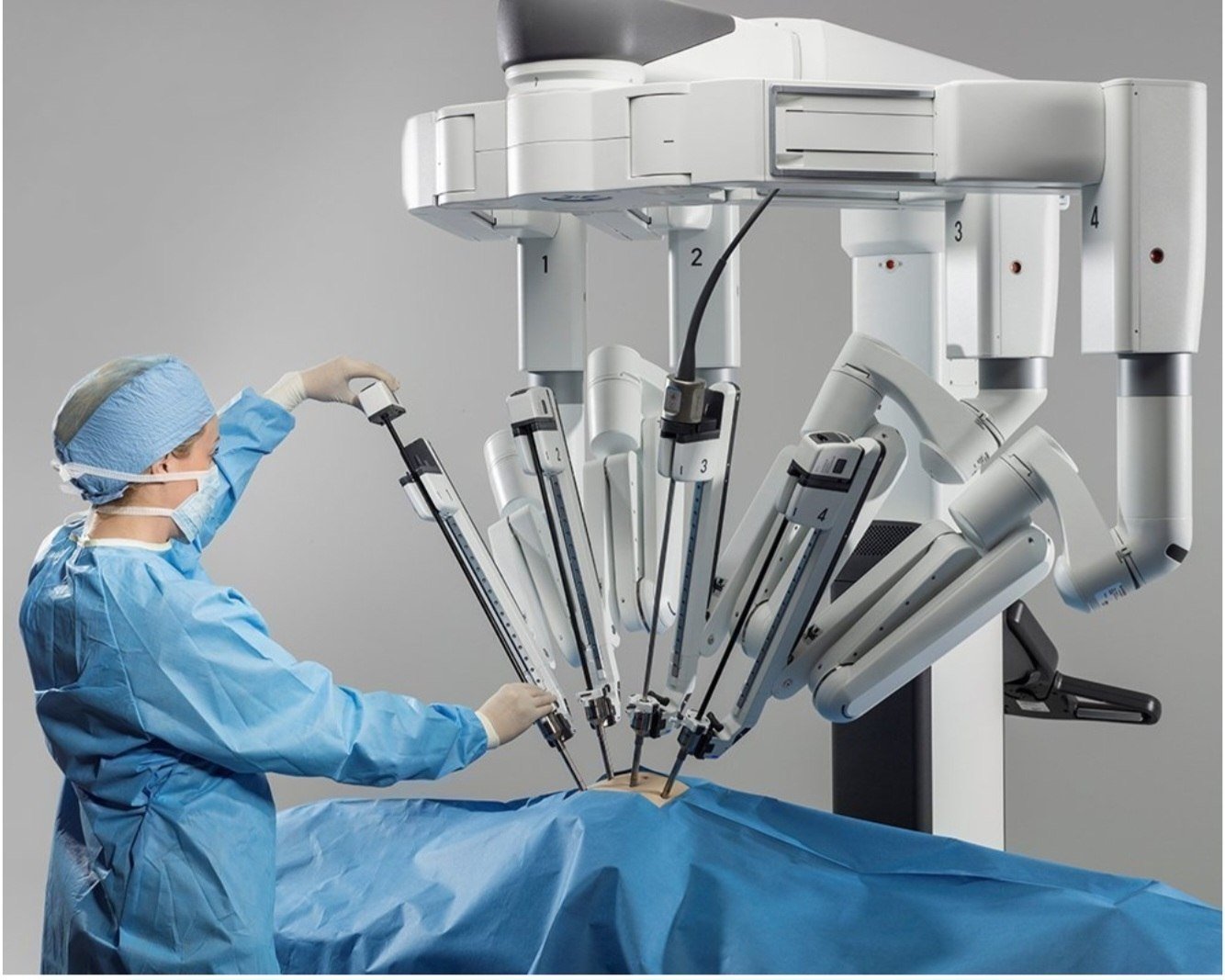
The robotic platform — I work with the Da Vinci Xi system — changes three things that matter in difficult cases:
3D high-definition vision. Real depth perception inside the body. When dissecting near the nerve plexuses controlling bladder and sexual function, this changes what I can safely see and therefore safely do.
Wristed instrument movement. Seven degrees of freedom at the instrument tip. Inside a narrow pelvis, I can reach angles and dissection planes that are mechanically impossible with straight laparoscopic instruments.
Tremor elimination. The system filters out natural hand tremor and scales my movements to precise tip control. For delicate work around vessels and nerves, this is meaningful.
Why Rectal Surgery Is Technically Demanding
The rectum sits deep in the pelvis, surrounded by nerves controlling bladder and sexual function, by the prostate in male patients, and by vessels that bleed seriously if disturbed. The correct operation for rectal cancer — total mesorectal excision — requires removing the rectum cleanly within its natural tissue envelope to achieve clear margins and complete lymph node clearance.
Performing this precisely in a confined bony space, with instruments that cannot fully articulate, is where conventional laparoscopy reaches its limits.
What changed when I started performing robotic rectal surgery
When I trained in laparoscopic rectal surgery, the quality of the camera assistant on any given day could influence whether the dissection stayed controlled. I would rehearse each operation mentally before entering theatre, accounting for the constraints of straight instruments in a narrow pelvis.
With robotic rectal cancer surgery, I gained direct control over both the camera and the instrument platform. The 3D view replaced the flat image. The wristed instruments replaced the pivoting ones. In difficult pelvic cases — a low rectal tumour in a male patient after chemoradiotherapy, for example — that combination changes what I can achieve technically.
The robot does not operate. I operate. But it gives me better tools for the most demanding part of the work.
My Approach: Choosing the Right Tool
I do not default to robotic surgery to justify a higher fee. I use it when the anatomy and clinical situation make it the better instrument.
For right hemicolectomy — right-sided colon cancer or large polyps — I frequently use laparoscopy. The anatomy is accessible, both approaches produce equivalent oncological outcomes, and there is no clinical case for robotic surgery when laparoscopy is technically sufficient.
The goal is always the operation, not the instrument.
What the Evidence Shows
Published conversion rates in laparoscopic rectal surgery — cases where minimally invasive surgery must be abandoned for open — range from 9% to 16%, and are higher after chemoradiotherapy. The ROLARR trial, the largest randomised controlled trial comparing the two approaches, demonstrated lower conversion rates with robotic surgery in technically difficult pelvic cases. This matters to patients because avoiding conversion to open means faster recovery, lower complication risk, and a shorter hospital stay.
Complication rates in comparative studies run approximately 11–12% for robotic rectal cancer surgery versus 17–18% for laparoscopic. Long-term oncological outcomes — clear margins, lymph node harvest, recurrence rates — appear equivalent between approaches.
These are population-level figures. Your individual outcome depends on tumour characteristics, anatomy, and operative complexity.
What About Cost?
Robotic surgery costs more, reflecting equipment, disposable components, and typically longer operating time.
For low colorectal cancer in a male patient with a narrow pelvis after chemoradiotherapy — where the technical stakes are high and a poor dissection carries serious consequences — the additional cost is clinically justified. For a straightforward right hemicolectomy in a patient with favourable anatomy, it may not be.
I discuss this openly at consultation. Most integrated shield plans cover robotic surgery when clinically indicated. My team can assist with pre-authorisation queries.
What Happens at Your Consultation
Before recommending robotic or laparoscopic surgery, I personally review:
- MRI and CT imaging
- Tumour location and stage
- Pelvic anatomy and body habitus
- Prior surgery and treatment history
- Your functional goals — sphincter preservation, bladder and sexual function
You will leave the consultation knowing which operation I recommend, why, and what a realistic recovery looks like for your specific case.
Frequently Asked Questions
Is robotic colorectal surgery safer?
In complex rectal operations, robotic surgery is associated with lower conversion rates to open surgery and lower complication rates. For straightforward colon operations, both approaches have comparable safety profiles. The answer depends on your specific operation and anatomy.
Will I recover faster after robotic surgery?
Both approaches offer significantly faster recovery than open surgery. For rectal operations, robotic surgery is associated with slightly faster return of bowel function in some studies, likely related to more precise nerve and tissue handling.
Does robotic surgery improve my chance of avoiding a permanent stoma?
In low rectal tumours, the precise pelvic dissection possible with robotic surgery can support sphincter preservation in cases where conventional laparoscopy is more limited. Whether a stoma is required depends on tumour location, sphincter function, and other individual factors — not the platform alone.
Is robotic surgery covered by insurance in Singapore?
Most integrated shield plans cover robotic colorectal surgery when clinically indicated. Coverage depends on your specific plan and policy tier. My team can assist with pre-authorisation.
Is robotic surgery better specifically for rectal cancer?
For rectal cancer requiring deep pelvic dissection, yes — the robotic platform offers meaningful advantages in visualisation and instrument control that translate to lower conversion rates and complication rates in technically difficult cases, while achieving equivalent long-term oncological outcomes.
Who is not suitable for robotic colorectal surgery?
Most patients suitable for minimally invasive surgery are candidates for robotic surgery. I assess each patient individually based on imaging, anaesthetic fitness, and the specific operation required.
Summary
For rectal surgery and deep pelvic dissection, I use the robotic platform because the evidence and my clinical experience both support it as the better technical tool for that work. For many colonic resections, laparoscopic surgery remains the right choice.
If you have been advised to undergo colorectal surgery, I will review your scans, anatomy, tumour location, and treatment history personally to determine which approach gives you the safest and most precise operation.
If you are due for a colonoscopy or have been diagnosed with colorectal cancer, early consultation allows me to plan the most appropriate surgical approach for your case.
Dr Sulaiman Yusof is a Senior Consultant Colorectal and General Surgeon with Colorectal Clinic Associates, fellowship-trained in colorectal cancer surgery at the Peter MacCallum Cancer Centre, Melbourne. He is listed on the Da Vinci Xi surgeon locator and holds Adjunct Associate Professor appointments at NUS Yong Loo Lin School of Medicine, Lee Kong Chian School of Medicine, and Duke-NUS Medical School.
