
Considering Robotic Surgery?
Book a consultation with Dr Sulaiman today. Same-day and same-week appointments available.

A member of the Colorectal Clinic Associates

Learn how robotic rectal cancer surgery improves precision, nerve preservation, and recovery. Dr Sulaiman Yusof explains who benefits most in Singapore.

Dr Sulaiman’s Perspective
When I first started performing laparoscopic rectal cancer surgery, I would spend days planning and mentally rehearsing every step of the operation. Rectal surgery deep within the pelvis is technically demanding, and outcomes depend heavily on the coordination of the entire operating team.
In laparoscopic surgery, the quality of the operation is influenced not only by the surgeon’s skill, but also by the experience of the camera assistant and the surgical assistant. Stable exposure and precise visualisation during deep pelvic dissection can make a significant difference in how cleanly the operation proceeds.
Transitioning to robotic surgery on the Da Vinci Xi changed many aspects of that experience. The platform gave me direct, stable control over the camera, exposure, and instrument movement throughout the operation — independent of an assistant. In difficult low pelvic cases especially, the improved precision was immediately apparent.
The learning curve for robotic rectal surgery is steep, and not every surgeon commits to mastering it fully. Having now performed more than 100 Da Vinci Xi rectal cancer cases, I have seen the platform’s advantages most clearly in low rectal tumours, narrow male pelvises, and cases where nerve preservation is the priority alongside oncological clearance.
Precision in the Pelvis
Superior 3D visualisation and instrument dexterity in the narrow, deep anatomical space where rectal tumours sit.
Lower Conversion Rates
Significantly lower risk of converting to open surgery compared with laparoscopic — a conversion that increases complication risk.
Nerve Preservation
Enhanced ability to identify and protect the autonomic nerves controlling bladder and sexual function during pelvic dissection.
Faster Recovery
Smaller incisions, less tissue trauma, and reduced blood loss compared with open surgery translate to shorter hospital stays.
Robotic surgery is not required for every rectal cancer patient. Treatment is always individualised based on tumour location, stage, anatomy, and overall condition.
Robotic rectal cancer surgery is an advanced minimally invasive approach to removing rectal tumours with precision deep within the pelvis. The standard oncological operation is called a Total Mesorectal Excision (TME) — the complete removal of the rectum together with its surrounding mesorectal envelope, which contains the lymph nodes and tissue through which cancer spreads.
The Da Vinci Xi system enables TME to be performed robotically throughout all stages of the operation, without the need to reposition the robot between abdominal and pelvic phases. The surgeon operates from a console, controlling robotic arms that translate finger movements into micro-movements inside the body — with tremor filtration, 3D high-definition vision, and instrument wrist rotation not achievable with standard laparoscopic tools.
| Feature | Laparoscopic | Robotic (Da Vinci Xi) |
|---|---|---|
| Vision | 2D | 3D HD with depth |
| Instruments | Rigid, straight | Wristed, 7° freedom |
| Pelvic access | Limited | Optimised |
| Camera control | Assistant-held | Surgeon-controlled |
| Conversion to open | ~17% | Significantly lower |
| Ergonomics | Counter-intuitive | Intuitive, natural |

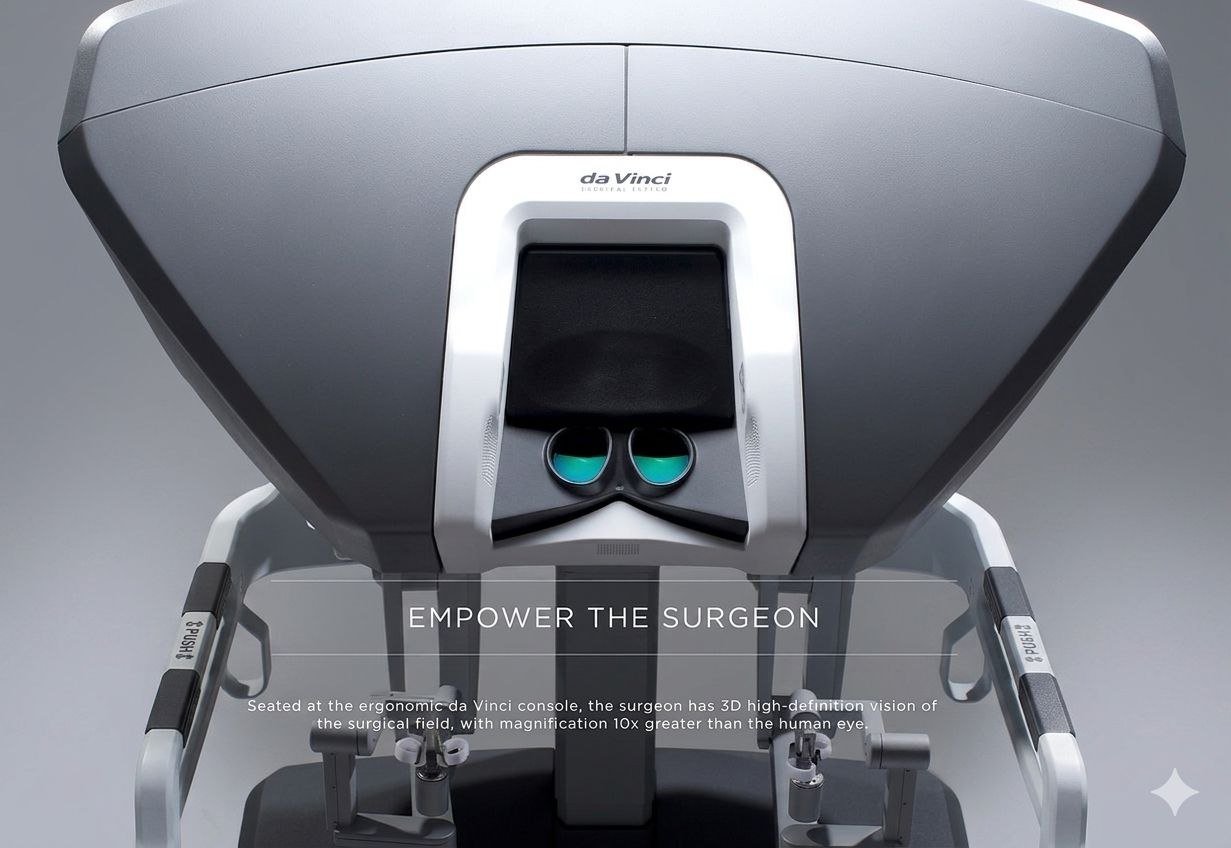
The surgeon operates from an ergonomic console with 3D high-definition vision and intuitive hand controls.
The rectum sits deep within the pelvis — a narrow, bone-encased cavity surrounded by structures that must be preserved throughout the operation.
The narrow space problem. Operating at the bottom of the pelvis with laparoscopic instruments is like working in a deep, narrow funnel with rigid tools. Even experienced laparoscopic surgeons face technical limitations in achieving consistent TME quality in low pelvic cases.
Nerve preservation. The autonomic nerve plexuses governing bladder function, urinary continence, and sexual function run directly alongside the surgical dissection plane. These nerves are paper-thin and difficult to visualise at relevant depth with a 2D camera.
Sphincter preservation. For tumours in the middle and lower rectum, the goal is to achieve oncological clearance while preserving the anal sphincter and avoiding a permanent stoma. The closer a tumour sits to the sphincter, the more precise the distal dissection must be.
The consequence of conversion. When laparoscopic rectal surgery cannot be completed minimally invasively, conversion to open surgery is required. Published data shows conversion carries significantly higher complication and mortality rates. Reducing conversion risk matters for patient safety.
TME quality is the most important determinant of long-term rectal cancer outcomes. An incomplete or disrupted mesorectal excision increases the risk of local recurrence regardless of surgical approach.
Robotic surgery’s advantage is in the consistency with which high-quality TME can be achieved in technically difficult cases:
Published meta-analysis comparing robotic versus laparoscopic rectal cancer surgery across more than 25,000 patients found robotic surgery to be associated with significantly lower conversion rates and comparable oncological outcomes including lymph node harvest and margin clearance.
Not every rectal cancer patient requires robotic surgery. Dr Sulaiman’s assessment takes into account tumour location, pelvic anatomy, body habitus, and functional preservation priorities. Robotic assistance is most clearly advantageous for:
Effective rectal cancer surgery balances two goals: complete oncological clearance and preservation of function. With precise technique, both are achievable in selected patients.
Bladder function. The pelvic autonomic nerves controlling urinary continence and bladder emptying run close to the dissection plane. Careful nerve-sparing TME reduces the risk of post-operative urinary retention, one of the most common functional complications of rectal cancer surgery.
Sexual function. In men, the nerves governing erectile function lie alongside the lateral dissection planes. In women, the equivalent structures affect vaginal sensation and lubrication. Robotic 3D visualisation improves the ability to identify and preserve these structures where oncologically safe.
Bowel function. Changes in bowel habit are common after rectal cancer surgery and are related primarily to the length of bowel removed and the level of the anastomosis rather than the surgical platform. Patients should expect some adjustment in bowel frequency, particularly in the first year.
Stoma. A temporary diverting stoma is frequently created at the time of surgery to protect the anastomosis while it heals. This is usually reversed in a second procedure after approximately three months. A permanent stoma is required when the tumour is so close to the sphincter that preservation is not oncologically safe.
Book a consultation with Dr Sulaiman today. Same-day and same-week appointments available.

The Da Vinci Xi hand controls translate the surgeon’s finger movements into micro-movements of the robotic instruments.
Both are safe minimally invasive approaches. For complex rectal cases — particularly low tumours and narrow male pelvises — robotic surgery is associated with lower conversion rates to open surgery, which reduces associated complication risk. Oncological outcomes including lymph node harvest and margin clearance are comparable between the two approaches in published data.
The technical advantages of robotic surgery are most relevant for low rectal tumours, male patients with narrow pelvises, obese patients, and cases where nerve preservation is a priority. For straightforward high rectal or sigmoid cancers, laparoscopic surgery often achieves equally good results. Dr Sulaiman will assess your specific anatomy and tumour on imaging before recommending an approach.
Whether a temporary or permanent stoma is required depends on the tumour’s location relative to the sphincter, the quality of the anastomosis, and the patient’s overall fitness. Robotic surgery improves the precision of low anastomoses, which may assist sphincter preservation in selected cases. A temporary diverting stoma is commonly created to protect the join while it heals and is typically reversed after three months.
Compared with open surgery, yes — robotic and laparoscopic surgery both offer significantly faster recovery, less post-operative pain, and shorter hospital stays. The difference in recovery between robotic and laparoscopic surgery is more modest, though robotic surgery is associated with lower blood loss and conversion rates in complex cases.
Yes. Robotic rectal cancer surgery is generally covered by Integrated Shield Plans and is MediSave-claimable, subject to plan limits and applicable surgical procedure codes. Please contact our clinic team for guidance on pre-authorisation.
TME is the gold-standard surgical technique for rectal cancer, involving complete removal of the rectum together with its surrounding mesorectal envelope — the tissue package containing the lymph nodes and fatty tissue through which cancer spreads. Quality of TME is the single most important determinant of local recurrence risk.
Experience with robotic surgery varies considerably between surgeons. When choosing a specialist for robotic rectal cancer surgery in Singapore, patients should feel empowered to ask:
You do not need a referral to see Dr Sulaiman. Same-day and same-week appointments are available across five clinic locations in Singapore.
Clinical information on this page reflects Dr Sulaiman’s practice and is informed by published evidence including: meta-analysis of robotic versus laparoscopic rectal cancer surgery (25,458 patients, 2024); Da Vinci Xi first 100 rectal cancer cases series (Istanbul Medical Journal, 2019); COLOR II randomised trial data on laparoscopic rectal cancer conversion rates. This page is for informational purposes only and does not constitute medical advice.

MbChB (Sheffield)
M.Med (Surgery)
FRCSEd (General Surgery)
蘇萊曼·尤索夫博士
Dr. Sulaiman Bin Yusof is a Senior Consultant colorectal and general surgeon in Singapore with over 15 years of specialist experience across public and private practice. Trained in the United Kingdom and awarded a Ministry of Health Fellowship to the Peter MacCallum Cancer Centre in Melbourne, he has built his practice around complex colorectal surgery, with robotic-assisted technique as his primary surgical platform for colectomy and anterior resection.
Patients consult Dr. Sulaiman for his depth of experience in colorectal cancer and perianal conditions, as well as for consultations that are thorough, unhurried, and focused on giving patients a clear understanding of their options.
Dr. Sulaiman holds an MBChB from the University of Sheffield, a Master of Medicine in Surgery (M.Med), and a Fellowship of the Royal Colleges of Surgeons of Edinburgh in General Surgery (FRCSEd). He completed a Ministry of Health Fellowship at the Peter MacCallum Cancer Centre in Melbourne, one of the world’s foremost oncology institutions, serves as a Visiting Consultant at Changi General Hospital and has contributed eight peer-reviewed publications to medical literature.
Dr. Sulaiman served as Director of Endoscopy at Changi General Hospital, overseeing one of Singapore’s busiest endoscopy units, and brings that public-sector depth of experience to his private practice. In this role, he led a high-volume diagnostic endoscopy service encompassing colonoscopy and gastroscopy across a broad and diverse patient population.
Dr. Sulaiman holds concurrent Adjunct Associate Professor appointments at the NUS Yong Loo Lin School of Medicine, Lee Kong Chian School of Medicine, and Duke-NUS Medical School. He has been recognised on the Dean’s Honour Roll for Teaching and received the Singapore Health Quality Service Star Award 2023, reflecting his contribution to both surgical education and clinical care.
Consult Dr. Sulaiman for an accurate diagnosis and a personalised treatment plan today.
For Singaporeans, Singapore Permanent Residents and Foreigners. Please speak to our friendly clinic staff about using your insurance plans.


*Extended Panel
6 Napier Road #06-16
Singapore 258499
38 Irrawaddy Road, #10-48/49
Singapore 329563
#05-08, 319 Joo Chiat Place
Singapore 427989
#08-62, Medical Centre D
820 Thomson Road
Singapore 574623
Farrer Park Medical Centre #14-12
1 Farrer Park Station Road
Singapore 217562